The APS system:
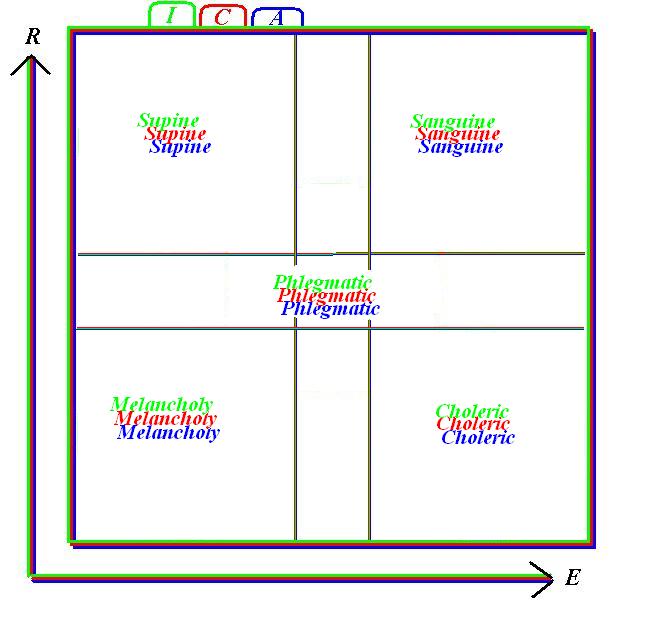
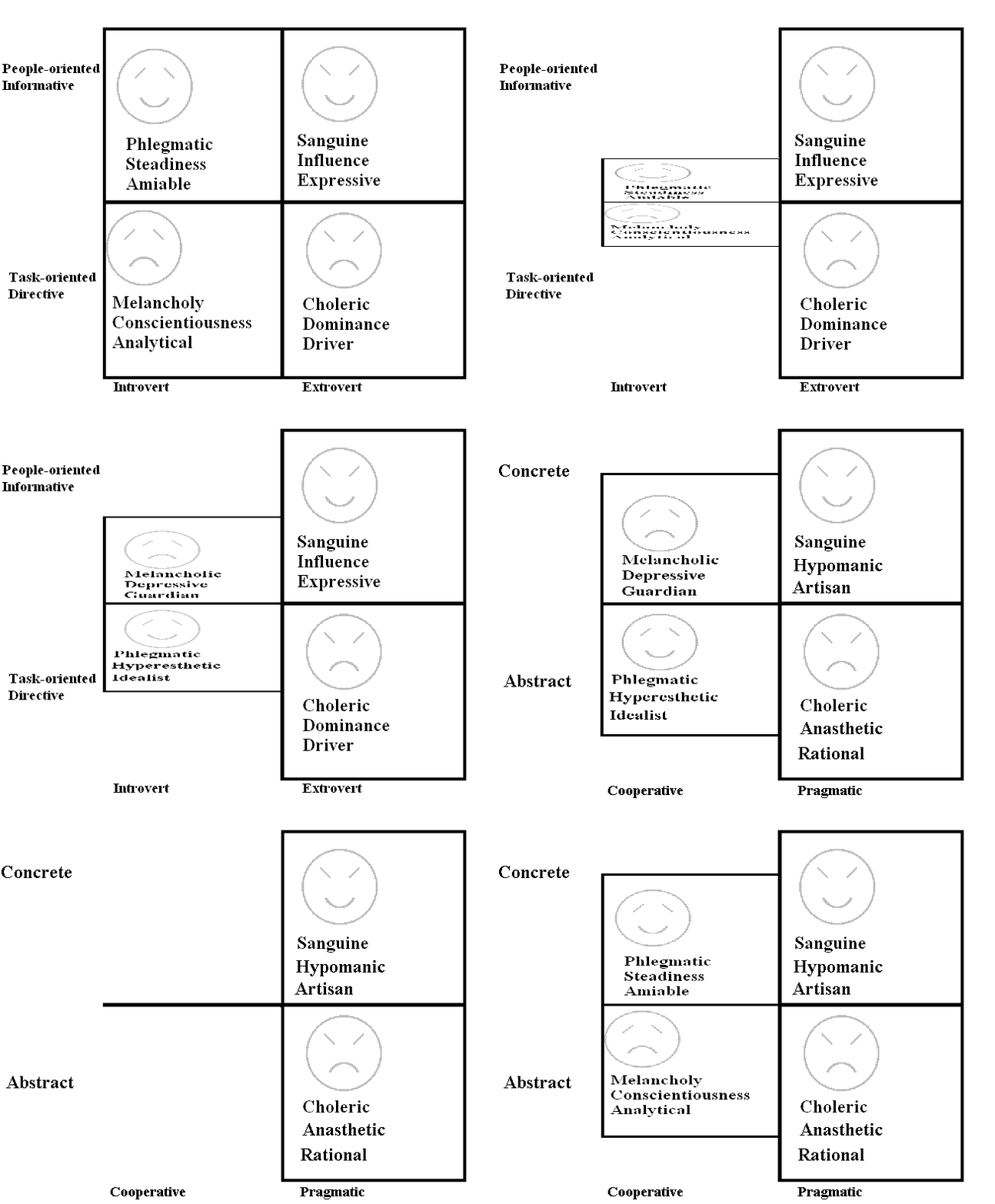
•Five temperament matrix image
•Interactive Graphic of temperaments
•"Four to Five" image
•Inclusion, Control & Affection
•The five temperaments in IC&A
•Summary: The unifying principle of personality
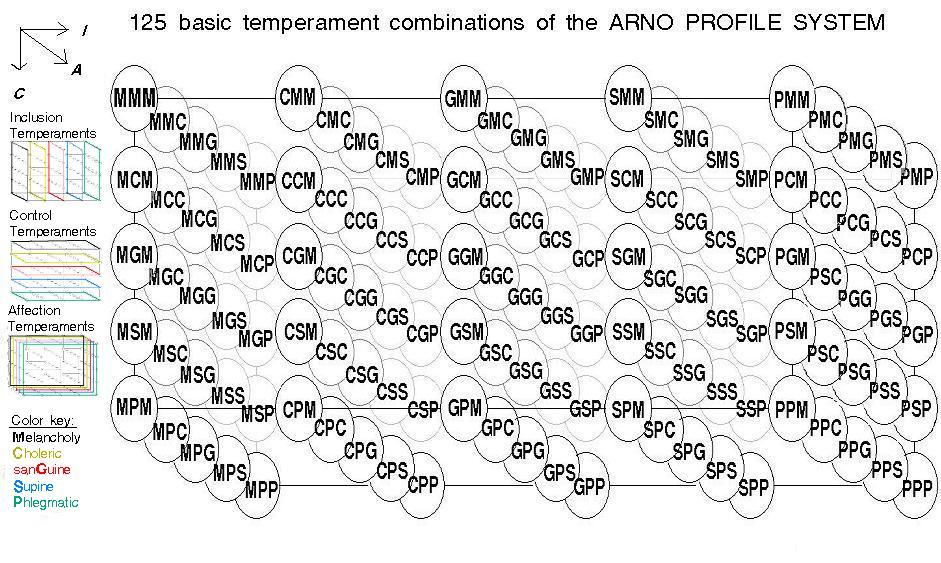
•Image of 125 temperament combinations
MyersBriggs/Keirsey/Berens vs FIRO/Arno/Worley (and LaHaye)
•type letter group table
•Arno-Berens overlaid matrix image
•Type/temperament blend correlation
•correlation image
•T/F/J/P "responsiveness" table
•Galen to Keirsey "flip" image
•comparisons of factors with FFM table and image
•Type as binary code
Cognitive Processes and Archetypes
•Beebe-Thomson image
•Developing of functions from Beebe/Thomson input
•differentiation image
•Established tandem names
•28 possible tandem combinations
•How the eight positions are generated from two by mirroring and shadowing
•Intertype dynamics
•Naming the preference blocks
•Naming specific tandem function combinations
Objective/Subjective
Type Name table
Grand table of comparison of systems
Temperament/Type series:
"Personality Matrix" part 1: APS and Expressive/Responive system
"Personality Matrix" part 2: MBTI and the Functions from scratch
Evolving the MBTI-APS Correlation (longer page from where most of this page is taken)
To SHORTER Essay on correlation
To "Super Short" version of this part of the series (15KB)
Part 3: Enneagram and other systems
Part 4: Dynamic type (Adding moderate scales to MBTI for 81 types)
Introduction to temperament theory
The theory of personality began with temperament, which has traditionally been measured in terms of expressive and responsive behavior. Expressive behavior is generally how much a person approaches others in interaction. Responsive behavior is how much a person wants to be approached by others. Anciently, these were expressed in terms of the states of different bodily fluids, called "humors".
| wet | dry | |
| hot | air/blood (Sanguine) | fire/yellow bile (Choleric) |
| cold | water/phlegm (Phlegmatic) | earth/black bile (Melancholic) |
The temperament factors became associated with the quickness of their emotions or reactions:
The sanguine temperament showed quick, impulsive and relatively brief reactions. (i.e. short delay, short sustain)
The choleric temperament manifested a short response time-delay, but the response was sustained for a relatively long time.
The melancholic temperament (renamed "Melancholy") exhibited a long response time-delay, and the response was sustained at length, if not, seemingly, permanently.
The Phlegmatic was characterized by a longer response-delay but the response was also short-lived.
To translate these factors to more familiar ones
hot/short delay—expressive: "extrovert"
cold/long delay—reserved: "introvert"
wet/short sustain—responsive: "people-focused"
dry/long sustain—directive: "task-focused"
This leads to these familiar descriptions:
Melancholy - has an unquenchable thirst for knowledge, prone to genius, very creative, mind tends to work overtime, going over and over events of the past, needs alone time to regroup. (Also prone to "black moods").
Sanguine - fun loving, will leave in the middle of a chore or assignment if they find out there is something fun going on somewhere, never wants to grow up, stressed out if there are not places to go and people to see.
Choleric - a drive to greatness, but will step on your toes to get there, needs lots of appreciation along the way.
Phlegmatic - quite stubborn and set in his ways, uncomfortable with confrontation and seeks peace at all costs to avoid strife, feels he needs sleep to regroup but never gets enough, very annoying to the Choleric as this is the one temperament that cannot be coerced into doing something if they don't want to.
The Arno's of National Christian Counselors Association determined that there was a previously unrecognized fifth temperament, who was as reserved as a Melancholy, but as responsive as a Sanguine, and it was called "Supine" (while the Phlegmatic was really moderate in both dimensions).
They like people and want to be accepted, but lack the mechanism (boldness) to express this need by approaching others. Thus, they use tasks, like service to others, to try to win this acceptance, and otherwise, end up frustrated that no one recognizes their need.
APS and the Fifth Temperament
APS "E/R×ICA" matrix:
How Fifth temperament was derived:
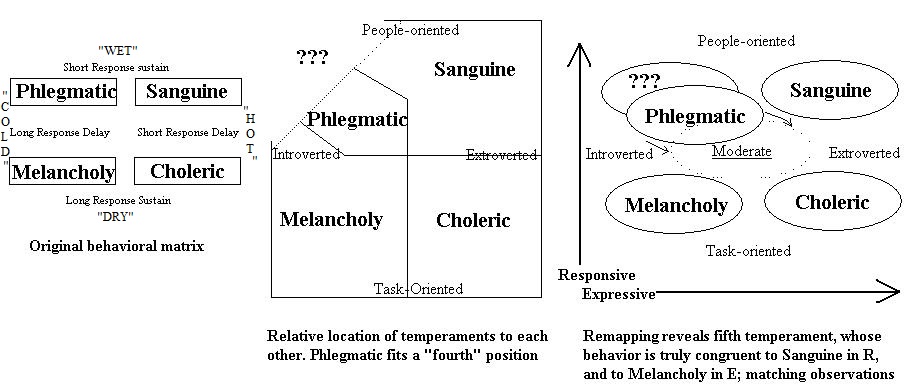
Expressiveness and Responsiveness: Temperaments' approach and reaction to approach by other people

The Three Need Areas (Derived from FIRO):
Inclusion (How much you generally include other people in your life and how much attention, contact, and recognition you want from others)
Control (How much influence and responsibility you need, and how much you want others to lead and establish procedures and policies), and
Affection; (How close and warm you are with others and to what extent you want others to show warmth and support to you).
A person can be a different temperament in each of the three areas, or the same one in two or three. This leads to five "pure" temperament types, and 120 different "blends". With two "moderate" and one "compulsive" variation for four of the temperaments in each area, you end up with as many as 2197 or 4913 different blends!
The Five Temperaments across the three areas:
| INCLUSION: Who is IN or OUT of the relationship | CONTROL: Who maintains the POWER and makes the DECISIONS for the relationship | AFFECTION: How emotionally CLOSE or FAR the relationship | |
| Melancholy | Everyone OUT, except for "Exclusive Club" | "I don't control you, so please don't try to control me" | generally, emotionally FAR |
| Sanguine | Everybody "IN" ("Come on in!") | Controls or being controlled according to "SWING" | Emotionally CLOSE |
| Choleric | Don't call me; I'll call you; until then, OUT! (except for "Exclusive Club") | "I'M the Boss!" | emotionally FAR, unless you meet CRITERIA |
| Supine | Everybody IN; but you must reach out and invite me! | "YOU'RE the Boss!" | emotionally CLOSE, but you must reach out to me |
| Phlegmatic | "Take 'em or leave 'em" | Democratic; "Let's all be Boss!" | moderate; take it or leave it |
Summary: The unifying principle
All of this shows that the factors of expressive and responsive behavior provide an underlying framework for understanding personality. It is the basis of communication. We express to others, and respond to (or want from) them. As we shall see, the E/R matrix becomes a unifying principle that will allow us to make easier comparisons to several other temperament and personality type systems. This framework even helps us right now visually represent the temperaments.
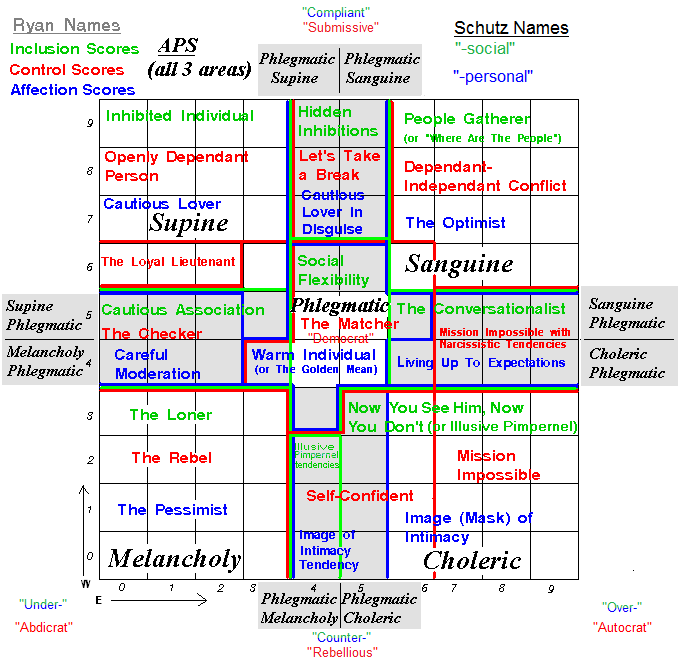
Five Temperaments and Dr. Leo Ryan "Clinical Interpretation of FIRO-B" names on combined I/C/A "locator chart" grid
Type is based on the way we cognitively divide reality. Just like we divide spacetime between back and forth, up and down, left and right, and past and future.
So likewise, we also divide reality into what is “I” (the “subject”; individual) or “not I” (called “objects”, and in the “environment”). This forms the basis of what we can call “orientation” (also commonly called “attitude”).
We also divide our cognition into taking in information that comes to us (which is basically involuntary), and then making rational (voluntary) decisions with it. These modes of processing are also split.
So we divide the information we take in (perceive), into what is clearly observable by our physical senses (“tangible”, “material” or “practical”), and what is not based on the senses, but rather inferred from other data in some way. (And thus, intangible, "hypothetical", "theoretical").
We also make a distinction in our mental decisions (judgments), which stems from a sense of "right and wrong" (and usually leading to courses of action to make what’s deemed “wrong” to “right”), as determined by our reactions. The emotions (leading to our reactions; whereby we are making rational decisions) can tell us that the affect on us is from something about the object (which is “impersonal” or "mechanical"), or it can tell us that it is about our “soul” (the “subject”, and hence, “personal” or "soulish"). This will generally split the neutral “right/wrong” into the more impersonal “true/false” or the more personal “good/bad”.
(Hence, we see "subject" and "object" associated with both i/e and T/F. This is expanded to all four dichotomies, below).
These are the bases of the three main variables in type; two preferred functions (one perception, and one judgment), and orientation. Orientation then becomes split into a third and fourth variable, based on which orientation is dominant, and then, which function is oriented environmentally or individually. The dominant function will take on the dominant orientation, so this also tells us which function is dominant. The other preferred function will be “auxiliary” (needed simply because we also must have a preference in other mode of process; both perception and judgment).
To break it down further, all self-conscious beings perceive data through imagery.
When the images are based directly on physical material (superstrings vibrating an a way that produces fields that we cannot pass through, and thus stimulates our nerve sensors, and reflect photons and other waves which also stimulate sensors), then we are experiencing sensation (S), and we call these fields “material”, and can say that it is empirically “what's KNOWN”. The material reality forces everyone to agree with what image is seen (even if they try not to see it, or interpret it as something else).
Our experience of this can be immediate, in the environment (e), or previously learned and retained, individually (i).
If the imagery is not backed up by the material experience, then it is merely inferred (may or may not exist, but we haven’t verified it yet), or is imagined (put together in our minds, such as “stories”, “big pictures”, “meanings”, etc.) and is thus “hypothetical”, or described as “what's INFERRED”, and the function is iNtuition (N). These are more fluid and subject to individual interpretation. That’s why topics such as religion and politics can become endless disputes, and thus so heated.
These hypotheses can be from the environment (e), where they’re based on other objects of patterns, or they can be from the individual (i) unconscious, often brought up as "insights" from reflection.
All self-conscious beings assess things as right or wrong. What’s right is what we strive for, and what’s wrong is what we seek to make “right”.
If the sense of right or wrong is from reactions that are based on the effect of objects based on their own properties (their "mechanics"), we speak of things being “true” (versus “false”) or “correct” or not, and the function is called Thinking (T).
This assessment can be based on the environment (e), where the objects themselves, or a group or culture’s demands or consensus on the best use of them, determines what is correct; or it can be based on individually (i) determined knowledge or logical preference.
If the sense of right or wrong is from reactions that are based on the effect of objects on our own souls, we speak of things being “good” (versus “bad”) or “liked” or not, and the function is called Feeling (F).
This assessment can be based on the environment (e), where a group or culture’s demands or consensus (of values) determines what is “liked” or good (which the assessing ego takes as its own and acts accordingly); or it can be based on individually (i) determined knowledge or ethical preference (which can be used to guage the needs of others).
Each ego prefers one function, and either the environmental (“extraverted”) or individual (“introverted”) focus. Since we have to both take in information (“perceive”), and determine right/wrong (“judge”), then each ego will have an "auxiliary" preference for the other mode of processing from its dominant. This will also take on the unpreferred orientation.
From here, we are able to identify 16 “types”. The ego or various ego states (which mirror the ego's consciousness) will then reference the other functions (which will mirror the first two) as needed.
Four steps to reading the type code:
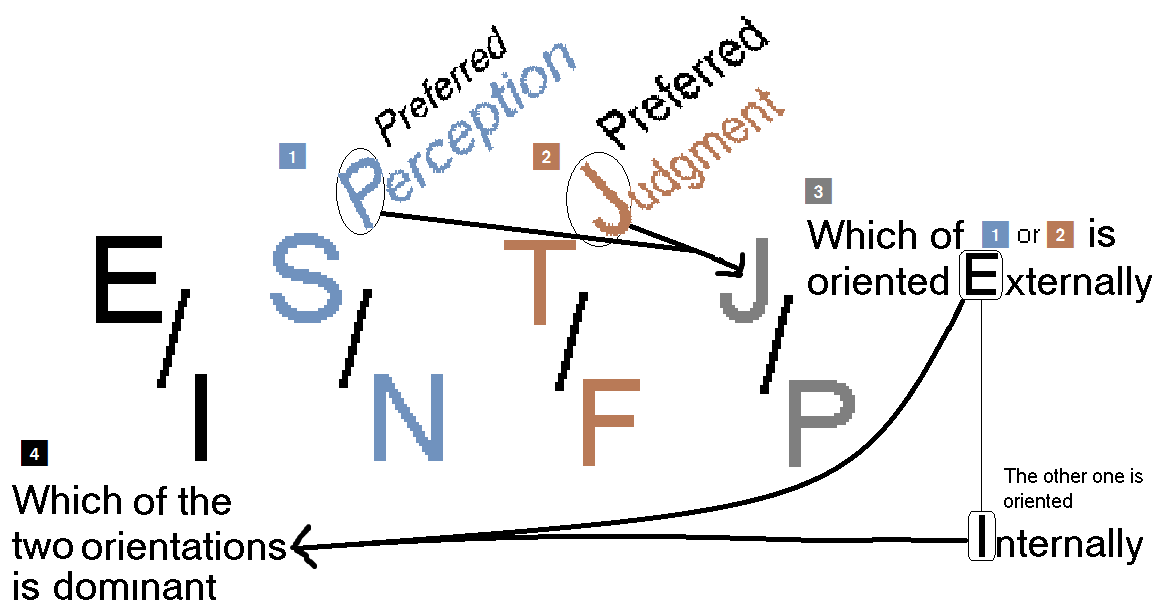
| basic description | What it does | |
| S | positive awareness of material reality | itemizes at hand sense mpressions |
| N | positive awareness of hypothetical reality | relates mental constructs; filling in one situation from another |
| T | positive/negative assessment based on the mechanics of the situation | assesses based on what our reactions tell us about an object |
| F | positive/negative assessment based on the "soulish" affect of the situation | assesses based on what our reactions tell us about our souls |
| e | external source or standard of perspective | takes on data as is in the world or culture |
| i | internal source or standard of perspective | filters data through one's own understanding of data or what is learned from nature |
| basic product | deals in | passive product | active product | alt. terms | other terms | "in..." | Bruzon | old terms | Jung | |
| S | material | substance | known (actual) | behold(observe) | tangible | experience | practice | static (items) | concrete² | "what it is" |
| N | hypothesis | idea | guessed (potential) | infer/imagine | conceptual | story | theory | motion (process) | abstract² | "where it's heading" |
| T | mechanics | impersonal | true/false | correct/incorrect | technical | "if-then" | "the head" | linear | logic | naming (categories) |
| F | soul affect | personal¹ | good/bad | like/dislike | humane | "human factor" | "the heart" | holistic | ethics/values | "what's it's worth" |
| e | environment | external | culture | turn outward | emergent | breadth | "the now" | wide(p)local(j) | objective³ | "conscious"4 |
| i | individual | internal | nature | turn inward | stored | depth | universals | local(p)wide(j) | subjective³ | "unconscious"4 |
¹also used for "introversion". F could be distinguished as "pan-personal"; with "inter-" as Fe, and "intra-" as Fi
²also used for i/e and/or differentiated vs undifferentiated functions
³also used for T/F
4also used for S/N
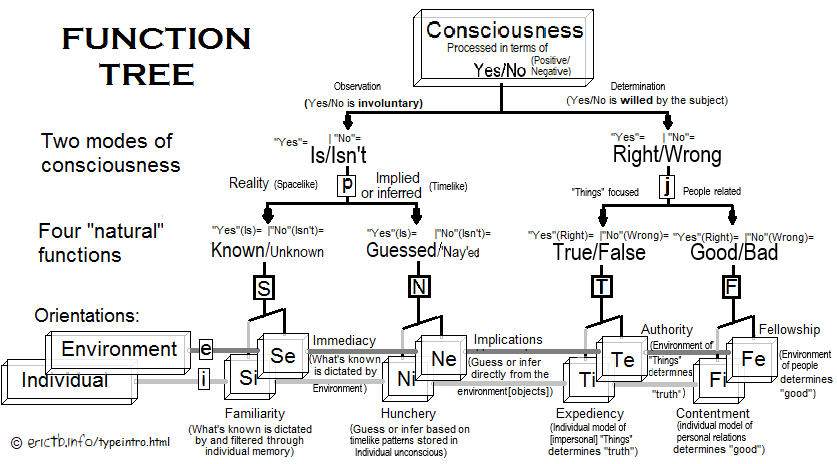
We can reduce the functional processes down to reactions of "yes" or "no".
If "yes or no" are basically answered by the data itself and we only pass it along, this is perception. "Yes or no" translates to that something either "is" [there] or "isn't".
When we have to "rationally" determine "yes or no" ourselves, this is judgment, and yes or no becomes "right" or "wrong".
What "is or isn't" can be determined either by emergent external data being taken in in the moment, or can be brought up from an internal reservoir of data (conscious or unconscious memory)
What's "right or wrong" can be determined by the environment (such as group consensus, or the most efficient use of objects), or by our own standard, often derived from our own learning.
External perception bears the "P" attitude designation, while external judgment bears the "J" designation.
Due to the way we divide data and consciousness compensates with a need for balance, the internal judgment, which works to organize external perception, then also bears a "P" designation, while internal perception, which informs external perception, bears a "J".
What results is:
"P": is/isn't determined by the environment; right/wrong determined by the individual
"J": is/isn't referenced from the individual; right/wrong determined by the envirnment
If what "is or isn't" there is determined by the physical senses, then it becomes known or unknown, and the perception is called, simply "Sensing" (S).
If what "is" or "isn't" is something inferred and not immediately (or previously) sensed, then it is basically guessed or imagined, (with the "isn't" being, what you could call "nay-sayed"), and the perception is "intuition" (N).
If "right or wrong" is determined by impersonal criteria (regardless of how people "feel" about it), then right/wrong is specified as "true or false" (or "correct/incorrect"). If it's based on how it affects people emotionally, then right/wrong is good or bad" (or "liked/disliked").
So these then break down into the i/e attitudes as follows:
Se: known/unknown according to the immediate environment
Si: known/unknown according to individual recollection
Ne: guesses(imagines) according to objects themselves (doesn't really "naysay" on its own)
Ni: guesses(imagines) or "nay-says" according to individual unconscious
Te: true/false determined by objects in the environment
Ti: true/false determined by individual reflection
Fe: good/bad determined by objects in the environment
Fi: good/bad determined by individual reflection
Here are the definitions of the eight resulting function-attitudes I use:
Se: awareness of material reality in the environment (turn outward for attention to immediate at hand objects, such as physical/practical items, as it occurs)
Si: awareness of material reality filtered by individual knowledge (turn inward to compare at hand data such as physical/practical items with a storehouse of fact and experience)
Ne: awareness of hypothetical reality inferred from the environment (turn outward to "fill in" experience of objects with mental/ideational constructs such as connections or patterns)
Ni: awareness of hypothetical reality inferred by individual impressions (turn inward to subject's unconscious to "fill in" mental/ideational constructs with connections like "hunches")
Te: assessment of "correct/incorrect" (mechanical "truth") by an environmental/cultural standard (turn outward to objects to determine their proper relationship to each other)
Ti: assessment of "correct/incorrect" (mechanical "truth") by an individual/natural standard (turn inward to internal "blueprint" of proper relationship between objects)
Fe: assessment of "like/dislike" or [soulish] "good" by an environmental/cultural standard (turn outward to evaluate proper relationship involving/between people)
Fi: assessment of "like/dislike" or [soulish] "good" by an individual/natural standard (turn inward to internal "blueprint" of proper relationship involving people)
Here, starting from a premise that we take in information in the form of "imagery", and what is affected in our assessments. The connections of the data to the "environment" is what determines both S/N and the attitudes of all four functions.
Se: individual’s images match current environment
Si: individual’s images ONCE matched the environment, but currently can only be held among individuals sharing the experience
Ne: individual’s images never matched environment, but are still based on the environment (and thus others can possibly be made to perceive them)
Ni: individual’s images have never matched the environment, and can only be directly perceived by the individual.
Te: individual’s assessment of true/false (mechanics of the situation) are determined by the environment.
Ti: individual’s assessment of true/false (mechanics of the situation) are determined by individual reflection.
Fe: individual’s assessment of good/bad (soul-affect of the situation) are determined by the environment.
Fi: individual’s assessment of good/bad (soul-affect of the situation) are determined by individual reflection.
I had long avoided trying to come up with single-term "names" for the eight function-attitudes, like Berens and Personality Hacker do, since these can be confusing. But when one of them came to me (see below), then I realized the key is to name perspectives (for that's what the function-attitudes are), instead of behaviors or actions, which the other people's terms have been. (For it will usually turn out that either attitude can DO the same things). Also included are the basic "faculties" the functions represent, in their undifferentiated form.
Se: obviosity (objects form sense impressions; "current senses")
"obvious" = "ob-" ("against") + "via" ("the way"), meaning "standing in the way of". The objects cannot be denied.
Si: familiarity (sense impressions emanate from subject; "memory")
The first one that came to me. I would be thinking of the Si perspective, and "familiarity" kept coming to mind, and it fit, reminding me of the way Personality Hacker use "Memory" for Si.
Ne: implications (objects form their own inferences or "big picture"; the "imagination")
It's really an object that implies another object
Ni: "hunchery" (big picture or inferences emanate from the subject; the "unconscious")
Originally considered "forebodance". The definition of "forebode" is basically "forsee" (as Berens uses for Ni; but I felt was not specific to it; technically, Ne, Si and even Se can "foresee" something happening, via their own faculties, such as memory or the immediate senses). "Foreboding" carries more of a specific sense of the impression coming from within, and not necessarily about the future, beyond the uncovering of the data. But it also tends to carry a negative connotation (which fits when it's a shadow function), but will not be seen this way for those who prefer it. If we're going to make up a new form of a word, then "hunch" seems to be what covers Ni products the best.
Te: authority (correctness determined by an object; "common sense")
Ti: expediency (correctness determined by subject; "reason")
Definition is "(of an action) convenient and practical although possibly improper or immoral." This has a strong "subjective" element to it, where "efficiency" can be either individual or environmental, but is usually assumed to be environmental
Fe: Fellowship (Sense of "goodness" shared by a group; i.e. "object"; "sociability")
Fi: sensibility (Sense of "goodness" within the subject; the "conscience"; personal "feelings")
The functions and attitudes represent divisions of reality, much like space and time (which continuums themselves are divisions of reality):

Ego states: what defines and sets the order of the functions in type
The best way to think of type differentiation (i.e. how the preferred functions define the type, and here the other ones fit in the so-called "stack") is through complexes, with the ego itself being a complex, and our main sense of "I". Complexes can be thought of different "ego-states", or lesser senses of "I" partially dissociated from each other (Dissociation is what becomes the familiar "multiple personality" disorders when it is too great, yet is quite normal in lesser degrees. This paper: http://www.ptintensive.com/images/Journal_3-2_Ego_Surrender.pdf explains this well).
One ego state can be anger at someone, and another can be happiness, or sadness, amorous, etc. These all are kinds of "ruling patterns" (archetypes) connected to the limbic system of emotions. Through them, we can have different expressions of "I" that feel different things.
So regarding type preferences, some of these ego states will determine how reality is divided by consciousness. These are what Beebe has outlined as being associated with the eight functions for each type. The ego itself will determine the dominant function (and attitude), which will also be connected with a "main achiever" state; and a more "supportive" state will associate with the auxiliary function (and opposite attitude), and six other states (which mirror and/or shadow these) will carry the remaining six function-attitudes (which also essentially mirror or "compensate" those first two, in being the rejected functions in the rejected attitudes).
| generic term | Area | code | Keirsey | Berens | FIRO/APS |
|---|---|---|---|---|---|
| affective | social | E/I + S + T/F; E/I + N + J/P | "roles of Interaction" | Interaction Styles | Inclusion; Affection |
| conative | action | S + J/P; N + T/F | "temperament" | Essential Motivators (temperament) | Control |
| cognitive | processing | S,N,T,F + J/P | N/A (rejected) | Cognitive Processes (Jung/Beebe) | omitted, but implied by possible correlation |
The way the factors seem to line up:
| code | Keirsey | Berens | APS (approximate) | Ryan/Schutz FIRO score names |
| SJ | Guardian | Stabilizer | Melancholy in Control | Rebel |
| SP | Artisan | Improviser | Sanguine in Control | Independent/Dependent Conflict |
| NF | Idealist | Catalyst | Phlegmatic or Supine in Control | Dependent/Checker/Matcher/Democrat |
| NT | Rational | Theorist | Choleric in Control | Mission Impossible |
| IST/INJ | Contender | Chart the Course | Melancholy in Inclusion | Loner |
| ISF/INP | Responder | Behind the Scenes | Phlegmatic or Supine in Inclusion | Inhibited or Socially Flexible |
| EST/ENJ | Initiator | In Charge | Choleric in Inclusion | Illusive Pimpernel |
| ESF/ENP | Coworker | Get Things Going | Sanguine in Inclusion | People Gatherer |
| Expressive | Initiating | High Expressed Inclusion (eI) | "oversocial" | |
| Reserved | Responding | Low Expressed Inclusion (eI) | "undersocial" | |
| [S]+F; [N]+P | Role-Informative | Informing | High Wanted Inclusion (wI) | "social-compliant" |
| [S]+T; [N]+J | Role-Directive | Directing | Low Wanted Inclusion (wI) | "countersocial" |
| [N]+T; [S]+P | Pragmatic, Utilitarian | Pragmatic | High Expressed Control (eC) | "Autocrat" |
| [N]+F; [S]+J | Cooperative | Affiliative | Low Expressed Control (eC) | "Abdicrat" |
| [N]+F; [S]+P | "contagious"* | Motive | High Wanted Control (wC) | "Submissive" |
| [N]+T; [S]+J | "annoying"* | Structure | Low Wanted Control (wC) | "Rebellious" |
| N/A | Intersecting | Process (Movement) | eI≈wI (Direct) | |
| N/A | Interlinking | Outcome (Control) | eI≠wI (Indirect) | |
| concrete | concrete | eC≈wC | ||
| abstract, introspective | abstract | eC≠wC | ||
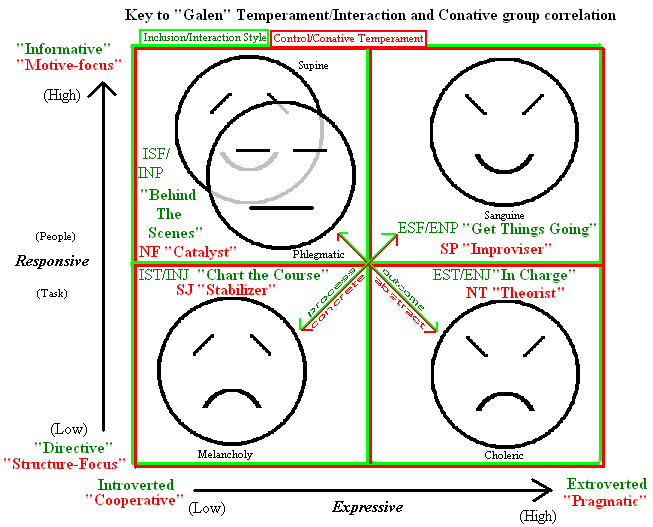
We can divide type into:
"HIPPOCRATIC temperament": derived from the four humors of Hippocrates (Sanguine, Melancholic, Choleric, Phlegmatic) and adopted by Galen, which have often been used for "social" skills
"PLATONIC temperament": The "four kinds of men" (Artisan, Guardian, Rational, Idealist), which are either "trades" or figure in trade, and thus are "conative", mean dealing with "action", and by extension, "leadership" skills.
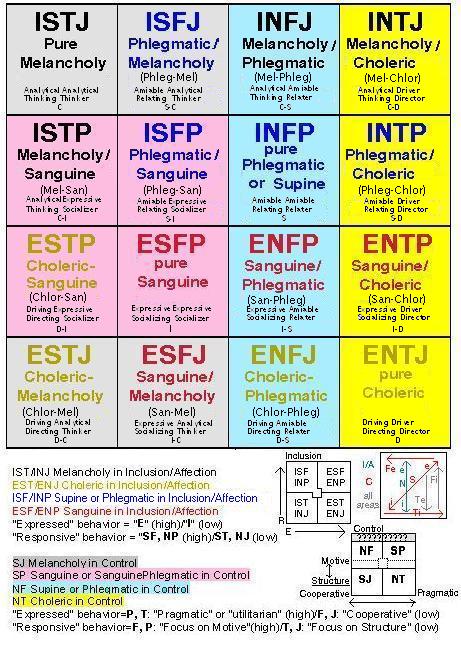
The 16 types, to use LaHaye’s combinations (with the "primary" temperament presumed to be Inclusion or Interaction Style, and the “secondary” to be Control or conative):
ISTJ: pure Melancholy Converting the Galen/Marston/Merrill Matrix to Kant/Kretschmer/Keirsey How EISeNFelT and FFM factors fit on APS E/R matrices. Temperament key is small matrix to left of title
Free online Five Temperament Test: ("traits chart" version by MindTweaks; Reg Atkins/Tori Deaux)
Temperaments.info (Pastoral Counseling Center) Most online info on APS besides this page, and questionnaire can be ordered online. The hypothesis is that the factors of temperament are the root of personality through neurological elements, rather than the cognitive processes, which themselves are believed to have a neurological basis.
It's all about a person's stimulatability.
There are two dimensions of stimulatability.
If we divide this into the areas of surface social skills (I), leadership and responsibilities (C), and closer personal relationships (A), we will have a six digit binary code.
xxxxxx (x=variable)
The values of each digit represent:
For the 16 types, we only need the first four digits.
The way it translates into the type factors:
ISTJ 0000xx
Temperaments, Interaction Styles
We now can also map the cognitive functions to this neurological binary, through their common effects on type:
Se xx11xx (dominant: 1x11xx) My full type binary code: 011001
This is also useful in outlining Leo Ryan's partial ICA combinations:
The Rock: 000000
This would be basically the same as what we used on the first page: 0="l"[low]; 1="h" [high]
We could also extend it to the moderate scores, with "M", and for APS, to distinguish between the neighboring Phlegmatic blends, 4=m; 5=M.
Looking at it this way, there would be six "switches" in the brain so to speak, determining our personality; with the first four determining our cognitive preferences. Here is a table showing how the functional type perspectives could branch off from the stimulus binary: People have said that they like Socionics better because it goes more into intertype dynamics, where MBTI doesn't. But what is Beebe's model but the groundwork for the same dynamics?! That is what attracted me to it in the first place, and still makes me think of it as the most complete. So I had proposed names for all of the type relations, which do imply what the relations would be like. A few concepts are taken from Socionics, as they seem like good descriptors, and for familiarity sake. Here are how the relations are determined:
Compatible (same quadra) Incompatible (alternate quadra) Rationally compatible (adjacent quadra) Irrationally compatible (opposite quadra) INTERTYPE DYNAMICS TABLE Example: INTP
Compatible (Alpha quadra) incompatible (Gamma Quadra) rationally compatible (Beta quadra) irrationally compatible (Delta quadra) Cognitive Processes and archetypes
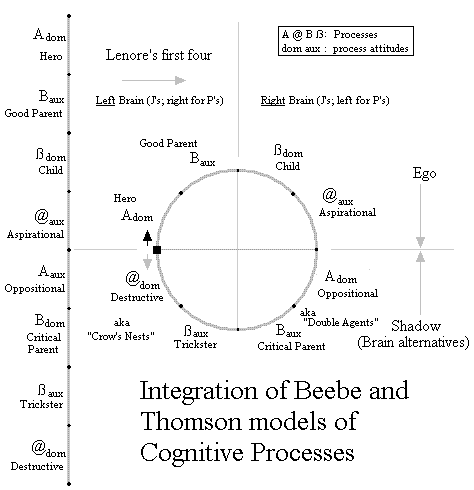
How the eight positions are generated from two by mirroring and shadowing
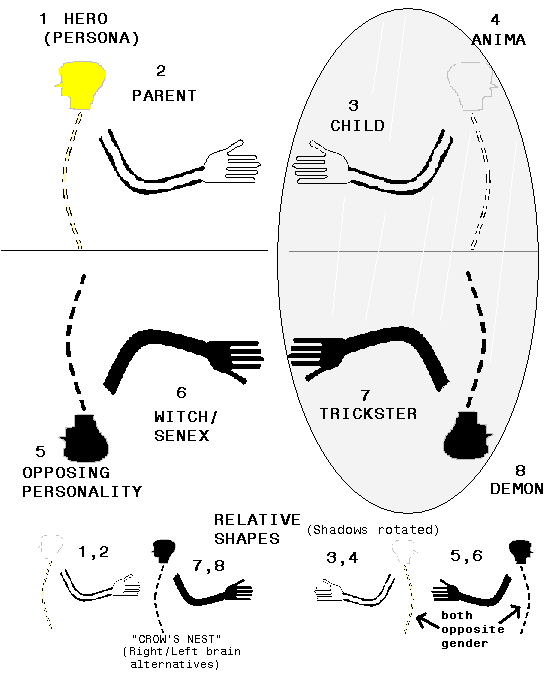
This illustration features a number of other symmetries inherent in the system, and I didn't even particularly plan it that way.
I chose a one-sided arrow, because it could be rotated and reversed and look different in all of the resultant eight positions. This one reconfigures the concept, showing how basically, type is really shaped by just the two preferred functions (and their associated archetypes), and the other six are generated through both reflection and shadowing. This creates a two way symmetry, where you have reverse images, and a double-reverse image, which then becomes congruent in shape to the original image. This ends up indicating certain similarities, such as the anima/animus and Opposing Personality being the opposite gender, and same side brain alternatives being the same shape.
Based on Beebe's model with input from Lenore Thomson, here is how I now understand a person develops with the functions: •The ego starts with its preferred comfort zone of the inner or outer world.
•The ego chooses its dominant function, which it receives stimili from in its preferred realm. •Soon, an auxiliary will be chosen, which will be of the rejected perceiving mode of processing, as well as it being in the rejected outer orientation.
These two functions will become apart of heroic and parental complexes.
•So the rejected outer orientation of the [otherwise internal] Thinking then becomes apart of an oppositional complex. •The opposite function from the dominant, Feeling, will be inferior and most rejected, yet in the opposite outer orientation will be what the ego believes will complete it. •A "child" complex will take on the opposite process from the auxiliary, and align it with the dominant attitude. So using Lenore's theory with Beebe's theory seems to fill in some gaps and create a more complete theory!
Integration of Beebe and Thomson models (line becomes a circle): I would also divide all eight functions into pairs, which all display similar roles. (Socionics does this, calling them "blocks"; however the order of the last six functions is different from John Beebe's, which I'm using here). Both dominant and auxiliary (lead and supporting) as "preferred", by themselves determine the one-in-sixteen type.
The tertiary and inferior develop later, and the tertiary is known as "the eternal child" or "relief", while the inferior remains immature even longer. The way we behave with it is also described as "childish" and immature. So we see a common thread with both postions of functions: immaturity, "childlike innocense" and "vulnerability").
Likewise, the fifth and sixth (in the nearest area of the shadow) are "opposing personality" and "immobilizing" or "critical". The common theme here is resistance to something, either present or future. I also call them the "near shadow".
The deepest shadow consist of "deceiving" and "destructive". Both share in common a regretting of actions taken with the function.
So I would name the four resultant pair blocks:
1,2: Preferred (Socionics: "Valued/Strong") I have found a great parallel between the blocks and the four playing card suits:
1/2: ♦ diamonds: the ego's most cherished goals This is useful for grouping together the functions shared in common by either the two-letter function attitude combinations (SP, SJ, NP, NJ, TP, TJ, FP, FJ) or three letter "intelligence types": STP, STJ, NTP, NTJ, SFP, SFJ, NFP, NFJ), for whom either one or both functions will fall into the same block. Keirsey had said that I/E was the least important factor, and even the EAR study supported it. So when speaking of TP's, for instance, we can mention "resistant Te", or "regrettable Fi". When talking about NTP's, they will both have "immature Si".
The tandems of the functions in themselves have finally been given a name! In the new model being developed by Linda Berens and Chris Montoya, the tandems have been tentatively labeled as such:
Se/Ni: "Realizing Awareness" The names make sense, as Se and Ni will tend to take things as they are, and simply "realize" something from the data; Se just taking it "as is" from the external world, and Ni filling in a pattern from internal inferences. Si and Ne, on the other hand, both basically "compare" data (comparing tangible data with internally stored facts, or comparing one external pattern with another to infer their "interconnections"). Hence, a lot of "inquiring" is necessary to make the comparisons. Assuming "order" being logical, Te will be most externally visible, and Fi will support it from internally. Ti's internal logic is more variable, so both it and its companion external Fe expression will tend to "align" things accordingly. "Enhancing" (Ne/Si + Fe/Ti: SFJ/NTP) The premise is that the title of each group is the common “intention” of the types in the group.
Another writer, Micheal Pierce, Motes & Beams: A Neo-Jungian Theory of Personality (2020, self-published) also names the groups, which he considers "the four temperaments".
All of these groups are very useful to refer to, as often people seeking a type (or those helping them on the type boards) will know which function or even the function tandem they prefer, but could previously only refer to them by such clunky and misleading terms as "Ti/Fe user".
My earlier attempt to give names to the tandems (the names were clunky, and did not resonate with people I mentioned them to, but they do actually parallel the new names):
Surprised no one in Western type until now named these. In Socionics, however, the corresponding groups are four of the "Reinin Dichotomies": So when I help with looking for the best-fit preferences for many supposed "NiTi" types in discussions, who often weigh between INTP and INFJ, because of high Ti and Ni in cognitive process tests; I can now say that they have an obvious "Realizing" preference, since Ni and Se are high, and Ne is low. So INTP is very unlikely, though the person looks like it because of the Ti + abstract focus. I can then suggest another Realizing type into the mix, such as ISTP. (In addition to INFJ). ISTP will be Ti dominant, followed by Se. If they think their Ni is high, we can point out that it may actually be tertiary, which is said to often "inflate" itself, and appear preferred. Of course, if he's weiging between types that share both tandems, like ISTP and INFJ, he can say he knows he is a "Customizing" type! Others have shorthanded the judgment functions as: With this new model, the rest of Berens' model (Interaction Styles, temperament, Beebe archetypes, etc.) plus the excellent concepts Lenore Thomson offers, and the intertype dynamics of TypeLogic, Western type has just about everything that Socionics (which many people claim to like for the dynamics like these) offers!
1/4; 5/8: spines (Beebe) The 28 possible tandem combinations (my extension of this)
With brain lateralization, we could also make tandems out of the resulting pairs of alternatives. The dominant and last place (1/8) I think of as the "superspine", and the auxilary and 7th place (2/7) as the "superarm". Since both inferior and oppositional (4/5) are said to be opposite gender, and are in the middle of the list, they can be called the "contrasexual core". So for the INTP:
Objective processing=Perception (P) The eight functions are then expressed as:
Objective processing of Objective data from Objective source (OOO): Se This basically reduces the four dichotomies down to one!
Table of Comparisons: Moderate blends
© ETB 2007-18
ISTP: MelSan
ISFP: PhlegSan or SupSan
ISFJ: PhlegMel or SupMel
ESTP: ChlorSan
ESTJ: ChlorMel
ESFP: pure Sanguine
ESFJ: SanMel
INFJ: MelPhleg or MelSup
INTJ: MelChlor
INFP: Supine & Phlegmatic; pure or blended together
INTP: PhlegChlor or SupChlor
ENFP: SanPhleg or SanSup
ENFJ: ChlorPhleg or ChlorSup
ENTP: SanChlor
ENTJ: pure Choleric
Nonresponsive Responsive Concrete (S) Abstract (N) Orientation of preferred decision making function
Judgments/decisions are based on EXTERNAL standards ("that's just the way it is; too tough; nothing can be done about it") perception is internally referenced ("I KNOW inside that this is true; I remember/foresee...")
Perception is what is externally referenced ("let's see what we can do about this; let's look at the options; let's experience the thrill of the moment") judgments/decisions are based on INTERNAL standards ("this is how I think/feel; my opinion is...")(perception attitudes)
+J=Internal: schedules according to familiar structure
+P=External: probes current reality (and motives)
(perception attitudes)
+J=Internal: schedules and directs according to foresight
+P=External: probes possibilities, open ended, informative
The decision making functions themselves
THING oriented (IMPERSONAL)
judgment/decision making is based on logical principles ("This is true/false; that's just the way it is; the way we feel won't change that")
PERSONAL oriented
Judgment/decision making is based on values or ethics ("This is good/bad; it means so much to me/us; we should empathize and offer help")(preferred function pairs)
+T: directs according to concrete principles
+F: informs according to concrete values(preferred function pairs)
+T: acts in accordance with logical structures
+F: acts in accordance with ethical motives
16 types models ("EISeNFelT") FFM Category ("Big Five") FIRO/APS ("ERICA") E/I (extraversion/introversion) Extraversion "Expressed" Inclusion (eI) "Informing/Directing"* Agreeableness "Wanted" Inclusion (wI) "Cooperative/Pragmatic"* Conscientiousness "Expressed Control" (eC) "Structure/Motive" orientation"* "Wanted Control" (wC) S/N (concrete/abstract) Openness (to new experiences) eC-wC congruence/incongruence**
(Comfort/Discomfort —TDI only) Neuroticism Low e and/or w—high or mod. e and w**
*Factors determined by T, F, J and P
**Not official "factor"; only inferred
•Descriptions of each temperament variation in each of the the three areas
We can make 1 a need for more stimulation, and 0 a need for less stimulation.
How much one is willing to actively move to gain stimuli (e), and how much he wants to passively receive it from others (w).
ewewew
IICCAA
eI = extraversion (1)/introversion (0)
wI = informing (1)/directing (0)
eC = pragmatic (1)/cooperative (0)
wC = motive (1)/structure (0)
INFJ 0001xx
INTJ 0010xx
ISTP 0011xx
ISFJ 0100xx
INFP 0101xx
INTP 0110xx
ISFP 0111xx
ESTJ 1000xx
ENFJ 1001xx
ENTJ 1010xx
ESTP 1011xx
ESFJ 1100xx
ENFP 1101xx
ENTP 1110xx
ESFP 1111xx
SJ xx00xx
NF xx01xx
NT xx10xx
SP xx11xx
Chart the Course 00xxxx
Behind the Scenes 01xxxx
In Charge 10xxxx
Get Things Going 11xxxx
(Also, Y and Z will indicate that the values must be different from each other, and it can be either way: Y=0, Z=1 or Y=1, Z=0).
Si xx00xx (dominant: 0x00xx)
Ne x1YZxx (dominant: 11YZxx)
Ni x0YZxx (dominant: 00YZxx)
Te x0x0xx (dominant: 10x0xx)
Ti xY1Zxx (dominant: 0Y1Zxx)
Fe xY0Zxx (dominant: 1Y0Zxx)
Fi x1x1xx (dominant: 01x1xx)
The Hollow Man: 101010
Full Blown Neurotic/High Expectations: 010101
Ball of Fire: 111011
Let's Have a Party/Party Time/Flower Child: 110011
Dictator/Controller: 001000
Foot Stomping Dependent: 000100
Affectionate Homebody: 00xx11
Table Hopper: 11xx00
Have your cake and eat it too: 10xx01
The Patsy: xx1xx1
Thus, Phlegmatic-Melancholy-SanguinePhlegmatic, would be MM001M.
(It would also further explain why the preferred functions-- the first two determining type --must always be Ji/Pe or Pi/Je alternations. Try to pair two e's or i's; or P with P or J with J, and you will get a conflict in one or two digits).

Problem is, he does not seem to have any complete listing of all the intertype relations. You find only particular examples in Beebe's articles/interviews or knowledgeable people's discussions. I recently even contacted him, asking which article would contain the most information, and while he pointed to "Understanding Consciousness Through The Theory Of Psychological Types" which contained a lot of useful information about how he put together the model (goes more in depth than "Evolving the Eight Process Model"), it doesn't go into examples for all type relations, and apparently, he has not put together any such project.
Then, I eventually find that the Type Logic site has its own names for the intertype relations:
Relationship Pairs: Definitions
If you click on the type profiles on the site, at the bottom, you will see each Type Relation name, whih is a link to the correspondign type's profile. You can also purchase the software (link at bottom of above linked page).
XXXX Identity (1 2 3 4 5 6 7 8 = A1, B2, C1, D2, A2, B1, C2, D1)
yXXX Pal (ETB: I/E companion) (2,1, 4,3 = B2, A1; D2, C1; etc)
Xyyy Supplement (ETB:[right/left brain] counterpart (syntonic block opposite)); (3, 4, 1, 2)
yyyy Anima (Beebe: "inverse relationship"; ETB syntonic opposite; aka "dual") (4, 3, 2, 1)
yXXy Contrast (opposing personality/attitude-antagonistic; ETB: dystonic parallel) (5,6,7,8 = A2, B1, etc.)
XXXy Complement (ETB: J/P antitype (aka Quasi-identity)) (B1, A2, D1, C2, etc)
yyyX Novelty (ETB: dystonic block opposite) (7,8, 5,6, etc)
XyyX Enigma (McAlpine, "Dynamic Opposite"; ETB: dystonic (total) opposite) (8,7,6,5,4,3,2,1)
XyXX Neighbor (ETB: rational comrade/(kindred); semi-identity) (A1, C2, B1, D2 etc)
yyXX Counterpart (ETB: rational semicomrade)
XXyy Advisor (ETB: semi-benefit —because of shared hero-child relationship with common S/N "language")
yXyy Pedagogue (ETB: irrational semiopposite, semi-anima)
XXyX Companion (ETB: irrational comrade/kindred) D1, B2, C1, A2)
yXyX Tribesman (ETB: irrational semicomrade)
XyXy Suitemate (ETB: social image semi-antitype)
yyXy Cohort (ETB: rational semiopposite; semi-opposing personality; semi-dual)

Descriptions:
http://typelogic.com/pairs.html
INTP Identity
ENTP Pal
ISFJ Supplement (ETB: "left-brain counterpart")
ESFJ Anima
ENTJ Contrast
INTJ Complement
ESFP Novelty
ISFP Enigma
ISTP Neighbor
ESTP Counterpart
INFJ Advisor
ENFJ Pedagogue (semi-dual)
INFP Companion
ENFP Tribesman
ISTJ Suit-mate
ESTJ Cohort
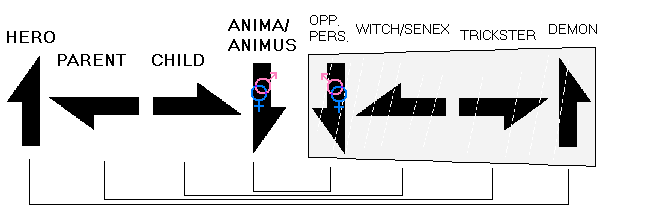
This is the simple prototypical concept, showing the four shadows as direct reflections of the four primaries. Hence, the Dom/aux become # 7 and 8, which are also the brain lateral alternatives, the tertiary or Puer becomes the Witch/Senex (and the Senex actually in the original conception of the archetypes was the shadow of the Puer, rather than of the Good Parent as it is in this theory). Anima/animus becomes the Opposing Personality, as ahown by both being contrasexual.
So the "Hero" happens to look like a "1" (not intended), but then this is good, as it represents the ego, and "looks out for 'Number One'" as it is put.
It is pointing upward, and facing forward (left in this case). Upward then represents the ego's orientation (e or i), while forward represents the ego's preferred perspective. The Auxiliary, or Parent is pointing forward but downward. The tertiary and inferior are the reverse of these, and the shadows (reflections) are aligned the same vertially, but rotated horizontally. The OP and Witch Senex are reflected from the backward facing child and inferior, and thus end up facing forward like the dom and aux. (again, left).
The spines point up and down, while the arms are lying horizontally. (That also was not intended, but just fell into place!)
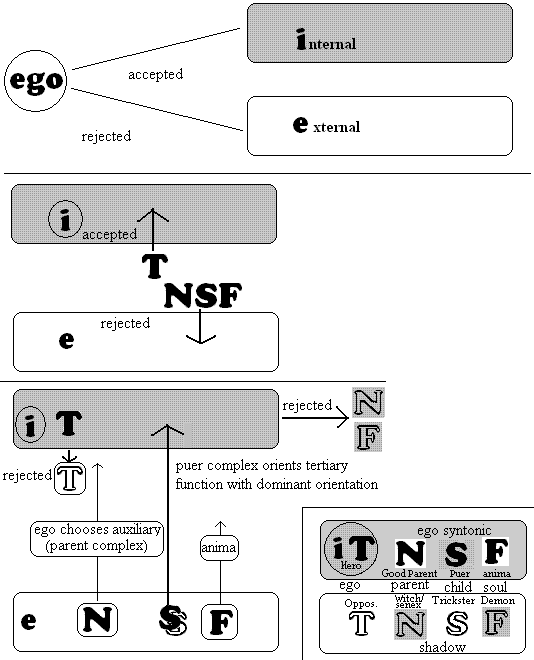
If Thinking (for instance) is chosen as the dominant, and in the internal world, then everything else is rejected by the ego: the external world and the other three functions; Feeling along with both perceiving, which remain undifferentiated. (They are engaged, but not as conscious ego functions, and not really distinguished in orientation, though Jung said they would be associated with the rejected orientation; this case being the outer world).
•The perception rejected from the internal world by the auxiliary then takes on a negative parent role.
•Internally, it will remain the most rejected of all by the ego, and take on the most negative role.
•The aspects of the perception function not internalized by the child remain external, and take on a negative childlike nature.
3,4: Vulnerable (aka "non-preferred"; also looking at "immature"; Socionics: "Valued/Weak")
5,6: Resistant (or "near shadow"; Socionics: "Subdued/Strong")
7,8: Regrettable (or "deep shadow"; socionics: "Subdued/Weak")
3/4: ♥ hearts: the vulnerable, innocent area
5/6: ♠ spades (sharp weapon)
7/8: ♣ clubs (blunt weapon)
Ne/Si: "Inquiring Awareness"
Te/Fi: "Ordering Assessments"
Fe/Ti: "Aligning Asessments"
These make up the groups at the center of the new model, the "Intentional Styles" (working title, "Cognitive Styles"), which are the four groups of four types sharing both perception and judgment tandems:
"Customizing" (Se/Ni + Fe/Ti: STP/NFJ)
"Orchestrating" (Se/Ni + Te/Fi: SFP/NTJ)
"Authenticating" (Ne/Si + Te/Fi: STJ/NFP)
type group functions quadra Intentional Styles Pierce "four temperaments" SFJ/NTP Ne, Si, Fe, Ti alpha Enhancing "Democratic" STP/NFJ Se, Ni, Fe, Ti beta Customizing "Theocratic" SFP/NTJ Se, Ni, Te, Fi gamma Orchestrating "Monarchic" STJ/NFP Ne, Si, Te, Fi delta Authenticating "Anarchic"
Se/Ni: "aspective" (ad "to", -spect "look". You deal in the now and forward
Ne/Si: "circumspective" (to "look around"). You look around both to the past, and to all the possibilities in the present.
Te/Fi: "systemic" (short for "systemiorational"). You evaluate what's important, and then go build on it.
Fe/Ti: "harmonic" (short for "harmoniorational") Different types of "harmony" (technical precision or interpersonal) are the common theme of this pair.
Aspective = "Decisive"
Circumspective = "Judicious"
Harmonic = "Merry"
Systemic = "Serious"
When discussing relationship type matches between an NFP and NTP, we can say "you're both 'Inquiring' types, so you'll 'perceive things the same way'". In a personality clash, instead of "the real clash is Ne/i-Si/e; not Te/i-Fi/e”; I can say “the real clash is between an Inquiring and Realizing perception preference rather than an Ordering and Aligning judgment”. More to type, but easier to say or even think than all those process codes!
Te/Fi: "We think; I feel"
Fe/Ti: "We feel; I think"
2/3, 6/7: arms (Beebe)
1/2, 3/4, 5/6, 7/8: blocks (Socionics)
1/3, 2/4: I/E faces (Reinhold, Personality Pathways)
Even more tandems can be made out of other pairups that might occur. Like under stress, I might make the lateral transformation from Ti to Fi, but maintain my Ne. Hence, I will come off as an NFP (which I believe is part of what was happening in my discovery process when I seemed to possibly be ENFP). So that is the parent working with the demon (2/8), sort of simulating the NFP's hero-parent (1/2) combination. It's like a "block" split between the primary and shadow ranges. The same can hold true for a hero-trickster (1/7) combo (when I'm using logic and facts to try to trap someone in an argument), a child-opposing personality (3/5), and anima-witch (4/6). These I guess I'll call "superblocks". While the ego block will represent the type's "intelligence variant" (last three letters), the other blocks and superblocks will yield the other seven variants. 3/6 (child-witch) would be "compensatory arm", since the witch will step in to protect the child. And then, 1/6, 2/5, 3/8 and 4/7 can be called "superfaces" (since they also will share the same attitude). Since there are two pairs of introverted and extraverted, they can be distinguished as "upper" and "lower". The parallel function attitudes of the primary and its shadow (1/4, 2/5, 3/7 and 4/8) are basicaly the original "whole" functions!
TiNe ego (preferred/mature) block (NTP)
TiSi primary introverted face
TiFe primary spine
TiTe whole dominant function (T)
TiNi upper introverted superface
TiSe dominant superblock (STP)
TiFi superspine
NeSi primary arm
NeFe primary extraverted face
NeTe upper extraverted superface
NeNi whole auxiliary function (N)
NeSe superarm
NeFi auxiliary superblock (NFP)
SiFe vulnerable/immature block (SFJ)
SiTe tertiary superblock (STJ)
SiNi compensatory arm
SiSe whole tertiary function (S)
SiFi lower introverted superface
FeTe contrasexual core
FeNi inferior superblock (NFJ)
FeSe lower extraverted superface
FeFi whole inferior function (F)
TeNi resistant block (NTJ)
TeSe shadow extraverted face
TeFi shadow spine
NiSe shadow arm
NiFi shadow introverted face
SeFi regrettable/reactive block (SFP)
Subjective processing=Judgment (J)
Objective data=concreteness (S) or logic (T)
Subjective data=abstractness (N) or value (F)
Objective source=external (E)
Subjective source=internal (I)
Objective processing of Objective data from Subjective source (OOS): Si
Objective processing of Subjective data from Objective source (OSO): Ne
Objective processing of Subjective data from Subjective source (OSS): Ni
Subjective processing of Objective data from Objective source (SOO): Te
Subjective processing of Objective data from Subjective source (SOS): Ti
Subjective processing of Subjective data from Objective source (SSO): Fe
Subjective processing of Subjective data from Subjective source (SSS): Fi
Type Old Keirsey
w/Bates (PUM1)Current Keirsey
(PUM2)Berens, Nardi Hirsch &
KummerowPersonality
PageInclusion/Control by Ryan Inclusion/Control by ETB ISTJ Trustee Inspector Planner Inspector Reliant Duty Fulfiller Loner/Rebel pureMel ISTP Artisan Crafter Analyzer Operator Realist Mechanic
Loner/IDConflict** MelSan ISFP Artist Composer Composer Producer Aesthete Artist Inhibited*/IDConflict** PhlegSan or SupSan ISFJ Conservator Protector Protector Supporter Nurturer Nurturer Inhibited*/Rebel PhlegMel or SupMel ESTP Promotor Promoter Promoter Executor Adventurer Doer Illusive†/IDConflict** ChlorSan ESTJ Administrator Supervisor Implementor Supervisor Enforcer Guardian Illusive†/Rebel ChlorMel ESFP Entertainer Performer Motivator Presenter Joker Performer Gatherer/IDConflict** pureSan ESFJ Seller Provider Facilitator Caretaker Helper Caregiver Gatherer/Rebel SanMel INFJ Author Counselor Foreseer Developer Mystic Protector Loner/Checker*** MelPhleg or MelSup INTJ Scientist Mastermind Conceptualizer Director Free-Thinker Scientist Loner/Mission MelChlor INFP Questor Healer Harmonizer Clarifier Dreamer Idealist Inhib*/Checker***; |Sup. & Phleg. pure and blends**** INTP Architect Architect Designer Theorizer Wizard Thinker Inhibited*/Mission PhlegChlor or SupChlor ENFP Journalist Champion Discoverer Advocate Visionary Inspirer Gatherer/Checker*** SanPhleg or SanSup ENFJ Pedagogue Teacher Envisioner Mentor Sage Giver
Illusive†/Checker*** ChlorPhleg or ChlorSup ENTP Inventor Inventor Explorer Inventor Innovator Visionary Gatherer/Mission SanChlor ENTJ Field Marshall Fieldmarshal Strategist Mobilizer Leader Executive Illusive†/Mission pureChlor
*possibly Inhibited Individual, Cautious Expectations or Social Flexibility
**possibly Independent Dependent Conflict or Mission Impossible with Narcissistic tendencies
***possibly Checker, Matcher, Loyal Lieutenant, Let's Take a Break or Openly Dependent Person
****purePhleg, pureSup, SupPhleg or PhlegSup
†"Illusive Pimpernel"; alternate name for Ryan "Now You See Him Now You Don't". (http://www.bcs.org/upload/pdf/131107-cchang.pdf) Can also be "Conversationalist".
[People] Gatherer types also can be Conversationalist or Hidden Inhibitions.
Mission Impossible or Rebel types can also be "Self-Confident".
(Many instruments' "types" not recognized as Inborn "temperament")
Generic Term Outer Behavior Inward Orientation Social Skills Leadership and responsi-
bilitiesdeep personal relations Introverted, Task-Oriented extroverted, Task-Oriented extroverted, Relationship-Oriented Ambiverted/Moderate and/or Introverted, Relationship Oriented Hippocrates' Four Humors (c.400 BC) Scales not recognized black bile yellow bile blood Phlegm Not recognized Galen (c. 190 AD) Response Delay
(fast or slow)Response Sustain
(short or long)Areas not recognized Melancholic Choleric Sanguine Phlegmatic Not recognized Ivan Pavlov's dog temperaments (C. 1900 AD) Passivity:
(Active or Passive)Extremeness:
(Extreme or Moderate response)Areas not recognized Melancholic (Weak inhibitory) Choleric (Strong excitatory) Sanguine (Lively) Phlegmatic (Calm, imperturbable) Alfred Adler's four styles of life (C. 1900 AD) "activity" "social interest" Areas not recognized Avoiding Ruling or Dominant Socially Useful Getting or Leaning Erich Fromm's Four types of character (C. 1947) assimilation socialization Areas not recognized Hoarding Exploitative Marketing Receptive Hans Eysenck(1947) extraversion "Neuroticism" is similar scale Areas not recognized Melancholic Choleric Sanguine Phlegmatic Not Recognized Temperament by Tim LaHaye (1966) Makes comparisons with other systems Areas not recognized Melancholy Choleric Sanguine Phlegmatic "passive sanguine" (Not recognized as separate temperament) Temperament Features by Florence Littauer Areas not recognized Perfect Melancholy Powerful Choleric Popular Sanguine Peaceful Phlegmatic Not recognized Blake-Mouton Managerial Grid Model (1964) Concern for Productivity Concern for People Areas not recognized Impoverished Produce or Perish Team Type Middle of the Road Country Club Jay Hall Conflict Management (1973) Concern for personal goals Concern for relationships Areas not recognized Leave-lose/win Win/lose Synergistic; Win/win Mini-win/mini-lose Yield-lose/win Thomas-Kilmann Conflict Modes (1974) Assertiveness Cooperativeness Areas not recognized Avoiding Competing Collaborating Compromising Accommodating William Schutz: FIRO-B (1958) (Leo Ryan's Interpretation, 1971. Schutz names in table below) Expressed
BehaviorWanted
BehaviorInclusion "the Loner" "Illusive Pimpernel"† "People Gatherer" "Social Flexibility" "Inhibited Individual" Control "the Rebel" "Mission Impossible" "Independant-Dependant Conflict" "the Matcher" "Openly Dependant" & "Loyal Lieut." Affection (aka "openness") "the Pessimist" "Mask/Image of Intimacy" "the Optimist" "Warm Individual/The Golden Mean"
"the Cautious Lover" Arno Profile System (fka "Temperament Analysis Profile")(1980's) Expressive
BehaviorResponsive
BehaviorInclusion Control Affection Melancholy Choleric Sanguine Phlegmatic Supine Worley Identification Discovery Profile (1995) Demonstrated Desired Social Leadership Relationship Melancholy Choleric Sanguine Phlegmatic Introverted Sanguine Enneagram "Surface Direction" and "Deep direction" similar scales Social Self-Preservation Sexual Type 5 Type 8 Type 7 Type 9 Type 6 ([Expanded] Type A Theory Friedman & Rosenham (1950's); J. Denollet (1996) Various, sometimes including "Neuroticism" Areas not recognized Type D Type A Type B (HireSuccess; Mindpub) Type B Type C William Marston (1928) and John G. Geier (1970's), DiSC Assessment Assertive/
Passive Open/Controlled Areas not distinguished Conscientious-
nessDominance Influence Steadiness California Psychological Inventory CPI 260 (c. 1948) action, social confidence/inner life, privacy Rule-favoring/questioning, Agreeable/disagreeable stability/value system, Areas not recognized Visualizer Leader Innovator Supporter Stuart Atkins, LIFO four Orientations To Life(c. 1960's) Planning vs.Doing Directing vs. Inspiring Areas not recognized Conserving-Holding Controlling-Taking Adapting-Dealing Supporting-Giving David Merrill, "Social Styles" Assertiveness Responsiveness Areas not distinguished Analytical Driving Expressive Amiable Tony Alessandra "Personality Styles" Indirect/
DirectOpen/
GuardedAreas not distinguished Thinker Director Socializer Relater Interaction Styles by Linda Berens (c2006) Initiating-
RespondingInforming-
DirectingCorresponds to SOCIAL skills area Chart the Course In Charge Get Things Going Behind the Scenes Keirsey's "roles of interaction" (2008) Expressive/
Reserved"Role-Informative/
Role-Directive"Contender Initiator Coworker Responder MBTI Codes (1958) E/I S + T/F; N + J/P IST, INJ EST, ENJ ESF, ENP ISF, INP Eric Adickes (1905) "heteronomous"/"autonomous" (ties together opposites; corresponds to S/N) Appears to correspond to LEADERSHIP skills Traditionalist Agnostic* Innovative Dogmatic* Ernst Kretschmer (post-WWI) "Cyclothymes"/"Schizothymes" (ties together opposites; corresponds to S/N) Depressive Anesthetic* Hypomanic Hyperesthetic* Eduard Spränge(1914) "Social"/"Political" N/A Economical Theoretic* Aesthetic Religious* Keirsey/Berens "Conative" Temperaments Cooperative vs Utilitarian (Pragmatic) Structure vs. Motive focus (Cross factor swapped with S/N, by Berens) SJ
(Guardian/
Stabilizer)NT*
(Rational/
Theorist)SP
(Artisan/
Improviser)NF*
(Idealist/
Catalyst)
*Keirsey correlations: NT="Phlegmatic"/NF="Choleric" (PUM 1)
Moderate "e", task-oriented Moderate "e", relationship-oriented extroverted, Moderate "w" Introverted, Moderate "w" FIRO-B(I) "Illusive Pimpernel" Tendencies[?] Hidden Inhibitions Conversationalist Cautious Expectation FIRO-B(C) Self-Confident Let's Take a Break "Mission Impossible" with Narcissistic Tendencies The Checker FIRO-B(A) "Image of Intimacy" Tendency Cautious Lover in Disguise Living Up to Expectations Careful Moderation APS Phlegmatic Melancholy
Phlegmatic CholericPhlegmatic Supine
Phlegmatic SanguineSanguine Phlegmatic
Choleric PhlegmaticMelancholy Phlegmatic
Supine PhlegmaticEnneagram Type 1 Type 2 Type 3 Type 4 