PERSONALITY MATRIX
Part 2:
MBTI and the 16 Types and Cognitive Functions
Intro to type (the bare basics of the type code)
E-reader version of entire series on Academia
E-reader version "Building the Code" section
The processes: Input and Output and other two dichotomy letters
•[introduction: (the functions)]
•What is a "preference"?
•The attitudes (two middle factors)
•The type functions' operational definitions, derived from common function terms
•The fourth factor
•The dominant
Building the Code
•first two letters to develop ("sociability temperament")
•dominant function (next letter to develop); other functions (and orientation) suppressed
•auxiliary function (type code complete)
•alternation of functions
•Preferred vs Unpreferred Functions
•Definitions of the Function Attitudes
•Simple type descriptions based on definitive dominant and auxiliary functions
•The standard four function-attitudes of each type
•What really sets the function order?
•The primary archetypal roles and attitude order
•The Arm and Spine of consciousness
•The Four Functions and their “shadows”
Understanding Archetypes and Complexes
•Projection: The Complexes and other people
•How the shadows manifest within the ego
•What invokes this stuff?
•An example, the block and tandem parallels, and summary of shadow dynamics
Lenore's interpretation of the eight function order: Brain lateralization
J/P regain their significance; Summary of different levels of suppression from consciousness
A Word on Socionics (j/p switch)
Recap of the entire process
Temperament and Interaction Style
Correlation with APS?
It's all about “consciousness”
Temperaments are complexes too!
APPENDIX
Block names
Archetypes in three variables; Generic terms
Beebe Resources and Intertype dynamics
Animals and temperament or type
More on the function definitions
•Different perspectives with the functions
•Functions as "perspectives"
•("Not Cognitive Processes" premise)
•(Lenore Thomson's definitions from the book, and developing additional root definitions)
•Functions and gender roles
•How we divide reality: "abstracting" from the "concrete" world
•The neurology behind the functions
•Eight atitudes, and difference between the "general" and type-specific "uses"
The Myers-Briggs Type Indicator® (MBTI)'s 16 types (based on the theory of cognitive processes by Carl Jung) is the most popular form of personality theory today, surpassing both the FIRO-B® system and the old Galen temperaments used by APS, LaHaye and others.
The basis of type is the way we divide reality between opposites. We have two different ways of processing information, and those are divided into opposite poles as well.
The best way to begin to understand the type code and the functions is to think of our processes as like a computer, in terms of INPUT, PROCESSING and OUTPUT. We take IN information, PROCESS it [meaning "rationally"], and then PRODUCE something with it. The information gathering processes are either Sensing or iNtuition, and what we do with the information are Thinking or Feeling. The "output" is basically the acting out of the decisions, and other behavior involved with our functional preferences.
The processes basically can be framed in terms of "positive"/"negative" data, or YES or NO (i.e. something is TENABLE i.e "able to be held" by the ego, or not):
1) IS or ISN'T. This takes the form of what's "known vs unknown" or "guessed vs "naysayed".
2) RIGHT or WRONG. This takes the form of "true vs false" or "good vs bad".
They've also been expressed as "S/N are “functions of the given”, and T/F as “functions of option”. (I.N. Marshall, "The four functions of: A conceptual analysis" Journal of Analytical Psychology 13(1), 1-32, 1968)
The best way to understand the functions is to think of them as "perspectives", rather than as "things" (like "gears" or "skills sets") that we "use", as is often put. Instead of "using ['X' function]" to see something is there or not there, or determine "right/wrong", we see the situation through the lens of that function, and then make the natural (mental or action) response. (Again, the "output").
These functions involve the ways the emotions interplay with our "rational mind". They carry what can be called a "sense of meaning" when brought into consciousness by the ego, and when not conscious, come out as felt reactions. In consciousness, they become the "interpreters" of these emotional events.
The "meaning" or "interpretation" we tend to draw in situations takes the form of:
Sensing: recognition of tangible information taken in through the senses; material items in space, what "known/unknown" (substance)
iNtuition: recognition of conceptual information inferred from or "filling in" situations; hypothetical patterns in time, such as larger contexts —"guessed/naysayed" (idea)
Thinking: evaluation based on the mechanics of objects and factors as (impersonal) "things"; in terms of "true/false" or "correct/incorrect".
Feeling: evaluation based on anthropic ("intrapersonal" or "interpersonal") considerations, involving affects on people or souls. In terms of "good/bad" or "like/dislike".
Perception is when the data or life itself, says “yes” or “no”. Something is either "there", or "not there"; you only can take it in, and agree or disagree.
With S, tangible reality says “yes” (it’s there, perceptible via the senses), or “no” (it’s not there)
With N, a pattern ("Where it's heading"; also "there" or not "there") says "yes" or "no".
Judgment is when we ourselves; i.e. the "ego" (and it's "will" or "emotions"), says "yes" or "no".
T, based on an impersonal criteria, such as how objects work
F, by personal criteria, such as how things affect people
Basically, the functions (divided first, into perception and judgment) can be framed as answering one of two questions:
1) What things are we observing?
2) What are the proper relationships between things?
The two functional poles for each question determine the type of observation or relationships being processed. Both can be expressed as either a more factual "it is what it is" approach, or one where there is some sort of meaning or worth to us.
They really represent artificial divisions of reality, where each person pays more attention to one aspect of experience or the other.
Basic functional "products":
[Awareness of] what exists; "is/isn't" observation (irrational):
S: [special recognition of] material data or practical experience (e.g. "substance" of reality; "known/unknown")
N: [special recognition of] immaterial "implications" of objects and events (e.g. "idea" of reality; "guessed/naysayed")
[Evaluation of] how things relate; "right/wrong" evaluations (rational):
T: [Determination or evaluation of] the proper relationship between objects (i.e. "true/false")
F: [Determination or evaluation of] the proper relationships of things to our feelings (i.e. "good/bad")
Jung has been quoted in saying "that we need a function to tell us what is*, and that is sensation. We need a function to give it a name [i.e logically categorize it], and that’s thinking. We need a function to tell us what it is worth, and that’s feeling, and we need a function to tell us what its possibilities are, where it is headed, and that’s intuition". (Beebe, "A Jungian Analyst Talks About Psychological Types" at Inner Explorations).
Jung also expressed them as S: “registers reality as real", N: connected with time; that things have a past and a future, and thus “come from somewhere and go to somewhere, and you cannot see where they came from and you cannot know where they go to, but you get what Americans call a hunch”. So this function “divine[s] the implications or possibilities of the thing that has been empirically perceived, logically defined, and discriminatingly evaluated” [i.e. via S, T and F].
From there, we can simplify it as N dealing with time, and S dealing with space, since sensation comes through waves or other stimuli directly from objects in space. Any "pattern", "hypothesis", "theory", "implication", or "inference" you deal with involves something playing out in time.
*(While Jung associated "what is" with S, that would assume everything that exists is perceived through the senses only. But to our consciousness, patterns of "where it's heading" are "things" that exist as well. They are simply inferred, or basically "guessed" or "imagined", and if guessed against, this may come off as "naysaying"; i.e. objecting just for the sake of objecting, without any visible reason. You could distinguish it as S="WHAT it is" [the existence of something is already given], and perception in general is "THAT it is", to begin with).
F is "merely the function that places the highest premium on the psychological act of assigning value." It is “neither affect (or what we sometimes call ‘feelings’) nor the result of more unconscious emotion-based processes, even though [Jung] admitted our complexes are ‘feeling-toned'”. The difference between “Feeling” and “feelings” (emotion) is that Feeling is “the function that sorts out feelings”. Or, “discriminates affect”. (Beebe: Energies and Patterns in Psychological Type, 2016, p10, 148, 158).
T “defines for us” what we are perceiving “is” there. You can think of it in terms of “how things work”. “Defining” is done basically by determining “what it is” by how it works, or what it does, which yields the judgment of “true” that things are measured true or false by (as opposed to how we feel about it, which determines "good or bad").
We can parallel it up as S and T both dealing with "what is" in the sense of "fact"; one function observing, and the other assessing, and N and F dealing with "what it means"; again, one observing, and the other assessing.
To observe "fact" is to take in the tangible data "at hand", and to assess "fact" is to make the rational decision (based on how it works) of how the data is to be categorized (e.g. "named").
To observe "what it means" is to find an unseen meaning or inference the data implies or can fit into. (What N observes again, exists, and so "is" in the sense of being something that can be named. But it's not fact, in a tangible sense; it's a "meaning"). To assess "what it means" is to make a rational decision regarding how we (humanity) relate to the data.
Just what is a "preference"?
Now, we all do all of these things, so one can wonder what this is all about. What do we mean when we declare some of these processes as “preferred” in making up a “type”? The answer is that there are what can be described as more "general" and "special" instances of these perspectives; and it's the "special" instances that connect to the type "preferences" we are discussing here.
(As will be discussed more later, the key to understanding "preference", is what's called "ego-states". The ego is our main sense of "I", and will generally choose one function as its main "world-view", and various lesser "states" will hold other world views, represented by the other functions. These all represent "special" uses that will be specific to the different types. The "general" uses are those whose senses of meaning are not set apart and interpreted by a particular ego-state).
A Sensing type (_S__) is one whose primary outlook is to register reality as real, through tangible, material or practical "at hand" data and/or experience, located in space, which they generally "itemize", and thus think in terms of what is tangibly "known" or "unknown", or the substance of reality (which is what sets the idea, or what's implied).
An iNtuitive type (_N__) is one whose primary outlook is inferring the implications of things; "filling in" experience with [mental] "constructs" that work or play out through time, such as concepts, hypotheses, or theories, which all involve "larger contexts" or meanings behind things and [non-physical] "patterns". Even physical or visible things, like in comparing one thing to something separate, but has some sort of inferred similarity. Focusing on a property to compare, like its shape; they have turned into an “idea”. They can be said to generally "philosophize" experiences based on putting these ideas together. This is about what is implied or inferred (or "imagined"), or we could say "guessed" or "nay-sayed" (which explains or improves what's "known", or the "substance" of reality).
A Thinking type (__T_) is one whose primary rational outlook is looking at the world "impersonally" or "technically", in terms of objects and how they work, which we can call the "mechanics" of things, (including people), often with a focus on goals such as efficiency. They tend to think in terms of "true" or "false" (which is what will automatically determine "like/dislike").
A Feeling type (__F_) is one whose primary rational outlook is paying attention to or sorting out feelings (theirs and by extension, others), looking at the world in terms of people or humanity, and the elements that makes them “subjects”, which is basically what could be called "anthropic" (or "humane"), and ultimately deals with the "soul", with its emotions and values; usually with a focus on goals such as individual or group harmony. (They will often mirror the other person's inner state and adjust their behavior accordingly). They approach life in terms of being human first, and seeing others as humans to interact with, and objects are to be looked at and used from the perspective of how we relate to them (or their affect on us). This leads them to "think" in terms of "good" or "bad" (which will assume what is "correct/incorrect").
Coming up with good definitions is pivotal to understanding the concepts, as many become confused in their or others' types from looking at behaviors, thinking "such-and-such type can't do that", or "He does such and such too much to be this type"; often using terms such as "emotions".
The type functions' operational definitions, derived from common function terms
Thinking and Feeling function's connection to literal "thinking" and "feeling":
The literal terms are based on the emotionality of the process, with emotion representing more of a deeper personal involvement in the process, in contrast to a detached impersonal pondering of subjects. This is where the confusion about "Feeling=emotions" comes from, but it says nothing about the humane or technical focused content of the process, which is what the T/F functions are about. A person can be "thinking" of how something affects him and how to react, and we see him sitting there "thinking", but in our sense of the terms, he's actually "Feeling". And a person can be having an emotional reaction because he sees something is incorrect; it won't work, and will lead to some sort of problems, if nothing more than inefficiency. We'll look and say he "feels" strongly about that, but his judgment is actually "Thinking"!
So the experience of emotions, wants and likes is not the Feeling function; it's the rational assessment of them that is.
Indeed, the feeling function, as a mode of psychological orientation, must above all not be confused with emotion. The latter, more properly called affect, is invariably the consequence of an active complex. "Feeling is distinguished from affect," writes Jung, "by the fact that it produces no perceptible physical innervations, i.e., neither more nor less than an ordinary thinking process." (Jung, Psychological Types, par. 725) Affect tends to contaminate or distort each of the functions: we can't think straight when we are mad; happiness colors the way we perceive things and people; we can't properly evaluate what something is worth to us when we're upset; and possibilities dry up when we're depressed. PERSONALITY TYPES: Jung’s Model of Typology, Daryl Sharp, Toronto, Inner City Books, 1987 p.18 http://www.innercitybooks.net/pdf/books/personalitytypes.pdf)
In our usage, thinking is basically a decision-making (even if just mental) process based on linear cause-and-effect principles. It tends to be more "detached" from emotions or "impersonal", as it deals in logic. I found that it can be summed up as dealing with the TECHNICAL or the MECHANICS of things, expressed as what's VALID.
Feeling is basically a decision-making process based on values where evaluations generally take into consideration what's DESIRED. This process will tend to have more emotion involved, and include personal ethics. It can be summed up as PERSONAL, as such "valuing" puts a personal aspect on things. Because "personal" can mean many different things, the term HUMANE or ANTHROPIC seems to cover its focus more specifically. Or we could say SOUL-AFFECT.
These two processes are also described as "arranging" or ordering one of two realms (below).
Sensing and iNtuition function's connection to literal "sensation" and commonly mentioned "intuition":
Sensation is of course the data taken in through the five senses, which everyone does, including animals. The difference between a Sensation type and iNtuitives and animals is that they derive the most meaning from the sensory data itself, moreso than extracting unseen inferences from it (like N's), or only reacting to it according to instinct (like animals).
"Intuition" is frequently used in a sense like "woman's intuition", which is just a "sense" or "hunch", only partly based on what's seen before you, but the meaning is extracted from this often less conscious impression from within. An iNtuitive type will be more drawn to these meanings behind things, often "reading between the lines", as it's put.
| We all can see, hear touch, taste etc. the items in the physical universe. But only some will have more of an emotional investment in paying attention to tangible experience such as this, where it becomes "preferred". What is seen right before them (or at least remembered) is more important as data. (And such "itemization" often leads to more attention to "details"). To others, the information gained from this alone will be less relevant.
We all can infer mental constructs such as big pictures or deeper meanings from situations. But only some will gain the emotional investment from such intangible, conceptual data, and it will be those who saw the plain, concrete data as less relevant. To them, there must be more to what is seen before you. (Overall patterns are more important than details). Here now, we can really clear things up regarding emotions, since this often gets mixed up with one of the functions. We all have emotions and like and choose things based on likes and dislikes. Yet only some will have an emotional investment in personally relating to situations, and prefer to make their decisions accordingly. This will lead them to focus on the more "humane" considerations of situations, which might include emotions (their own and/or others). So this might look like investing in emotions for their own sake. We all can see technical, linear cause-and-effect relationships in objects and situations, and make decisions accordingly to them. Yet only some will have an emotional investment in this process. They are the ones who feel the least in control of emotions. The only emotions normally allowed will be the controlled ones associated with his technical (rather than directly personal) focus. (Else, they will tend to come up in a rash fashion). |
The attitudes
Then, there's the matter of WHERE they engage (the OUTput), or the where the standard the evaluations are drawn from is located. Either the external world of people and action, or the internal world of thoughts and emotions. So the distinction can be made in terms of an individual versus environmental perspective. (And for judgment, standards learned generally from nature; i.e. "universals", or from culture; generally "local"). In MBTI certification class, they were described as "turning" or even "going" "inward" or "outward", as if describing literal movement to one or another literal place to perform the process. This I found helped clarify the difference the direction creates within each function when they are used in one area or the other (where others use general behavior descriptions).
Jung called this "extraverting" or "introverting" the functions (notice the verb form of the words. "-vert" means to turn. Also, he insisted on spelling "extraversion" with the "a", where others have used "o" as we did on the first page). Extraversion and Introversion of functions are also called "attitude" or "orientation". So when discussing the eight resulting function-attitude combinations by in this fashion, lowercase "e" or "i" are placed after the function letters indicating the "introverted" or "extraverted" orientation of the function. (Thus denoted "Xe" or "Xi", with "X" here used as the variable for all of them).
Introversion and Extraversion in themselves likely start from neurology, where a person is either oversensitive or undersensitive to stimulation by external data. If he is undersensitive, he will want more stimulation, and move to gain it from the external world; and if he is oversensitive, he will want less, and turn inward, where he has stored data from previous experience or constructed his own standards of decision-making.
So the way these orient the functions:
e attention or evaluation is derived directly from external object, or the environment.
i attention or evaluation is filtered through internal subjective blueprint, learned individually.
Another way of putting it is that the introverted function focuses our cognition on the "inner world" of our own senses, intuitions, thoughts, and feelings, while extraverted functions directs our cognition to the "outer world" of the sources of sensations, intuitive patterns, people's feelings, etc.
Jung had described an introverted functions as "one that has turned away from the object and toward the archetypal ‘idea’ that the object might be closely matched to. This archetypal idea, residing in the inner world, can be understood as a profound thought, a value, a metaphorical image, or a model of reality”, depending on the respective introverted function being T, F, N or S, and when orienting something external, “it is in the end, the comparison to the archetype [i.e. "ruling pattern"], not the stimulating object of situation itself, that finally commands the attention of the function".
To translate, an image of “true/false”, “good/bad”, an image itself (i.e. “an image of an image", hence introverted iNtuition’s “meta-perspective”), or “what is”. More simply put, the introvert's attention is drawn more to their own thoughts, feelings, sensations or intuitions, while the extravert's attention is drawn to objects in the environment.
It can be hard to determine, regarding the functional perspectives, what’s really “internal”, because in reality, all of our processes are technically “internal”. So this can be differentiated by
External world (environment): source of all data
Internal world (individual): where we receive and process all data
The process of data going from the environment to the individual is perception (“input”)
The process of data being ['internally'] assessed as right or wrong is judgment (“processing”)
The process of data going from the individual to the environment is behavior (“output”)
The extraverted subject [or complex/ego-state] simply goes to the environment to get to the [objective] source of the incoming data.
The introverted subject filters it within.
(Input is differentiated as a perception function and processing differentiated as a judgment function when connected to a typological complex. Extraverting is more than passive perception; it’s the ego state actively engaging the environment; seeking the input. With Se, tangible data is constantly coming in, but the ego state is already going out seeking it, and thus “paying more attention” [as we’ve often put it] to it).
So each person will have a preferred dominant orientation, of the inner or outer world. The dominant function will take the attitude of the dominant orientation.
Everyone uses all four functions (S, N, T, F), both internally (i) and externally (e), but for each type there is a particular order they fall in. One function will be dominant, and the others will follow.
Fourth factor and the code comes together
Myers and Briggs came along, and grouped this into the four letter codes. These consist of only two of the functions: the two most preferred, and the other two letters convey how the function is oriented and from that, which is first.
They designated the second letter as the information gathering or "perception" code, for S or N, and the third letter as the decision making or "judging" code, for T and F.
The fourth letter was then given to new "J" or "P" codes indicating which of the two functions (denoted in the "perception" or "judgment" slots) were "extraverted" or referenced externally. (This is called a "pointer variable"). This orientation was deemed important in personality type, and it makes sense, as this process will likely be the one that is more readily visible to the outer world (and thus figure more in our interactions), even if it is not the dominant. The other function of the two most preferred would then be presumed to be introverted.
So some common behaviors do result from having an extraverted J or P function, which appear in "J/P" dichotomy descriptions. Extraverting a judgment (decision-making function), tends to lead people to desire to establish order in the external world. Such as planning, scheduling, and other ways of desiring "closure". Extraverting a Perception function instead tends to make the person more open to emerging information or situations.
To show why extraverted attitude was deemed more important, it's pointed out that in some ways the dominant introverted perceiving type, who ends up bearing a "J", is actually the introvert more "open" to new information, and the dominant introverted judging type, who bears a "P" is more "closed" in ways; favoring his internally based decisions. But this "openness" or "closure" is internal, and though it does influence external behavior, what is more visible will be what matches the "extraverted function" J/P code.
The dominant introverted judgment type, for instance, may stubbornly hold onto internal "values" or "principles", as often described, but the nature of his judgment function is such that it does not really often latch onto fixed values or principles so hard in the first place; at least not as often as an extraverted judgment, where it's "set" by objective factors. There will usually be room for new variables to be taken into consideration, so that decisions (especially as carried out in the outer world) will be more flexible. Meanwhile, dominant introverted perception types will be "open" to information coming from within, and so will likely not be as open to new information from without. What the external world sees then is the "set" standard of the extraverted judgment.
So to complete the definition of the type codes:
An extravert (E___) is a person whose ego focuses on the environment through the dominant function. Jung described the ego or “subject” as essentially “merging with the object”. The environment itself, or its judgments (consensus of other people, efficient courses of action, etc.) then are taken as his own.
An introvert (I___) is a person whose ego focuses on its own individual perspective through the dominant function. The perspective is described as approaching the environment and eliminating what is irrelevant according to his own internally held standard or "model" of a situation.
A Judging type (___J) is one whose preferred judgment (decision making) function is oriented environmentally. They will tend to take on the “judgments” of a group (consensus, harmony, etc.), or courses of action determined by the environment (e.g. what’s most efficient, pleasing to all, etc.) as their own values. The person then seems to desire more “closure”, since he expects decisions to be “set” according to external factors. (His preferred perception is then what will be oriented individually, according to a model of experience).
A Perceiving type (___P) is one whose preferred perception (information gathering) function is oriented environmentally. The person tends to remain “open” to new, emergent (often variable) information, before making a judgment (which is what will then be individually oriented, according to a model of rational principles).
The dominant
The first slot was given to E or I codes identifying which one was dominant, by it being the one already identified —by J/P, as extraverted or by elimination, introverted. (This is one point where it is easy to get thrown off, as you would expect I/E to be what directly tells you which function is extraverted or introverted. It's telling you the ego's dominant orientation, and by extension, the function that falls in the dominant position). The function in the other slot would then be secondary or "auxiliary".
Here is the basic four step process for determining the type code's four letters:
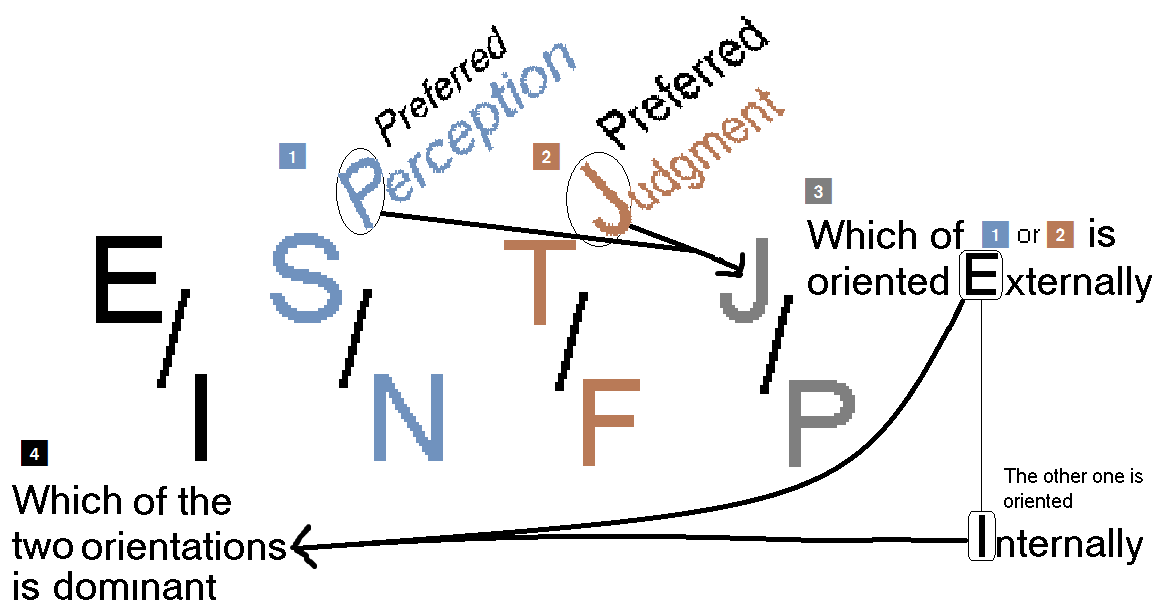
The dominant orientation shapes the orientations of the other functions as well. Thus, the function order is alternated, starting with the dominant, which consists of a function and its attitude.
The second or "auxiliary" function will be the other kind of process; if the dominant is perception; the aux. will be judging, and if the dominant is judging the aux will be perception. It will also be in the opposite attitude of the dominant. This is for the sake of cognitive balance (i.e. supplying data for or "informing" one's dominant judgment, or organizing one's dominant perceptions with rational assessments, and keeping us in touch with both inner and outer realms).
These two determine the type, and the rest of the functions follow in an alternating order.
The different attitudes are distinguished because they change some aspects of the functions within themselves. Data that's received from or shaped by the environment (outer world) will be different from that derived or filtered individually (i.e. inner world). So extraverted functions (in addition to sharing the J/P behavior), generally deal in breadth, and have a here-and-now or even "cultural" quality, while introverted functions go more in depth; often including "universals".
So a person can prefer tangible data, but if his orientation is outward, he will prefer current experience received from the outside, while the person who prefers the same tangible data with an internal orientation will instead prefer stored (already learned and internalized) experience, which he will tend to measure current experience by.
I have found it good to express introverted perception as dealing with stored data, and extraverted perception as dealing with emergent data. Extraverted judgment deals with set standards, while introverted judgment deals with variables (that are determined by an internal model of things).
Jung expressed them in terms of the extravert adding (himself, essentially) to the external environment through the function, while the introvert subtracts from it all that is not relevant to his subjective storehouse. The terms he used for these are "introjection" and the more familiar "projection". The extraverted "subject" takes on as his own (introjects) the experience or values of the "object", and the introverted "subject" sees his own perspective in (projects onto) the "object", such as saying "if that were me, I would...".
(These would be the common denominator in the "stored/variable" vs "emergent/set" terms, which are split across the lines of judgment and perception.
However, my terms are a bit more descriptive of the nature of the functions than a simple "add vs subtract". So I'll use both).
We shall explore all of this more.
How the factors/dichotomies are determined; Dividing reality into "I" or "not I", and resultant ambiguous terms such as "subjective/objective" Type is based on the way we cognitively divide reality. It's just like the way we divide spacetime between back and forth, up and down, left and right, and past and future. The dimensions of spacetime remain whole and undivided, but when we look in one direction, we do not see its opposite; yet it is still there, and remains implicit to us as the other pole of the dimension. We have just chosen one direction, and the opposite is basically "suppressed" (in a way) in our consciousness, caused by the limitations of our sight. (And in the case of time, the forces of entropy, which pull us in one direction of "causation". Meanwhile, the perpendicular spatial directions are suppressed in a lesser fashion, as you can see along them partly). We also divide our cognition into taking in information that comes to us (which is basically involuntary), and then making rational (voluntary) decisions with it. These modes of processing are also split. So we divide the information we take in (perceive), into what is clearly observable by our physical senses (“tangible”, “material” or “practical”), and what is not based on the senses, but rather inferred from other data in some way. (And thus, intangible, "hypothetical", "theoretical"). These are the bases of the three main variables in type; two preferred functions (one perception, and one judgment), and orientation. Orientation then becomes split into a third and fourth variable (actually, first and fourth, in the type code), based on which orientation is dominant, and then, which function is oriented environmentally or individually. The dominant function will take on the dominant orientation, so this also tells us which function is dominant. The other preferred function will be “auxiliary” (needed simply because we also must have a preference in other mode of process; both perception and judgment). Right here we see where two of the variables can be associated with the common terms “subjective” and “objective”, which may cause some confusion when these terms are encountered. One is dealing with an individual or environmental orientation, where only the individual is conscious of his own “soul”, and thus everything in the environment {including other people} become “objects”. The other is dividing all of reality directly between impersonal “objects” and personal “souls” {whether individual or environmental}, and making rational assessments based on which of these two categories we are reacting based on. There is "cross-talk" between some other dichotomies as well, such as "concrete/abstract" applying to S/N and i/e. (This will be discussed further in the appendix). David Keirsey Please Understand Me II p331 had said Myers "inherited Jung's error of confusing extraversion with observation (S) and introversion with introspection (N)". (See http://www.teamtechnology.co.uk/keirsey-analysis.html) So he uses "introspective" for N, and yet others get confused, because they still associate introspection with I. Some EN types are said to "look introverted", because N is "introspective". The difference can be seen in all three factors (i/e, S/N and T/F) dealing with the primary polarity in our existence, of "I" vs "not I".
|
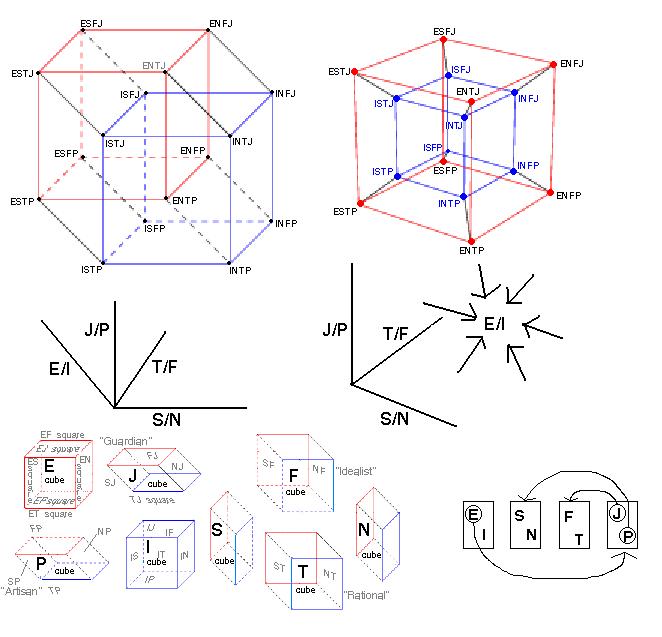
Two tesseract projections of four dimensional MBTI system, with individual "letter" cubes and squares, etc., and the four-letter code system, and how the different letters apply to the others.
Building the Code
It's best to start from the two letters said to develop
first in infancy. According to Brenda Muller of Personality Page; I/E and J/P are the first traits noticed in younger children. Notice, no functions have been identified yet, only the pointer variables (telling us what attitude and position they will be).
This makes up a type grouping that has been called the "sociability temperaments". It is rather
similar to the area of "Inclusion" discussed on the first page. If we take I/E to be "expressiveness", while J/P tends to fit "responsiveness" —(with a couple of important twists discussed later); we can call these "proto-temperaments".
So the four groups we have so far (and their basic meanings in relation to the external world):
EP: expressive, and preferring to experience the external world (proto-Sanguine)
EJ: expressive, and preferring to order the external world (proto-Choleric)
IP: reserved, and preferring to experience the external world (proto-Phlegmatic)
IJ: reserved, and preferring to order the external world (proto-Melancholy)
Most of these will grow into these temperaments, but some won't, depending on the other letters that develop.
It is also easy to imagine how simply experiencing the external world will tend to be more "responsive" than ordering it.
What these two letters tell us cognitively is:
EJ: dominant function will be extraverted, and it will be a judging function (T/F). Auxiliary function will be introverted and a perception function (S/N).
EP: dominant function will be extraverted, and it will be a perception function (S/N). Auxiliary function will be introverted and a judging function (T/F).
With introverts, it's a bit different, because J/P tells you which function is extraverted, yet for an introvert, the extraverted function will be auxiliary rather than dominant:
IP: dominant function will be introverted, and it will be a judging function (T/F). Auxiliary function will be extraverted and a perception function (S/N).
IJ: dominant function will be introverted, and it will be a
perception function (S/N). Auxiliary function will be extraverted and a judging
function (T/F).
The Dominant Function: Our main "world-view"
Soon, the dominant function will develop. This will add a third letter, and also yield Jung's original eight "personality types" (Classics in the History of Psychology -- Jung (1921/1923) Chapter 10):
[ESP] extraverted Sensation type (E-S)
[ISJ] introverted Sensation type (I-S)
[ENP] extraverted iNtuitive type (E-N)
[INJ] introverted iNtuitive type (I-N)
[ETJ] extraverted Thinking type (E-T)
[ITP] introverted Thinking type (I-T)
[EFJ] extraverted Feeling type (E-F)
[IFP] introverted Feeling type (I-F)
So we have one ego, with a dominant orientation, and four functions; only one of which has become dominant.
The process of the first function "developing" was called by Jung, differentiation. The way we in practice describe the "preferred" functions (the first two), and even the third and sometimes fourth, is technically a form of "differentiation". However, Jung actually applied differentiation primarily to the dominant function. The other functions remain in a state called "undifferentiated", where they can come into consciousness when linked to the ego structure set up in relation to the dominant function, or remain unconscious and tied to the emotions. This will be described as we go along.
A function is differentiated when we place greater value on those choices where emotion and reason are in synch.
When we use a function that is destined to become differentiated, we feel an emotional investment in what we're doing, and we feel in control of our emotional life, so we keep on doing it. We tend to be more stimulated by the function. It then appears to "develop" or get "stronger", and behaviors associated with it will increase. We then go from the more "general" to more "special" uses of the function, and then can put together a "type" code.
But the real motivation is deeper than just the behaviors, which often become focused on in descriptions and discussions.
As for the other functions, the whole concept of function preference is based on acceptance
vs. rejection. What the ego accepts as a sense of meaning becomes apart of the consciousness, and what it rejects or suppresses remains unconscious.
"Whatever we habitually put aside to make our willful conscious choices will inevitably make its alliance with the unconscious -- emotions we don't want to feel, desires we don't recognize..." (Lenore Thomson, Personality Pathways)
Another way of putting it is that the unconscious area takes form when the ego's bright light of awareness is focused on one part of reality, plunging the rest into darkness.
So the ego chooses its dominant orientation; the inner world of thoughts and emotions, or the outer world of people and action, to receive its main interpretation of situations through. It also chooses its dominant function (S, N, T or F), as its interpretation in that chosen orientation.
The other orientation and the other functions are initially suppressed. The person is capable of engaging in behavior associated with the other functions (i.e. "general"), but as distinct, "special" senses of meaning by which we have an emotional investment, the functions remain "undifferentiated". They simply remain tied to the emotional responses to life, as mobilized by the dominant function.
In other words, for the type preferring 'at hand' tangible data (the "substance" of what's "known", materially), any intangible conceptualizations or inferences from this data implied (the "idea" of what "guessed", hypothetically) will simply support the emotional investment the person has in that tangible data.
For the person preferring conceptual, inferential data, the tangible 'at hand' reality he sees before him will simply be used to support the inferring process. For the person who prefers technical ("true/false" according to impersonal mechanics) criteria for decisions, any humane "value" ("good/bad" according to the affect on living souls) he places on them will support his Thinking, rather than being a differentiated "Feeling" process. And for the person who prefers humane considerations, any logical, technical conclusions will support the humane endeavor somehow. What determines the true "preference" is not the "function" you might see him "using" at any given time, but rather the ultimate perspective it is supporting.
The opposite functional perspective is always implicit in a situation, because when we look at it through a function and orientation, we are in essence dividing the situation that in complete form consists of both material and hypothetical, mechanical and soulish, and environmental and individual aspects
So if I pick out of a situation the mechanical elements I individually (subjectively) subtract from (i.e. I pick it apart to determine what is true or false), then the soulish elements I would have to objectively add myself to (i.e. good/bad as determined by the environment or culture) are implicit, in having basically been differentiated or set apart. This will come out as a particular neglect of the environment of people in the logical analysis, and as the ego matures, this will start to become a "nagging" issue (e.g. "how others feel" about us), that we eventually will begin to integrate more into our consciousness.
Type theorist Lenore Thomson has compared this state to embryonic cells, which have not yet taken on their specific functions in the developing body (they start out all the same, yet some will become brain cells, others, skin cells, etc.). A differentiated cell focuses on that task, and then the information offered by other genes is blocked biochemically, and only genes that permit the cell to perform its task remain active. (Personality Type: An Owner's Manual, p.86). The functions in that state are not even differentiated from each other. They are not really separate entities waiting for us to "develop" skills associated with them, as we have often made them out to be. The symbols and images generated by the psyche will reflect admixtures of these functional products.
So the entire key to this whole thing is that when you choose one function, the perspective of the other is rejected or suppressed, and when you choose one orientation to use a function in, the other orientation is rejected or suppressed for its use as well.
This would also explain why I/E and J/P would be the first letters to develop. All that is known at first is that you are internally or externally focused, and either rational or a-rational (or "irrational"). These are Jung's terms for judgment and perception. Since judgment functions, both Thinking and Feeling deal with conscious cognition, they are considered rational, while perception is more involuntary, and thus not rational. In this very early stage, the kind of rational or a-rational data that will be preferred (true/false vs good/bad; or what's tangibly known vs inferred ideas) hasn't differentiated yet. But for when they do, the types are deemed "rational" or "a-rational" based on this dominant or first function that develops.
EJ=extraverted Rational, EP=extraverted a-rational, IP=introverted rational and IJ=introverted a-rational.
Notice that for the introverts, the J and P seem reversed. Even though the terms are basically synonymous with judgment and perception, we cannot readily translate the terms and call them "J and P types", because the J and P, as was mentioned, refer to the preferred extraverted function, not the dominant one! So again, for extraverts, it will line up properly, yet introverts will be dominant "j" (rational) with an extraverted "P" in the code, or dominant "p" (a-rational) with extraverted "J" in the code.
(Socionics, the Russian version of type theory, aimed to correct that by making [a lowercase] "j/p" refer to the dominant function, as will be addressed later).
The rationality (i.e. rational vs a-rational) of the dominant function, while deemed less important than the rationality of the preferred extraverted function by Myers; it may still be helpful to know in determining type, as people often may know their two preferred functions, but not be sure which is dominant. But the dominant is the ego's main approach to the world, and so the rationality does shape this.
An "a-rational" type [E__P or I__J] is one who's primary outlook is recognizing "what is" (whether tangibly "known"[S] or mentally "guessed"[N]). They will live to "take in" information to inform their judgments.
A "rational" type [E__J or I__P] is one whose primary outlook is determining "right" or "wrong" (whether impersonal "truth"[T] or humane "goodness"[F]). They will live to form decisions out of their perceptions, and to somehow make "right" what is deemed "wrong" (even if mentally rather than always implementing things).
Thus, T and F are just two sides of the "rational" coin, and S and N are two sides of the a-rational coin. And then if these function coins are split along the edge into separate coins in themselves, the different orientations of them are just different sides of those coins. While Jung did later supposedly make introversion and extraversion essentially properties of the functions (such that I/E became little more than "the dominant function attitude"), initially, they were properties of the ego, as they were in our old temperament matrix. It's the ego that chooses an internal or external preference. And this I have found is the best way to build and understand the model.
The Auxilary and the Complete Type
When the auxiliary function develops, then the type code is complete.
From here, we usually get into the alternating "attitudes" (the i/e orientations) of the functions.
For now, the best way to look at it is to keep thinking of the dominant orientation (I/E) along with the dominant function and its auxiliary.
This yields:
ESTP: E-ST (Extraverted Sensing with Thinking)
ESFP: E-SF (Extraverted Sensing with Feeling)
ISTJ: I-ST (Introverted Sensing with Thinking)
ISFJ: I-SF (Introverted Sensing with Feeling)
ENTP: E-NT (Extraverted iNtuition with Thinking)
ENFP: E-NF (Extraverted iNtuition with Feeling)
INTJ: I-NT (Introverted iNtuition with Thinking)
INFJ: I-NF (Introverted iNtuition with Feeling)
ESTJ: E-TS (Extraverted Thinking with Sensing)
ENTJ: E-TN (Extraverted Thinking with iNtuition)
ISTP: I-TS (Introverted Thinking with Sensing)
INTP: I-TN (Introverted Thinking with iNtuition)
ESFJ: E-FS (Extraverted Feeling with Sensing)
ENFJ: E-FN (Extraverted Feeling with iNtuition)
ISFP: I-FS (Introverted Feeling with Sensing)
INFP: I-FN (Introverted Feeling with iNtuition)
The Tertiary and Inferior
For each type, the other two functions will follow the ones denoted, in an inverse order. If the dominant and auxiliary are TS, then the next two, the tertiary and inferior will be N and F, in that order. For ST, it will be FN; for NF, it will be TS, and for FN, it will be ST. They basically "reflect" the first two.
These will be the functions suppressed from the preferred position. We initially tend to ignore or at least pay less attention to them, and often feel vulnerable in some way or another through their senses of meaning when forced to deal with them. We then project this onto others. This is the basis of a full model of cognitive dynamics we are leading to.
So to list out the different combinations of four:
STFN (I=ISTJ; E=ESTP)
SFTN (I=ISFJ; E=ESFP)
NTFS (I=INTJ; E=ENTP)
NFTS (I=INFJ; E=ENFP)
TNSF (I=INTP; E=ENTJ)
TSNF (I=ISTP, E=ESTJ)
FNST (I=INFP; E=ENFJ)
FSNT (I=ISFP; E=ESFJ)
(Note that changing I/E for types with the same function order also changes J/P. This is because that last dichotomy changes the orientations of all the functions, including the dominant).
Alternation of Functions and attitudes
What we see here is an alternation between rational and a-rational functions. To use the j/p notation, it is either jppj, or pjjp. (Recall, j = T/F = rational, and p = S/N = a-rational). This forms what are known as tandems, where the dominant and inferior are the same sort of function (judgment or perception), as are the auxiliary and tertiary.
There also are simply the consecutive pairs, which in Socionics, are called "blocks".
The dominant and auxiliary, will be more developed and mature, and the tertiary and inferior (when they develop, in coming years) will be less developed and immature, from being initially rejected and thus lower on the acceptance order from the first two. This will set the stage for the archetypal roles or complexes mapped to the functions.
Since it is the first two that define the type, we can now add the orientations as attitudes of the functions, and what we end up with is this:
ESTP: S(e)T(i)
ESFP: S(e)F(i)
ISTJ: S(i)T(e)
ISFJ: S(i)F(e)
ENTP: N(e)T(i)
ENFP: N(e)F(i)
INTJ: N(i)T(e)
INFJ: N(i)F(e)
ESTJ: T(e)S(i)
ENTJ: T(e)N(i)
INTP: T(i)N(e)
ISFP: F(i)S(e)
ESFJ: F(e)S(i)
ENFJ: F(e)N(i)
ISTP: T(i)S(e)
INFP: F(i)N(e)
Preferred vs nonpreferred functions
With the concept of "suppression" in mind, we can see why, when a person who is geared to focus on technical things (true/false), and normally suppresses or ignores the human-related ones (good/bad) is forced to deal with the latter, such as in a situation where his life is severely affected, it may trigger a strong negative reaction, which is all the repressed emotions erupting from the unconscious. Again, the part of him that is in touch with the "personal" side of life he feels is tied up with emotions he feels he cannot control.
Likewise, when someone normally focused on the humane is forced to deal with the technical, this might also negatively erupt in some way, as the part of themselves that would put logical efficiency first feels cold and inhuman to them. They'll likely do something like use cold logic to attack someone else's logic (but in a more reactive way than the T normally doing the same).
As an example of the problems that can erupt from the emotions involved with the functions, when someone has a negative "Feeling" reaction, I project how I would have to have been feeling in order to react that way, and assume that person must be that upset, and then feel very defensive, and might lash out in kind. The other person (who might not be that upset) will then wonder why I "overreacted".
Extending this to the perception functions, for someone normally focused on the tangible (substance of what is known), the part of himself that focuses on the conceptual (ideas that are guessed) might seem spaced out or unrealistic, while for the person preferring the conceptual, the part of himself preferring the tangible might seem unimaginative or fatalistic.
This will be more pronounced for the inferior function, because it is the most suppressed from the dominant being the most preferred. (This is covered most extensively by Naomi Quenk, Was That Really Me? How everyday stress brings out our hidden personality, Davies-Black, 2002). The tertiary, as we will see, will likely become strong sooner.
In this light, it should be reiterated out that these functions are best understood as "perspectives", rather than as behaviors, skills sets, or entities that do things, as type discussions often fall into treating them as. Again, we do not see a whole undivided reality. Just as we divide space and time into two "directions" for each dimension, we also divide the world cognitively.
Definitions of the Function Attitudes
From here, we can pick up discussing function orientations. So we can see how the auxiliary function is in the opposite orientation from the dominant, and these two functions with their attitudes determine the type and are normally notated as follows:
| ISTJ: SiTe | ISFJ: SiFe | INFJ: NiFe | INTJ: NiTe |
| ISTP: TiSe | ISFP: FiSe | INFP: FiNe | INTP: TiNe |
| ESTP: SeTi | ESFP: SeFi | ENFP: NeFi | ENTP: NeTi |
| ESTJ: TeSi | ESFJ: FeSi | ENFJ: FeNi | ENTJ: TeNi |
The functions have now been differentiated according to e and i, basically fanning them out from four to a total of eight: Se, Si, Ne, Ni, Te, Ti, Fe and Fi (which are often called "processes", but more properly designated "function-attitudes". There are also collective notations for extraverted or introverted Judgment or Perception: Je, Ji, Pe, Pi).
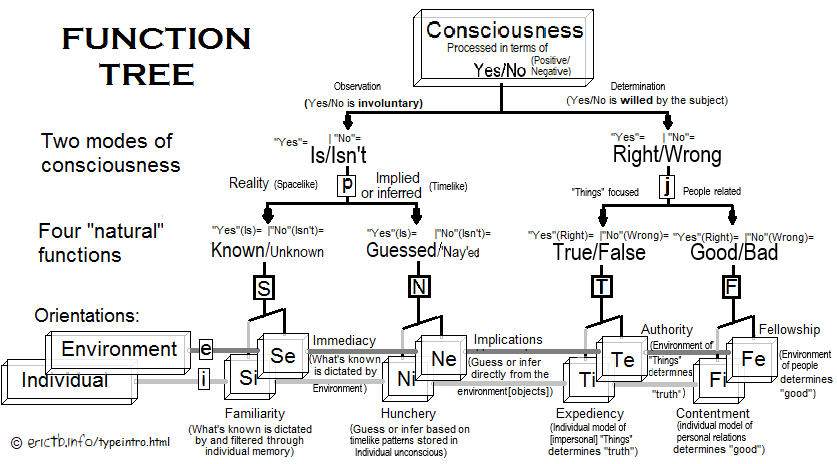
So now that we have identified these eight processes, we can look into what they actually are. There are many different descriptions of them, but I find it is better to start with elemental definitions.
i [internal: individual subject] or e [external: environmental object] represent:
S: source of tangible sense impressions
N: source of inferred impressions
T: standard of technical efficiency
F: standard of human behavior, harmony
The "proclamations" or command each function makes:
S: “behold!” (the environment or via individual recollection).
N: “imagine!” (inspired by objects in the environment, or images that come up from within)
T: “true!” (determined by environmental dictates or individual reflection).
F: “good!” (determined by environmental values or individual reflection).
Here are the combinations that result, in the common terminology and definitions or associated processes:
Se: concrete perception in an outer orientation (current physical sensation)
Si: concrete perception in an inner orientation (memory, learned "facts", internal bodily sensations)
Ne: abstract perception in an outer orientation (ideas and multiple "possibilities")
Ni: abstract perception in an inner orientation ("foreseeing"; "meta-perspective")
Te: logical judgment in an outer orientation ("organizing" for efficiency)
Ti: logical judgment in an inner orientation ("analyzing" with internal "frameworks", "principles", etc)
Fe: value judgment in an outer orientation ("connecting" socially; "considering others")
Fi: value judgment in an inner orientation ("evaluating importance", "what one wants", etc).
What I find are the most concise root definitions:
Se [spacelike] object recognition in the [outer reality of the] environment
Si [spacelike] object recognition in the [inner “image” or “model” of the] individual
Ne [timelike] pattern recognition in the [outer reality of the] environment
Ni [timelike] pattern recognition in the [inner “image” or “model” of the] individual
Te [impersonal] truth determination in the [outer reality of the] environment
Ti [impersonal] truth determination in the [inner “image” or “model” of the] individual
Fe [human] affect determination in the [outer reality of the] environment ("interpersonal")
Fi [human] affect determination in the [inner “image” or “model” of the] individual ("intrapersonal")
A little more detail:
Se: awareness of material reality in the environment (turn outward for attention to immediate at hand objects, such as physical/practical items, as it occurs)
Si: awareness of material reality filtered by individual knowledge (turn inward to compare at hand data such as physical/practical items with a storehouse of fact and experience)
Ne: awareness of hypothetical reality inferred from the environment (turn outward to "fill in" experience of objects with mental/ideational constructs such as connections or patterns)
Ni: awareness of hypothetical reality inferred by individual impressions (turn inward to subject's unconscious to "fill in" mental/ideational constructs with connections like "hunches")
Te: assessment of "correct/incorrect" (mechanical "truth") by an environmental/cultural standard (turn outward to objects to determine their proper relationship to each other)
Ti: assessment of "correct/incorrect" (mechanical "truth") by an individual/natural standard (turn inward to internal "blueprint" of proper relationship between objects)
Fe: assessment of "like/dislike" or [soulish] "good" by an environmental/cultural standard (turn outward to evaluate proper relationship involving/between people)
Fi: assessment of "like/dislike" or [soulish] "good" by an individual/natural standard (turn inward to internal "blueprint" of proper relationship involving people)
A compromise:
Se: recognition of what's known in space is stimulated by the environment (as it emerges in the external world)
Si: recognition of what's known in space is stimulated by individual reference (filtered through internal recollection)
Ne: recognition of what's guessed through time is stimulated by the environment (one pattern implies another “externally”)
Ni: recognition of what's guessed through time is stimulated by individual reference (looks outside time to the internal subconscious)
Te: determination of what’s correct (true/false) is stimulated by the environment
Ti: determination of what’s correct (true/false) is stimulated by individual reference
Fe: determination of what’s desired (good/bad) is stimulated by the environment
Fi: determination of what’s desired (good/bad) is stimulated by individual reference
We can also look at the common human "faculties" they are associated with; like Se involving the basic senses, of touch, taste, sight, hearing and smell, and Si being involved with "memory", where we store our sensory experiences to bring back up to consciousness to compare with current experience. Also, especially for the perception functions, the neural imprint being made (as neurology is naturally the foundation of cognition).
The eight faculties (and associated perspectives are:
Current sensation (associated with Se products; stimulation via space) —obviosity
Memory (associated with Si products; stores and filters spatial data) —familiarity
The 'imagination' (associated with Ne products; of potential changes through time) —implications
The unconscious (associated with Ni products; filters temporal patterns) —hunchery
Common Sense (associated with Te products; learning from outside authority how things work) —authority
Reason (associated with Ti products; learning or determining for yourself how things work) —expedience
Sociabilty (associated with Fe products; connecting with people via the environment) —fellowship
The conscience; personal "feelings" (associated with Fi products; our own human values used to relate to others) —sensibilities
The NEUROLOGICAL connections; what's actually going on in the brain:
Se: Neural connections made by CURRENT, DIRECT input
Si: Neural connections made by PREVIOUS, DIRECT input
Ne: CURRENT neural connections from INDIRECT input
Ni: PREVIOUS neural connections from INDIRECT input
Te: Previous neural connections instruct current ones based on impersonal objects
Ti: Current neural connections matched with previous ones based on impersonal objects
Fe: Previous neural connections instruct current ones based on our emotional state
Fi: Current neural connections matched with previous ones based on our emotional state
Now, the natural mistake to make is to define simply "Se=current experiences" and "Si=memory", and so on. This is not totally true. For one thing, only certain types have a normal preference for Se or Si, but every person has both current sensation and memory! So the function-attitudes are specialized attention to the data taken in through the faculties, as used by the ego-structure.
How we divide reality into the functions and attitudes All self-conscious beings perceive data (of what exists) through imagery.
When the images are based directly on physical material (superstrings in space vibrating in a way that produces fields that other superstring fields cannot pass through, including those making up our bodies; and thus stimulates our nerve sensors and reflect photons and other waves which also stimulate sensors), then we are experiencing sensation (S), and we call these fields “material”, and can say that it is empirically “what's KNOWN”. The material reality forces everyone to agree with what image is seen (even if they try not to see it, or interpret it as something else). If the imagery is not backed up by the material experience, then it is merely inferred (may or may not exist, but we haven’t verified it yet), or is imagined (put together in our minds, such as “stories”, “big pictures”, “meanings”, etc.) and is thus “hypothetical”, or described as “GUESSED”, (or "could be", which implies time), and the function is iNtuition (N). These are more fluid and subject to individual interpretation. That’s why topics such as religion and politics often end up becoming endless disputes, and thus so heated (and avoided by some). All self-conscious beings assess things as right or wrong. What’s right is what we [rationally] strive for, and what’s wrong is what we seek to make “right”. If the sense of right or wrong is from reactions that are based on the effect of objects based on the mechanics of their own properties, we speak of things being “true” (versus “false”) or “correct” or not, and the function is called Thinking (T). If the sense of right or wrong is from reactions that are based on the effect of objects on our own souls, we speak of things being “good” (versus “bad”) or “liked” or not, and the function is called Feeling (F). Each ego prefers one function, and either the environmental (“extraverted”) or individual (“introverted”) focus. Since we have to both take in information (“perceive”), and determine right/wrong (“judge”), then each ego will have an "auxiliary" preference for the other mode of processing from its dominant. This will also take on the unpreferred orientation. From here, we are able to identify 16 “types”. The ego or various ego states (which mirror the ego's consciousness) will then reference the other functions (which will mirror the first two) as needed. |
The extraverted functions and Si are fairly easier to understand. It's the remaining three introverted functions that often give a lot of people a hard time, and even get confused with each other. Ni is particularly the (infamously) hardest to understand. (It is generally recognized in the type community that introverted functions are "deeper", and being essentially "internal", not as easy to pinpoint. And while Ne is easier to understand on the surface, sometimes it's hard to tell which is which between the two attitudes of iNtuition understandably since it deals with the "abstract", and this can happen for T and F as well, due especially to confusion about the introverted variants).
Using the concept of "images" in the table (for perception, and "mechanical vs soulish" for judgment); I think I've come up with the best way to understand all of them:
Se: individual’s images match current environment
Si: individual’s images ONCE matched the environment, but currently can only be held among individuals sharing the experience
Ne: individual’s images do not [necessarily or currently] match environment, but are still based on the environment (and thus others can possibly be made to experience them)
Ni: individual’s images do not [necessarily or currently] match the environment, and can only be directly perceived by the individual.
(and hence, why it’s so hard to explain).
Te: individual’s assessment of true/false (mechanics of the situation) are determined by the environment.
Ti: individual’s assessment of true/false (mechanics of the situation) are determined by individual reflection.
Fe: individual’s assessment of good/bad (soul-affect of the situation) are determined by the environment.
Fi: individual’s assessment of good/bad (soul-affect of the situation) are determined by individual reflection.
Another way of looking at it is that in deciphering the two different attitudes of each function, the question to ask is:
WHAT is creating the actual sensation? (the object in the environment, directly, or the subject’s individual storehouse of memory)
WHAT is creating the actual intuition [i.e. pattern connection]? (the object in the environment [directly implies connection to something else] or the subject’s individual unconscious impressions [which infers connections by some other means than the object itself])
WHO is really doing the actual Thinking? (the subject, or an object; i.e. Other person, group, computer; e.g statistics, etc.)
WHO is really doing the actual Feeling? (subject, or an object; i.e. other person, group, culture).
We will explore other ways of describing these in the appendix.
Simple type descriptions based on definitive dominant perspective and auxiliary function
Even though each type code is defined by the dominant and auxiliary functions, the dominant is the one the ego really invests in. The auxiliary is just there, supplied by a “supporting” complex or ego state (as we shall see next), because of the need for balance (to balance the dominant’s judging or perception with the opposite mode of rationality, and the dominant’s introverted or extraverted attitude with the opposite).
So to start with the NP's, which are types most common in type discussion, and often wonder which function is really dominant:
INTP:
Ti ego: lives for the proclamation of “true! true! correct! correct!” as determined by the individual. Like I look back over my writings, [type, politics, other interests, etc.], noting the key points, and subconsciously relishing “true!” via the emotions (which are based on an impersonal declaration of "truth", not on the emotional state in its own right). Things that are “false” bring very negative emotions, especially when affecting the ego, but at other times, can be totally trivial, like simple lack of symmetry of something. A nice symmetry brings a warm feeling of an un-spoken “true”. Broken symmetry will feel dissonant.
Ne support: draws them to the "philosophical" side of things; shares truths as “ideas”, telling others to “imagine” them as possibilities, to see the truth in them, or how they work.
ENP:
Ne ego: lives to “imagine! imagine!” Already geared to the environment (patterns extracted from real life), it's not initially as much about sharing with others. It's for them to relish the world of ideas, and then share them via their Ji perspective. (Will not be as grounded upon “truth” or “goodness” as the Ji dominant. This was brought to mind by someone on a transit forum, who always puts out wild ideas of how to rearrange subway lines, even though many have shown him they will never be seen as efficient by the Transit agency. I myself had begun coming up with all sorts of ideas years ago, but quickly learned [and then internalized] the agency's principles of how to run things (and this even before working for the agency myself). The fact that his focus is so strongly on technical judgments of how to arrange things suggests a strong "mechanical" focus, and they are totally his judgments; ignoring the judgments of the external authority. So it's Ne being perhaps a bit overdriven, and thus not grounded enough with the T judgment of whether the principles behind the ideas are "correct", and, which when dominant and more mature, would also know when to back itself up with the opposite attitude. An ENFP with an overdriven dominant will have more of a "personal" focus, but not enough to ground the ideas to see they are not really doing anything for the people.
Ti support (ENTP): draws them to the mechanics of things, and shares imaginations by showing others how the ideas work.
Fi support (ENFP): draws them to the human side of things, sharing imaginations by showing others how the ideas affect people, like spreading happiness through “silliness”, or using theories like this to improve self and personal relationships
INFP:
Fi ego: lives for the proclamation of “good! good! nice! nice!”. I imagine they might look back over their writings, noting the key points, and subconsciously relishing “good!” via the emotions, which are what are focused on.
Ne support: shares niceties as “ideas”, telling others to “imagine” them as possibilities, to see the goodness in them.
ISTP, ISFP
Se support: draws them to the practical side of things; shares truths or niceties as practical experience such as the arts, mechanics, etc. showing others how tangible things work, or how to experience the joys of life
ESP:
Se ego: lives to take in “what is”. Already geared to the environment, where emergent data is taken in ‘as is’, it's not initially as much about sharing with others. It's primarily for them to relish the moment of tangible reality and then share the experiences with others via their Ji perspective. (Will not be as grounded upon “truth” or “goodness” as the Ji dominant. If too overdriven above a Ti sense of how things work, a person may do all sorts of stunts figuring from Se alone that he's mastered it, and yet make critical mistakes and get hurt. If too overdriven above an Fi sense of what affects people, may engage in offensive verbal or physical play).
Ti support (ESTP): draws them to the mechanics of things, and shares experiences by showing others their sense of how the dynamics of them work.
Fi support (ESFP): draws them to the human side of things, sharing experiences by showing others their sense of how they affect people, like spreading happiness through “fun”, or using internet venues like this to interact with others.
ISJ:
Si ego: lives to draw on the experience of what “is”, as maintained and filtered by the individual. Relishes what's “known”, used to navigate what currently “is“.
Te support: (ISTJ): draws them to the mechanics of things, and shares practical knowledge by showing others how they work to produce efficiency.
Fe support (ISFJ): draws them to the human side of things, sharing practical knowledge by showing others how to meet needs, like spreading happiness through service (Fi dom. “pure” Supines, in contrast, serve 'actively' via inferior Te, through which they are seeking acceptance in return. They're not adopting the environment's values, but rather environmental efficiency, though in a subordinate way. For more on this, see Supine “service”: introverted or extraverted Feeling?).
INJ:
Ni ego: like Ne, lives to “imagine! imagine!”, but now the patterns are extracted from the individual's own reflection or sudden insight, which do not come directly, immediately from the environment. This is for them to relish an internal world of ideas. (Will not be as grounded upon “truth” or “goodness” as the Je dominant)
Te support: (INTJ): draws them to the mechanics of things, and shares their visions by showing others how they work to produce efficiency.
Fe support (INFJ): draws them to the human side of things, sharing their visions by showing others how to meet needs, like spreading harmony through giving insights.
ETJ:
Te ego: lives for the “truth” of efficient order. Will point to “objectivity”, but the ego still is gratified, relishing the “correctness” of how things work in creating order and frets at “incorrect".
Si support (ESTJ): draws them to the tangible side of things, drawing upon their individual knowledge of “what is” in how to create efficiency.
Ni support (ENTJ): draws them to the philosophical side of things, drawing upon their individual visions of how to create efficiency.
EFJ:
Fe ego: lives for the “goodness” of environmental personal harmony. Relishes “good!” “nice“, “liked” in the environment, and frets at “bad” or “disliked” as well.
Si support (ESFJ): draws them to the tangible side of things, drawing upon their individual knowledge of “what is” in how to create interpersonal harmony.
Ni support (ENFJ): draws them to the philosophical side of things, drawing upon their individual visions of how to create interpersonal harmony.
We can sum up the basic "natural" (i.e. regardless of attitude) function preferences (the middle two letters) as such:
ST: practical mechanics ("realistic"; what really works)
SF: practical anthropinism ("aesthetic"; what really helps people)
NT: philosophized mechanics ("rationalistic"; the idea/theory of what works)
NF: philosophized anthropinism ("idealistic"; the idea/theory of what helps people)
The standard four function-attitudes of each type
While it is agreed that the auxiliary and inferior functions manifest the opposite attitude from the dominant, the tertiary was later determined by most (at least in common type discussion) to be in the same attitude. This theory has been attributed to type theorist Harold Grant. (See "Developing Models and Beliefs: Reviewing Grant, Thompson & Clarke's Image to Likeness after 20 years of life and type", Peter Geyer; c.Grant, Thompson & Clark, 1983. The MBTI Manual, however, leans toward Jung's view of the tertiary being the opposite attitude, while Naomi Quenk has it being either attitude, usually leaving off its attitude notation. This shall be addressed more, shortly).
So the order of attitudes is eiei or ieie
The functions (now with the attitudes) end up interlinking into tandems based on:
Pe: "Emergent" data: external perceptive source
Pi: "Stored" data: internal perceptive source
Je: "Set" criteria: external judgment standard not determined by the subject
Ji: "Variable" criteria: internal judgment standard requiring more detailed, "deep" analysis by the subject
With this, we see that the type-defining dominant and auxiliary must be balanced as JePi or PeJi because:
Emergent data (Pe) produces variable situations (Ji)
Stored data (Pi) is best for set procedures (Je)
The tertiary and inferior for each type will again "mirror" (reflect) these in both function and attitude, forming the tandems.
Using our definitions of the functions, the tandems come together as follows:
SeNi: the substance of experience is observed as it emerges from the environment, so the ideas of things are taken from an individual arsenal of subconscious impressions
NeSi: ideas of things emerge from the environment, so observations of the substance of experience is compared with an individual arsenal of facts.
TeFi: technical (impersonal) true/false assessments are set, so anthropic (personal) good/bad assessments must then be variable in deference.
FeTi: anthropic good/bad assessments are set, so technical true/false assessments must be variable, in deference to them.
They've also been expressed as:
TiFe: "I think, we feel"
FiTe: "I feel; we think"
I've never seen this one, but by extension:
SeNi: explore the emerging experience, internalize the meanings
NeSi: explore the emerging meanings, internalize the experience
On the flipside, if the variable judgments are preferred, the person will realize he needs to reference a set standard (in the opposite functional perspective) to promote his personal/universal conclusions with the outside world. Or, perhaps, feeling vulnerable in that area, he'll leave the external world to "do all the work" in setting the standards.
These tandems have finally been given a name! In the new model being developed by Linda Berens and Chris Montoya, the tandems have been tentatively labeled as such:
Se/Ni: "Realizing Awareness"
Ne/Si: "Inquiring Awareness"
Te/Fi: "Ordering Assessments"
Fe/Ti: "Aligning Asessments"
The names make sense, as Se and Ni will tend to take things as they are, and simply "realize" something from the data; Se just taking it "as is" from the external world, and Ni filling in a pattern from internal impressions or images that come up. Si and Ne, on the other hand, both basically "compare" data (comparing tangible data with internally stored facts, or comparing one external [intangible] pattern with another to infer their "interconnections"), relying more on memory. Hence, a lot of "inquiring" is necessary to make the comparisons (to what's in memory).
Assuming "order" being logical, Te will be most externally visible, and Fi will support it from internally. Ti's internal logic is more variable, so both it and its companion external Fe expression will tend to "align" things accordingly.
These make up the groups at the center of the new model, the "Intentional Styles" (working title, "Cognitive Styles"), which are the four groups of four types sharing both perception and judgment tandems:
"Enhancing" (Ne/Si + Fe/Ti: SFJ/NTP)
"Customizing" (Se/Ni + Fe/Ti: STP/NFJ)
"Orchestrating" (Se/Ni + Te/Fi: SFP/NTJ)
"Authenticating" (Ne/Si + Te/Fi: STJ/NFP)
The premise is that the title of each group is the common “intention” of the types in the group.
Another writer, Micheal Pierce, Motes & Beams: A Neo-Jungian Theory of Personality (2020, self-published) also names the groups, which he considers "the four temperaments". He starts by making some observations I had long made: S and T are very "factual", while N and F have more of a "human" element of "meaning". So S and T he calls "denotative", while N and F are "connotative". Also, I had long noted, S and T are more "objective", and N and F more "subjective". As was discussed in an inset above, extraversion is also considered "objective", and introversion "subjective". So in the pairing of functions with attitudes, when "objective" and "subjective" match up in function and attitude (denotative + extraverted; connotative + introverted) the resulting function tandem is what he calls "contextual" (Se-Ni and Te-Fi). The functions tend to look directly at reality, in the immediate contexts. When they are mismatched (denotative/introverted, and connotative/extraverted), the function tandem is "universal" (Ne-Si, Fe-Ti). The flow from subject to object is interupted, and the validity of one's own context can no longer be taken for granted. (p33-4). (Here we see the parallels to "Realizing vs Inquiring"; but the judgment tandems are bundled in with it as well! So it would stand that "Realizing" and "Ordering" are both together as "contextual", while "Inquiring" and "Aligning" are together as "universal").
So putting this all together, he ends up with:
"Monarchic" (Se/Ni + Te/Fi: "contextual" perception and judgment)
"Democratic" (Ne/Si + Fe/Ti: "universal" perception and judgment)
"Anarchic" (Ne/Si + Te/Fi: universal perception, contextual judgment)
"Theocratic" (Se/Ni + Fe/Ti" contextual perception, universal judgment)
Both of these models are outlining the same type groups as those commonly known in Socionics, which are called the "quadras").
All of these groups are very useful to refer to, as often people seeking a type (or those helping them on the type boards) will know which function or even the function tandem they prefer, but could previously only refer to them by such clunky and misleading terms as "Ti/Fe user".
What also emerges from the function order is yet another set of pairings: the alternating functions, which have the same orientation, such as the dominant and tertiary, or the auxiliary and inferior. These are called introverted or extraverted "faces" (Ross Reinhold, Personality Pathways).
The dominant/tertiary pair are also frequently referred to (unofficially) as a loop. This especially when the tertiary "inflates" (ego uses it to try to appear more confident in that perspective than it is), or the auxiliary is otherwise not being used much, and thus the person is operating out of their dominant face, and thus the dominant attitude in an unbalanced fashion. They are then said to be stuck in a "loop".
| position | "a-rational" order | "rational" order | "I" order | "E" order | preference |
| Dominant | perception (S or N) | judgment (T or F) | Introverted | Extraverted | Preferred |
| Auxiliary | judgment (T or F) | perception (S or N) | Extraverted | Introverted | Preferred |
| Tertiary | judgment (F or T) | perception (N or S) | Introverted | Extraverted | Non-preferred |
| Inferior | perception (N or S) | judgment (F or T) | Extraverted | Introverted | Non-preferred |
So what we now have is this:
ESTP: Se-Ti-Fe-Ni
ESFP: Se-Fi-Te-Ni
ISTJ: Si-Te-Fi-Ne
ISFJ: Si-Fe-Ti-Ne
ENTP: Ne-Ti-Fe-Si
ENFP: Ne-Fi-Te-Si
INTJ: Ni-Te-Fi-Se
INFJ: Ni-Fe-Ti-Se
ESTJ: Te-Si-Ne-Fi
ENTJ: Te-Ni-Se-Fi
ISTP: Ti-Se-Ni-Fe
INTP: Ti-Ne-Si-Fe
ESFJ: Fe-Si-Ne-Ti
ENFJ: Fe-Ni-Se-Ti
ISFP: Fi-Se-Ni-Te
INFP: Fi-Ne-Si-Te
This is the model most widely used across MBTI theory and discussions. We can now see the total of eight processes, and how the symmetrical first/last and middle functions are opposite in both function and attitude. However, in traditional MBTI use, only the four shown for each type are discussed.
Yet this naturally might raise the question of what about the "other four" processes for each type. This is where we move toward an "eight-process model".
What really sets the function order?
This is a question commonly asked in typology discussions.
First, since the notion of "eight" functions is formed by the attitude, we need to address that more, and start by going back to the dispute of which orientation the tertiary function takes. We already discussed the "mirroring" dynamic that assigns the ["natural"] tertiary function (i.e. without regard to attitude yet) as opposite of the auxiliary. Now we will look at what makes the attitude opposite as well. From there, the remaining function order will fall into place.
We got a clue to the source of this order, above, in looking at how one pair of functions is preferred, and the other pair are suppressed; either ignored or disowned within ourselves, and projected onto others. This sets the basis for this next concept. So now, we appear to jump to an advanced level of the theory.
That's because the key to understanding exactly how functions play out in each type and even why they fall into the order they do are the archetypes.
Jung's larger theories included hundreds of archetypes, which are "character roles" of sorts, within the psyche. These can be considered "emotionally freighted images", often associated with undifferentiated ("general" and unconscious) functions. A handful of them began to be associated with the function positions in each type (which would be additional "special" uses), most notably by Jungian analyst John Beebe.
Archetypes (the term meaning "ruling patterns") are basically defined as "a way of organizing human experience that gives it collective meaning". Hence, like the functions themselves; they and their differentiation are tied into our emotional reactions.
When an archetype fills up with a person's individual experiences, it becomes known as a complex. This may be defined as the conglomeration of images, memories, and emotions surrounding an archetypal core, but unique to ourselves. The best way to understand complexes, are as "ego-states". The ego (our main sense of "I", and itself a “complex”) is divided into numerous “states” representing discrete (though not totally conscious as such) lesser senses of “I” (which are also complexes. Explained more in the section on "Archetypes"). These "use" various functions as well, and are what will set the order all eight have been placed in, based on the level of consciousness they [the complexes] represent. (This is still not necessarily a hard "order" of relative "strength", though).
So one such human experience or sense of "I" involves "heroically" solving a problem. That is one archetype. Another experience or sense of "I" involves supporting others. Another one is looking up to others to support us. And another is finding completeness, through something "other" than ourselves (including attraction to the opposite gender).
The primary archetypal roles and attitude order
As was alluded to, it was originally assumed that all three of the non-dominant functions took on the non-dominant orientation. Jung believed all undifferentiated functions would be mixed together in the attitude of the unconscious, with the auxiliary being the one to offer the type's best shot at attitudinal balance. This led to a dispute about the exact order of functions, when the orientations would be assigned to them as "function attitudes".
So what will help decide this is to begin noting these different archetypal roles the functions play.
The dominant function, being the ego's most preferred, will tend to play out in a "heroic" role, as would figure.
The auxiliary, which is also mature and confident, will be more supportive, of both our dominant function, and we will tend to use it to help others. This had thus been identified as playing a "parental" role.
The tertiary function will be less mature and confident.
Compared to the others, it will manifest a childlike quality, as we look up to others and seek approval. It is also what we tend to associate with innocence and finding relief. (Beebe did an interview with an ENFP whom he described as an "eternal student of type theory" with her Te).
It has been associated with Jung's "puer aeternus" or "puella aeterna" archetypes. It is said to "inflate" itself in childlike enthusiasm, but then "deflate", when its vulnerability surfaces again.
The inferior is the most rejected function. Yet, we deep
down inside (only partly consciously) feel an incompleteness
without it, or “aspire” to it. It will thus be the most vulnerable, and even associated with "inferiority complexes". It also ends up being associated with the opposite sex.
Beebe, who identified the other three roles, connected this one with Jung's "anima/animus" complex. It is also likened to the "soul".
So the way the tertiary question can be resolved, is to see that all three views (dominant, opposite or either attitude) are right, though in different instances. The tertiary may well default to the opposite attitude, initially, but it is likely the child or "Puer" complex that orients the tertiary function to the dominant attitude, in order to maintain the ego's dominant orientation, while the auxiliary and inferior complexes try to pull it in the opposite direction, thus remaining in the opposite attitude. (This is the point we have been building up to in introducing the archetypes now). This would tie into what Lenore Thomson calls the "Tertiary Temptation" or "Tertiary Defense".
(It would also then stand that it's the "Parental" complex that orients the auxiliary to the opposit attitude to begin with. Many people wonder why it should be opposite from the dominant. Some even claim Jung made it the same attitude. And so it's this particular complex, whose initial agenda is trading some of the Hero's options for "adaptative" power, that chooses the opposite rationality and attitude of function).
So likewise, both the function and orientation repressed from the dominant viewpoint will come together in the inferior, which will carry a connotation of a love-hate relationship, as they are both suppressed, yet we sense a lack of completeness without them. So what looks like the 'diametric opposite' of the dominant, nevertheless works in tandem with it as an "ego-compatible" process. They will be even more compatible than the dominant function with the opposite orientation, and the opposite function in the dominant orientation, which are the true "ego-incompatible" processes, as we will see shortly.
(What ends up happening, is that this creates a double-negative with the J/P dichotomy when comparing types. If both the individual function is opposite, and its J/P orientation is opposite, the resulting function "preferred" by the type with the opposite letters, will still be "compatible" or "syntonic" with the ego; but nevertheless in a lower position in consciousness. The type with all letters opposite will simply prefer the same four functions in the opposite order. The types will generally have a "love-hate" relationship, but should ideally "grow together" as their tertiary and inferior develop).
Recall, I had cited a Personality Pathways article by Lenore, on how whatever we put aside to make conscious choices will inevitably make its alliance with the unconscious. So continuing: "That is, the hero who has successfully established a sense of self and assimilated the good, supportive aspects of a Parental figure will be compensated, in the unconscious, by everything s/he's rejected as not part of this self."
So we can see here, another "mirroring" dynamic paralleling the one earlier mentioned for the associated functions. This would explain why a dominant or "superior" function, attitude and associated archetype would generate an "inferior" (opposite archetype) of the opposite function and attitude. Likewise, why a "Parent" in second place would be mirrored by a "Child" in third place, again, with the opposite function and attitude.
The Arm and Spine of consciousness
Beebe had also named these two tandems. The hero and anima are called the "spine" of consciousness. The parent and child are called the "arm". Since each tandem will consist of either judgment or perception functions, Beebe terms them "rational" or "irrational", being Jung's terms for judgment and perception.
Beebe has made diagrams of these tandems crossing each other, with the spine as vertical, and the arm horizontal, so that it actually looks like a sort of skeletal frame. (And the dominant function is called the "head" while the inferior is the "tail"). But it actually means more than just that. As you may have noticed, the arm deals specifically with our relations to others. The spine, encompassing our main ego function, and the "soul", deals with our relationship to our own selves. These are set in place by the dominant and auxiliary functions. The dominant is like our ego's "operating charter", and the auxiliary is what we often use with others. So it's like the tertiary and inferior as a pair are a mirror image of the dominant and aux. as far as the rationality/a-rationality of the function, and whether it is associated with self, or with others.
As Beebe has expressed it; the spine, which in defining our identity concerns itself more with what we can be or do in and for ourselves. The arm is more focused on the ways in which we use our consciousnesses to reach out to others. Think; a child will look up to others (for help, approval, etc). Just like the parent will try to help children.
This will prove very helpful in understanding his model, and identifying where particular functions fit in determining a type.
Of course, this will not be a rigid distinction. Each function will usually come to play for both ourselves and others in some ways. For instance, the spine archetypes might deal with people if the function is extraverted, and likewise arm archetypes may deal with self if the function is introverted. But you have to look at the ultimate GOAL of the complex behind the archetype in determining spine vs arm.
How the Spine, Arm (and opposite orientation of dominant) work for me
The Four Functions and their “shadows”
So now, we can address the "other four" functions for each type. In the older theory, the inferior had been deemed what is known as the "shadow"; an archetype representing the least conscious part of the psyche. The type with the same four functions in reverse (inferior as hero, tertiary as aux., etc.; the type with all four letters opposite, or "inverse relationship" according to Beebe) was deemed the "shadow type", with a negative manifestation of it erupting under stress. (See www.teamtechnology.co.uk/myersbriggs.html)
Beebe determined that the inferior was actually apart of the "ego-syntonic" (or primary) range, along with the first three, but that it did border on the true "shadow" or "ego-dystonic" range, which is an even less conscious realm where these supposed "other" four processes lied.
(So the true "shadow type" would actually end up as the one sharing only the two middle letters, or its inverse, sharing the first and last letter! In the former case, the [opposite] J/P are orienting the common [preferred] functions in opposite ways, and in the latter case, the common [shared] J or P is orienting the opposite functions in the same way (which of course is also orienting the functions in common in the opposite way!) In either case, all four primary functions will lie in each other's shadow; either in the same order in the first case [being that changing I/E as well will keep the same function as dominant when its attitude is switched at the same time], or in the opposite order, leading to all eight ending up in reverse, in the last case).
| ISTJ | ESTJ | ISFJ | ESFJ | ISTP | ESTP | ISFP | ESFP | INFJ | ENFJ | INFP | ENFP | INTJ | ENTJ | INTP | ENTP | |
| 1st | Si | Te | Si | Fe | Ti | Se | Fi | Se | Ni | Fe | Fi | Ne | Ni | Te | Ti | Ne |
| 2nd | Te | Si | Fe | Si | Se | Ti | Se | Fi | Fe | Ni | Ne | Fi | Te | Ni | Ne | Ti |
| 3rd | Fi | Ne | Ti | Ne | Ni | Fe | Ni | Te | Ti | Se | Si | Te | Fi | Se | Si | Fe |
| 4th | Ne | Fi | Ne | Ti | Fe | Ni | Te | Ni | Se | Ti | Te | Si | Se | Fi | Fe | Si |
| 5th | Se | Ti | Se | Fi | Te | Si | Fe | Si | Ne | Fi | Fe | Ni | Ne | Ti | Te | Ni |
| 6th | Ti | Se | Fi | Se | Si | Te | Si | Fe | Fi | Ne | Ni | Fe | Ti | Ne | Ni | Te |
| 7th | Fe | Ni | Te | Ni | Ne | Fi | Ne | Ti | Te | Si | Se | Ti | Fe | Si | Se | Fi |
| 8th | Ni | Fe | Ni | Te | Fi | Ne | Ti | Ne | Si | Te | Ti | Se | Si | Fe | Fi | Se |
Recall, there are really only four functions, which an ego turns inward or outward to interpret situations through; rejecting the unchosen orientation for the function into the unconscious.
So what Beebe's concept of the shadow really is, is a glimpse into these suppressed orientations of both the functions and the complexes that employ them.
The "hero" degrades into an "opposing personality"
interpreting situations through the dominant function in its suppressed opposite orientation. (This is one of two Beebe named himself. In Jung's conception, it was just a "negative hero". The classic archetypes it can be linked to are the "Warrior" or "Amazon"). Since we're now tapping [further] into what has been rejected from the consciousness by the ego, this, (along with the next three) will often come out in a negative fashion.
Yet this one does also back up and fill in the blind spots of the hero. (The complex is also said to often be the opposite sex, like the anima. So "Warrior" and "Amazon" may swap for males and females. This may be from it being energized by the anima, which that latter complex tends to do when less mature. It's ultimately supposed to get us in touch with the Self rather than the Shadow).
The "parent" splits off a "critical" version of itself interpreting situations through the auxiliary function in the opposite orientation. Beebe matched this to Jung's "witch" and "senex" (old man) archetypes (for females and males, respectively). Its good side is that it can provide profound wisdom.
The negative aspect of the "child" interprets situations through the opposite orientation of the tertiary and becomes a bratty "bad child", associated with Jung's "trickster" archetype. It creates double binds for self and especially others, and its good side is comedic relief.
The anima or "soul" is shadowed by a "daemonic personality" (or "demon", but it's not necessarily the same as a foul spirit) which interprets situations through the opposite orientation of the inferior. (This is the other one named by Beebe; basically a "negative anima", and it appears a "double negative" principle leads to it being the same gender as the person. The gender symmetry is explored more "Sameness" vs "Otherness" and gender assignment in the spine archetypes . The term actually came from Freud, and others named the corresponding state "Internal Saboteur", "Bad Object" or "anti-libidinal ego"). Since the inferior was already the most rejected area, then its shadow manifests in a particularly destructive fashion. It can also become an "angel" or "transformer" in bad situations.
So the function order falls into this pattern:
| position | function (rationality) | orientations | preference | archetype | |||
| 1 | Spine | perception (S or N) | judgment (T or F) | Introverted | Extraverted | Preferred (dom.) | "Hero" (mature) |
| 2 | Arm | judgment (T or F) | perception (S or N) | Extraverted | Introverted | Preferred (aux.) | "Parent" (mature) |
| 3 | Arm | judgment (F or T) | perception (N or S) | Introverted | Extraverted | tertiary | "Child" (less mature) |
| 4 | Spine | perception (N or S) | judgment (F or T) | Extraverted | Introverted | inferior | Anima/Animus (least mature) |
| 5 | (Spine) | perception (same as #1) | judgment (same as #1) | Extraverted | Introverted | "shadow" of dom. | "Opposing Personality" |
| 6 | (Arm) | judgment (same as #2) | perception (same as #2) | Introverted | Extraverted | "shadow" of aux. | "Witch/Senex" |
| 7 | (Arm) | judgment (same as #3) | perception (same as #3) | Extraverted | Introverted | "shadow" of tert. | "Trickster" |
| 8 | (Spine) | perception (same as #4) | judgment (same as #4) | Introverted | Extraverted | "shadow" of inf. | "Demon" |
The integration of both attitudes in each function is demonstrated by the fact that Jung actually described the functions as starting from the preferred attitude, flowing toward the opposite realm, and then flowing back to the preferred realm. (So sometimes you'll see the "energy" described as "flowing" toward the subject or object, or flowing from the subject or object).
So an introverted function will start with the subject, reference the object, and return to the subject. The person's individual perspective will be the starting point as he approaches sensing, intuiting, thinking or feeling, in which he will then look at a person or situation, put himself into the situation, and then see the situation through the function, and then internally resolve to act accordingly.
An extraverted function will start with the object, reference the subject, and then return to the object. The person looks at the environment, and internalizes the Sensory, iNtuitive, Thinking or Feeling data, taking it in as his own, and then enacts the resolve, usually back in the environment.
So another way to describe how the shadow likely works, is that the shadow counterpart of the primary complex will "turn up the volume" on that opposite perspective of the corresponding function.
The resulting order, it must be stressed, is not to be assumed to be strength. And even though we have used "shadow" as the group of "bottom four", even that is not a hard division. According to Mark Hunziker and Leona Haas Building Blocks of Personality Type (Unite Business Press, a division of Telos, 2006):
Actually, the shadow encompasses all processes that are primarily unconscious in an individual. Which processes these are will depend on that person's type development and can even include all eight in a very young child. Note also, that the normal hierarchy of preference for processes five through eight has not yet been empirically established, and in practice is likely to vary from person to person. Beebe cautions us not to assume too much on the basis of his numbering, which in many ways is simply for convenience in identifying the various positions. He simply puts it forth as a tool that he has found useful and informative and which at least for the first four functions seems to reflect the order of conscious cultivation of the functions that he has observed. The numbers for the shadow functions are identified merely to mirror the ordering of the first four.
(Glossary: "Shadow", p. 215, emphasis added)
I believe the other seven archetypal complexes (after the dominant "hero") would also have the corresponding one of other function perspectives as their primary world-views: (parent: aux., child: tertiary, etc).
Hence, when an Ni-preferring type (NJ) is remembering something from yesterday, he is not "using Si", though we might generally consider the act a "product" of Si. But when past remembrances come up under stress, they may tie into deceptive or destructive ego states, which will now grant them the [otherwise unconscious] perspectives of Si, though usually negative ones. In contrast, for INP's like me, the Si perspective will often take on the form of child-like nostalgia.
An example of these world-views, using my type
| The key to remember here to distinguish the processes is that they are perspectives carrying senses of meaning, by which these eight complexes within the psyche are felt through. They are not eight solid "things" as we often treat them.
To recap our definitions: what the perspectives of the eight letters tell us: |
Understanding Archetypes and Complexes
Separate page on archetypes (all the above and below info on them grouped together).
While our type preference lies in the ego, which is the conscious part of the psyche, the archetypes lie in the unconscious part, specifically in the area that is "collective", meaning shared by all people.
The easiest example of the unconscious is simply things we've forgotten. It's still buried in the memory somewhere; we just can no longer bring it up consciously. It may come up on its own through dreams, déja-vu's, sudden flashes of memory under stress, etc. Those are personal forms of unconsciousness. There are others that are collective, which are not based on our own memory, but nevertheless shape aspects of human existence such as our inherited images of male and female, good and evil, love and power, that are represented in all cultures.
When we have individual experiences that fit into these particular collective frames of organization we are discussing, and form a pattern in us, they then enter the personal part of the unconscious, and become complexes.
The archetype is at the core of the complex, which is organized around emotions. And then the archetype becomes an "organizing principle", around the function. The function then becomes the operational perspective of that complex. The function provides the complex's primary sense of meaning.
Thus we develop an inferiority complex around the inferior function, a superiority complex around the superior function, a “best auxiliary” complex (the caretaker) around the auxiliary function, and an “eternal child” complex around the tertiary function. (Beebe)
The best way to think of complexes, is that just as the ego is itself a complex, and our main sense of "I"; complexes can be thought of different "ego-states", or lesser senses of "I" partially dissociated from each other (Dissociation is what becomes the familiar "multiple personality" disorders when it is too great, yet is quite normal in lesser degrees. This paper: http://www.ptintensive.com/images/Journal_3-2_Ego_Surrender.pdf, and the book Ego States: Theory and Therapy, John G. and Helen H. Watkins, W. W. Norton & Company, New York, 1997 explain this well).
One ego state can be anger at someone, and another can be happiness, or sadness, amorous, etc. These all are kinds of "ruling patterns" (archetypes) connected to the limbic system of emotions. Through them, we can have different expressions of "I" that feel different things.
So regarding type preferences, some of these ego states will determine how reality is divided by consciousness. These are what Beebe has outlined as being associated with the eight functions for each type. The ego itself will determine the dominant function, which will also be connected with a "main achiever" state; and a more "supportive" state will associate with the auxiliary function, and the six other states will carry the remaining six function-attitudes.
The ego itself, through its primary state (consisting of lesser states of "heroically" solving problems, and advancing its own agendas), will set apart in reality a predominant means of either taking in information (perception) or making decisions with it (judgment), and either an individual or environmental focus of that process.
So we then have a dominant function, which differentiates, and it creates the ego identity, which consists of these archetypal complexes, which are basically how an established ego (which is itself a complex) is likely to experience other complexes in relationship to itself. Undifferentiated functions give the ego access to other complexes in the psyche, and these complexes provide contextual meaning for objects registered in direct awareness.
A second ego state, will be about support (to the ego’s agenda, or to others), and this (for the sake of providing balance to the dominant standpoint) will generally see reality through an opposite mode of taking in or making decisions with the data, and the opposite individual or environmental orientation, from the dominant. (i.e. supplying data for or “informing” one’s dominant judgment, or organizing one’s dominant perceptions with rational assessments, and keeping us in touch with both inner and outer realms).
So to use the archetype/complex names, the dominant function will be connected with a “Heroic” complex; and the strong “Good Parent” complex will associate with the auxiliary. The two resulting “function-attitudes” then define the “type”.
So in Beebe’s theory, six other complexes will carry the remaining six function-attitudes, in an order mirroring and/or “shadowing” these first two: Puer/Puella (Tertiary): a more childlike ego-state which reflecting the “supporting” state will tend to look up to others and find relief, using the function and orientation opposite the supporting one. Anima/animus: an ego state conveying a sense of “inferiority”, which also realizes ego's place in the universe is very small (though ego usually fights this), and yet senses hypothetical “completeness” through it. This will see life through the function and orientation opposite the dominant.
The remaining ego states and associated functions parallel the first four. They are negative versions of them, and the functions are the same, but bearing the opposite orientation from the first four, which had been suppressed from consciousness in preferring the other orientations.
A sort of “negative hero” dealing with perceived obstruction (Opposing Personality)
A negative “parent” dealing with negation of ego’s agenda (Witch/Senex)
A negative “child” dealing with perceived double binds (Trickster)
A state dealing with ego’s fear of its own destruction (Demon)
So we can think of lesser senses of "I" that constellate and are what tend to “use” [so to speak] various functions as well. Hence, as I had put it in an earlier writing: “The part of himself that would…”.
Each of these complexes has its own "agenda", which it seeks through its associated functional perspective:
|
Extraverted Sensing Obviosity |
Introverted Sensing Familiarity |
Extraverted iNtuition Implications |
Introverted iNtuition hunchery |
Extraverted Thinking authority |
Introverted Thinking expedience |
Extraverted Feeling Fellowship |
Introverted Feeling sensibilities |
|
|
Hero Ego’s dominant achiever |
ESP Lives to experience the current tangible world |
ISJ Lives by known experience |
ENP Lives to imagine possibilities of objects |
INJ Lives by internal impressions |
ETJ Lives by externally necessitated logical order |
ITP Lives to relish internal "truth" |
EFJ Lives by external personal harmony |
IFP Lives to relish internal values |
|
Parent The part of us that seeks to impart ego’s knowledge |
ISP Seeks to share physical experience |
ESJ Seeks to share familiar knowledge |
INP Seeks to share ideas for objects |
ENJ Seeks to share insights |
ITJ Seeks to share means’ of logical order |
ETP External engagement colored by internal logic |
IFJ Seeks to impart social harmony |
EFP Seeks to impart sense of "humanity" |
|
Child The part of us that seeks relief and nurses old wounds |
ENJ Finds relief through physical activity |
INP Finds relief through nostalgia |
ESJ Finds relief through imagining with objects |
ISP Finds relief through internal impressions |
EFP Finds relief through establishing logical order |
IFJ Finds relief in logical frameworks |
ETP Finds relief in social harmony |
ITJ Finds relief in internal values and likes |
|
Inferior The part of us that feels inferior and looks up to life |
INJ Feels inferior in physical reality |
ENP Feels inferior regarding factual information |
ISJ Feels inferior in totally "open" situations |
ESP Feels inferior in pondering deep meanings |
IFP Feels inept with logical order, but aims to serve others |
EFJ Feels inferior with logical principles |
ITP Feels inferior in social situations |
ETJ Feels inferior regarding personal integrity |
|
Warrior /Amazon [OP]The part of us that attacks obstacles to ego’s drive |
ISJ Sees emergent reality as an obstacle |
ESP Sees reliance on prior knowledge as obstacle |
INJ Sees "open" ideas as obstacle to vision |
ENP Sees internal closure of ideas as obstacle |
ITP Sees external logical authority as obstacle. |
ETJ Sees ‘subjective’ logic as hindrance to goals |
IFP Sees external values as hindrance to the self |
EFJ Sees internal needs as obstacle to harmony |
|
Senex/Crone ("Critical parent")The part of us seeking to be negative and find fault |
ESJ Looks for faults in sensory environs |
ISP Looks for faults in history |
ENJ Looks for faults in open ideas |
INP Looks to find fault using internal impressions |
ETP Looks to find faults in logical order |
ITJ Looks to find fault in others’ subjective logic |
EFP Looks to find fault in social values |
IFJ Looks to find fault in personal values |
|
Trickster The part of us that seeks to get out of double binds, and reverse them onto others |
INP Seeks tangible reality to seek or create distortions of facts |
ENJ Uses past knowledge to seek or create distortions of fact |
ISP Would use objective ideas to find or create traps |
ESJ Uses internal impressions to prove negative thoughts or feelings |
IFJ Uses objective authority to seek or create distortions of truth |
EFP Use internal principles to seek or create distortions of truth |
ITJ Pays attention to social values to anticipate traps or trap others |
ETP Uses internal values to seek or create distortions of right and wrong |
|
Demon The part of us that hates ourselves, God, others, and wants to destroy |
ENP Will take impulsive action when threatened |
INJ Ignores past until using it to undermine someone else’s position |
ESP Objective possibilities are a threat and are imagined under stress |
ISJ Will use hunches to undermine self or others |
EFJ Will order the environment in a rash way that causes disharmony |
IFP Will undermine self and others with internal principles |
ETJ Will wield social values as a weapon against others |
ITP Will react to universal violations of values and regard life as worthless |
Again, outside of these ego states, the function-attitudes (i.e. judgment or perception functions and individual or environmental orientation combinations) remain undifferentiated (just general processes everyone does, apart from any particular ego-state). Hence, what many people need to realize is that the function is not fated to be equal to its archetypal carrier. This leaves room for the functions to step away from their carriers and operate independently of what brought them into the ego.
This matches what we just pointed out about the products of undifferentiated functions being capable of reaching consciousness. When it's linked to the ego's structure, it can be linked with the ego states or complexes that associate with the auxiliary, tertiary, inferior or shadows, or remain tied to our emotional reactions (and whichever other, generic ego states those involve), and can then be removed from the context of the unconscious structure as needed. They wouldn't be made use of the same [special] way a type preferring the function would. You could even recognize the standpoint a situation calling for the function requires [in a general fashion], but the emotions felt in those situations won't be under conscious control.
When a functional product is not so linked, it remains conflated with other ego states, at the limbic level of emotional response.
The full name of these elements is function[-attitude] complexes, or “Archetypal Complexes Carrying the Eight Functions”, rather than reducing the complexes to the functions or the functions to the complexes.
Lenore Thomson (who had added discussion of Beebe's model to her theory since writing her book) emphasizes the archetypes being complexes (see, for instance, Implications of Beebe's Model from a Neurological Standpoint).
Many in type discussions have gotten into treating the "processes"
almost as self-conscious entities ("I"'s) in themselves. Like we might say something
like "My Fe did not like this...", "his [puer] Te inflated itself", etc. But the
ego is the only self-conscious entity here, and the functions are just perspectives or senses of meaning
taken by the complexes manifested in the ego. I have found that this makes
it much less confusing, because in a given situation, I would be looking for a
"process" to commit some sort of action, and then it becomes
ambiguous.
So basically, this theory isn't showing you the functions being "used"; it's showing you the complexes working through them, influencing our behavior.
People often look for types through the functions by asking “which ones do we use more?” or “most of the time?”
But rather it should be “what (if any) ego state do you find yourself in when using them?”, or better yet, what is [generally] being used in a given ego state? The "preferred" ones [determining the type] will be connected with the ego's states of seeing the world through your main “world view”, and supporting/balancing this through the opposite rationality of function in the opposite attitude. These will naturally tend to be “used more”, but that’s not really what you’re looking for. That can be misleading.
For one thing, since we really do all of them all the time, the whole idea of “used more/most” actually loses all meaning! Hence, why it’s often hard to determine which is really “used more”, and people still end up going through several different types this way, having to try to remember every instance of using them, like “I think I use this one more; no, I see I really use this one more; no, I just realized it was that one…”, etc.
Also, even the most “conscious” functions can ironically become “unconscious” in a way, as they become “second nature”, so you may not even be aware you’re “using” it (and this is especially true for introverted functions).
So it may be easier to recognize emotional states, however.
So the question to ask is:
When doing a particular activity associated with a function, which ego state are you in?
If, when “seeing” something just for what it is [S] and as it occurs in the environment [e], you’re not in a particular state associated with ego development, then it doesn’t “count” as a function “use”. Or, we could say it’s a very “general” rather than “special” use.
If it’s a state of heroically solving a problem or otherwise advancing a specific ego-agenda, then you could take that as an evidence of "extraverted Sensing" being dominant. If "supporting" the ego by informing a dominant introverted judgment standpoint, then perhaps, auxiliary. So the same goes for the other six archetypal positions.
(Now it becomes a matter of sorting out which ego state you’re in).
As an example of this, the "Ego Surrender" paper linked earlier, in the section on Ego States (p.17ff), discusses how a child develops, and then learns to build categories, such as dogs and cats, and then put together more complex categories such as "animals". This is basically introverted Thinking; determining impersonal truth [T] (categories things fall into, as often described by type theorists, which takes no consideration of how anyone feels about them) that is learned individually [i], (though it can also come from being taught by someone in the environment [e]). Then, even more specific categories are created, such as "good doggies" and "bad doggies". Now we have good/bad judgment in the mix. This is Feeling (a more "personal" assessment), which is also being learned individually [i], though in this case, can also be referencing environmental [e] considerations, such as the dogs disturbing the peace. Since it is still "categories", which are essentially "impersonal" or "technical", then it is still simultaneously Thinking!
(From there, many other categories are created, and organized by selected similar behaviors and experiences with a defining common element into the groupings called "ego states", such as “mad at mommy” or “eager to please” given as examples).
So we see several different (and even "opposing") functions being "used", but they are all really "mixed together", and tied in with sensations, including emotional response (which Jung referred to as "concretistic"). No "dominant" preference has even developed yet! When it does, it will be pulled out of this mix and set apart ("abstracted") by the ego, which will assign special value (also carrying emotional weight and energy) to it.
This is why it is not totally accurate, and often rather difficult to sort type by looking for function-"use" by itself. They're all "in there", mixed together, and it is the ego and its various states that sets them apart.
The shadow complexes manifest usually under stress, and most likely involve people or situations offending or intimidating the ego. The ego has boundaries; both external ones (against all that is not self), and internal boundaries (between the conscious and unconscious), and the ego's defenses. Also against painful emotions that can be damaging to us. When these defenses are challenged, then the ego's integrity is at stake.
The basis of this concept of cognitive intertype dynamics is the notion that the archetypal complexes (particularly the shadows) are what we project onto others, and the goal of ego-development is to "own" them, and see them as apart of ourselves. We will then withdraw the complex being projected. In other words, we all have the same ego-states within us, but some are so negative, we don't want to see them as apart of us. When they manifest in others, they do, however, "resonate", subconsciously, so we can see them clearly in the other person, and will often go after them for that reason, often in total denial of our proclivity to be the same way.
Hence, the larger Self, which goes beyond just ego consciousness into the personal and collective unconscious, is said to constantly be trying to "get our attention" through means such as conflicts and reactions, as well as dreams.
This is because the ego thinks it's the center of the psyche, when the larger Self really is.
"The Shadow" was originally conceived by Jung as a single archetype or complex that gets projected onto our enemies. In this model, it is of course divided into four distinct roles, "shadowing" the primary archetypes. When we project the encompassing complexes onto people, they seem to fit those roles, generally involving the function-attitude in that position in some way, and we react antagonistically in kind with that function. (There are also positive projections, such as the anima or animus projected onto a loved one). Or, they might genuinely be fitting the role in their own behavior. Like an example once given to me was that an INTP, for whom the Demon is associated with Fi, might well project this image on to people who are so emotionally identified with a cause that they'll torture people who don't agree with them (that is, if what they're standing up for somehow threatens the ego's goals). This I can testify to, and realize that it appears to shape my reactions to certain movements within Christianity and politics as reflected in some of my Christian and political writings.
As an example of a more positive side of the shadows, Beebe mentions an INTP husband of an ENFP interviewer ("Typology In the Development of Integrity"), whose dominant function is her Trickster. The "humorous" positive side of this complex that gives us "a certain ability to cope" that "allows you to get through the jungle of human relations", is that the function conveyed "a sense of humor about introverted people and understood how to get along with them".
Again, this is likewise from something unconscious inside the person, being projected onto the husband.
To own the complex instead of projecting it at others, we must see ourselves as playing those roles; our own worst enemies. This is hard, because these parts of us are precisely what we have shut out of our consciousness. When we do this, the aggression associated with the archetype then comes more under conscious control, and the Shadow thereby becomes more of an ally (yet, without losing its feral danger). We also become more receptive to interpretions of situations through the function that has become embedded in the complex's archetype. We can then experience the positive side of the perspective more.
This is what this whole concept is ultimately about, and self-growth is the real goal of these theories!
This is what has somewhat misguidedly become shorthanded as "developing the functions". (Which then raises questions such as "How do I develop all the functions?" or "How do I develop my Witch?" (or any of the other shadow archetypes); or "If a person develops all the functions, does their type become 'XXXX'?") This again assumes the functions are "skills" we "use".
But you're not really developing functions; you're expanding consciousness and recovering suppressed perspectives, as that again is what the function attitudes are. The hypothetical goal again, is "individuation". While this would yield a more balanced perspective in living, it is really not simply becoming "strong" in "all eight functions".
The archetypes are also said to communicate with each other in kind, from person to person. We got a glimpse of this earlier, when we saw that with the parent we tend to help others, and with the child we look up to others.
So one person's good or bad "child" might annoy the other person and trigger his negative "parent". Intimidating the child may also trigger the negative parent, along with the negative child. Even
within the ego-syntonic primary range, child and parent will communicate with and read each other in kind. This dynamic will be especially pronounced when the two people have the same function in the respective conflicting or connecting archetypes!
This is a great explanation of many conflicts and miscommunication, like when one person thinks the other is "talking down" to him. Sometimes we might want to be "parented" by someone with our tertiary function as their auxiliary. (An interesting point is that people tend to come to us for help using the function in that role for us. Like people know to come to me for different options and possibilities, such as how to get from one place to another). Yet if we don't want to be parented at a particular time, we might be irritated by it. Especially considering the fact that using the same function, the person with it as "parent" will be more serious with it, while the person with it as "child" will want to "play", with it.
The way to understand this is by the concept of resonation. Broadcasting works by emitting electromagnetic waves, which pulse in intensity in a particular frequency. When a receiver is vibrated at that same frequency, it resonates with the wave (vibrates with it, at the same step, so to speak), and thus picks up and relays the sound or other data being transmitted.
Likewise, this is how the archetypes work in cognitive dynamics. You parent someone with a particular function. If that same function happens to be in their "child" position, it will fit right into place like a puzzle piece, and a sort of "parent-child" relationship will develop around that function. If your critical parent functional perspective is used by anyone in any role, it may end up playing right into the things you are disgruntled about since they often involve that same function.
How the shadows manifest within the ego
Within the ego, shadow function perspectives usually aren't trusted (even as they may technically be "used" all the time), and take up a lot of energy when specially engaged more, so it is under stress that the normal inhibitions we have to interpreting situations through them and acting upon it are removed, and they erupt in an "emergency" and usually haphazard sort of way. This is the same principle we had earlier mentioned with just T vs F without the attitudes. The opposite attitude of the same function is even more suppressed.
The way this seems to work is that the Self tries to bring the shadow perspectives into consciousness, and the ego resists this, trying to keep them out of consciousness when they go against the ego's goals. When they do come into consciousness against the ego's wishes, it will often take the form of an erratic reaction, often responding in kind through the perspective of the function, or behaviors associated with it. This is what would be commonly misconstrued as "uses of shadow functions".
Others' engagements of their perspectives also might irritate us, especially in conflict, and especially if the function is also in their shadow, in which case it would resonate within their corresponding complex.
However, this too is not to be taken but so far, as it is tempting to do. Not every product of a particular function invokes that archetype for us in such a special, type-specific fashion. Recall, as general, functional orientations, they are all always operating in the psyche, and we will be conscious of their products as long as they support our dominant standpoint or further our dominant goals. If not, then they may conflate with one of the unconscious archetypal complexes (which carry the functional perspective), and cause stress for us, or clashes with others as described, since what we have suppressed is now being invoked.
In studying these concepts, I had outlined five questions as to how these shadows manifest:
1) What exactly triggers them in us
2) How others "use" of them affects us
3) how they affect ourselves, inside
4) how we use them on others
5) when the "good" or "bad" sides of them surface
One way to get a rough idea of how they work is by the fact that there are four functions, with one set shadowing the others with the opposite orientations. When the primary function can no longer solve the problem, the ego might switch its orientation in defense, and you will get a very negative reaction in that [opposite] function-attitude.
In actuality, rather than the archetypes constraining the functions, the functions constrain the complexes. That is, when a complex is activated, the behaviors will reflect the function associated with it. When the complex is invoked, the feelings will reach us by way of the associated function; and especially the aspects of it that we don't usually allow into consciousness, or something that we associate with it that strikes us as fitting the archetype. (oppositional or adversarial, cranky or witchy, deceptive or mischievous, or evil and inhuman. It could also hold for the inferior and other primary ones as well).
What invokes this stuff?
So then what triggers the complexes? As part of the personal unconscious, they likely are "constellated" when something occurs that triggers a conscious or unconscious memory of an event associated with an archetype. So the repeat of a situation in which you felt oppositional or adversarial will trigger the Opposing Personality Complex, and its associated functional perspective. A situation that makes you feel very disgruntled might trigger the Witch/Senex and its function-attitude, etc. A person might trigger them, again, when they are engaging the related function in a way that invokes these memories or makes the ego feel threatened. Again; it is not necessarily any engagement of it, however.
Again, the key to this is the ego's boundaries. From what I have been able to gather, they are basically constellated in response to the following threats to the ego:
The Opposing Personality is a reaction towards the ego and especially its heroic dominant perspective and persona being opposed or obstructed. Obstruction might also be when ego's connection with the anima is obstructed.
The Senex/Witch is the reaction against negation and vulnerability. The complex conveys the human desire to have an ego to begin with. When this goes overboard, it leads to rigidity and authoritarianism in our dominant perspective, where we take our knowledge for granted and become less reflective. We harden into an ego-centric stance of "I know!" (which easily feels negated by any other perspective).
Historically, the archetype is basically a once respected authority who now feels taken for granted, and so becomes known to be cranky and bitter. (Its female counterpart might more closely be "the Crone", rather than the Witch, which carries a "magical" connotation not necessarily present in the functional role).
The Trickster is a reaction against being bound, controlled or put upon. (Child feels burdened, parent feels powerless).
The Demon is basically a reaction against a threat (real or imagined) of "ego death": the total removal of its boundaries. So, it might erupt when the ego feels totally helpless, especially when the anima is under strong attack. (The anima is said to relate to inner world of "object relations", and the Demon, recall, has been associated with the "Bad Object"). Where the anima represents our connection to "life", the Demon represents "death".
Beebe has said that the "daimon" is more the positive version of the archetype, which surfaces more when successful "ego-Self axis" has been established. This represents a level of development where the ego realizes more that it is not the center of consciousness, and so becomes more open to positions other than its dominant standpoint.
The Demon and Trickster are also said to specifically appear at times when there is a more genuine danger of ego disintegration. This is when the ego's boundaries (mainly, in this case, its defenses) are breached. We would then be left defenseless against damaging emotional content. So the larger Self dispatches these last stands to protect its integrity. This might occur in the aftermath of trauma, especially when trying to get back to normal, where demonic figures appear in dreams threatening to destroy you in some way, or the person's ego might confuse itself to bind him from taking action that might expose him to more trauma.
From here, there is a debate as to whether these complexes surface only in those kinds of severe instances, or in everyday situations.
The way they were originally conceived is more the former. Beebe, of course, introduced the latter view.
For now, I believe it is a combination of both. You could say the everyday constellations of the complexes are miniscule versions, for when the ego's boundaries feel threatened in more miniscule, everyday ways. These can include feeling ill-treated, with no respect for one's basic humanity; or when personally attacked for one's ideas or beliefs. The associated function will be all mixed up with the ego's fear of damage and annihilation. So the person might feel out of control and in danger of being destroyed, even though there really is no such danger.
Hence, both the 7th and 8th functions as "mirrors" of the dominant and aux, as well as shadows of the tertiary and inferior. Also, the 5th and 6th functions both mirroring the tertiary and inferior, as well as shadowing the dominant and auxiliary.
This is described as a "limbic" reaction, meaning an emotional response not tempered by our rational mind. When a particular complex is not engaged in this fashion, the function remains in the neutral undifferentiated state, and can possibly be manifested as (and tolerated in others) good as anyone else. (That is, depending on experience; which is what fills the "images" of the neurological connections associated with the functions). Hence, iNtuiters can see, hear, smell, touch etc. in the current context; thinkers can feel and feelers can think, extraverted Sensors and introverted iNtuitive types can remember things; etc. without necessarily "using" an out of preference "process" or manifesting one of the complexes.
(Likewise, one person's very shadowy manifestation of one of the other person's ego-syntonic functions will also likely have a negative effect. Like if someone were to employ a Ti perspective in a negative way against me; as in an argument. Or a TJ being "double-binding" or "destructive" with Fe).
Drawing upon the concepts of "abstracting" and "empathy", for shadow degradation, it then makes sense that if I prefer to devalue the object in favor of subjective content (individual perspective) in technical or mechanical ("true/false") relationships (the dominant ego perspective), and then tend to trust the object (environment) with humane or soulish ("good/bad") relationships, and this is a vulnerable, shaky area (inferior) as it is; then if I constantly get "burned" there, I'll eventually withdraw the value from the object (or environment) and place it back into the subjective (individual) content, in which I then strip it of its association with irrelevant elements (which don't figure in my individual assessment). The issue is still one of soulish relationships, so it's not simply the dominant perspective "mixing" with the inferior, as some four-process theorists would argue. As for the arm, the child seeks relief (in my case, nostalgia about the past) through Si, in which I devalue the tangible (material) object (in current experience, in the environment), and instead save the most relevant, individually chosen images. But the preferred perspective this is filtered through is still Ne, which merges with the hypothetical object (in the environment) and says things should be open, and unique. So there, in a nutshell, is an example of the degradation of all four "primary" functions and archetypes, into all four shadows!
This is a negative, reactive response that is not consciously controlled, and using a soulish perspective I normally dissociate from the individual perspective.
Likewise, when it comes time to take action through a technical/mechanical standpoint, I'll merge with the object in a negative way to support ego's goals (and thus oppose the threat).
This covers the spine.
If something conventional and closed is forced on me, that will make me feel like an oppressed child. So then, how will the person or institution responsible for this come across? As a negative, limiting parent, and one who forces a particular negative [hypothetical] pattern, in which the object or environment is now devalued, and a particular relevant element (selected individually) is locked in on, and thus not open and flexible. Thus, the projection of the Senex through the perspective of Ni. And then, how does this child deal with this perceived bad parent? Try to get him off my back through trickery, merging with the environment of emergent tangible data to exploit; being "bad" myself through the Trickster with Se (which is also simultaneously projected onto the other person in the form of a menacing bully).
| To expand upon an earlier point:
Everyone needs to experience sensory data from the environment ...but only SOME of our normal ego states (senses of "I") will associate with these different perspectives and thus focus on their products, and various factors can cause one state or another, using different functions to surface at different times. We often think, for instance, that someone like an IT type, on two levels, "doesn't need people" (since we would expect people and interaction to be the domain of E and F). But they really do need people, and all types need all functional perspctives. Typological "preference" (with all the letters and factors) simply reflects the awareness of "consciousness" of these needs. (And likewise, the "task=focused" classical temperaments, such as the Melancholies, which basically fall into the T and J categories, also need people, but are simply less conscious of the need than the responsive temperaments). |
Examples of the shadows in my experience
The block and tandem parallels, and summary of shadow dynamics
The different tandems also carry over into the shadow. All four complexes tend to be very negative towards both self and others, but the opposing personality and demon, as the shadow of the spine, will be more connected with the self (ego). The witch/senex and trickster, as the arm will be more about "tying down" others to get them off our backs. Hence, you will see the "Oppositional" process described in Linda Berens' books as being "stubborn" about things, while the "critical parent" is more sharply "critical", and described elsewhere in terms of "low blows" and "looks that stop you dead in your tracks". One is primarily serving the ego it is shadowing, while the other is focused on dealing with the other person.
Also, from what I have seen, the blocks will also parallel.
The opposing and witch will reflect the confidence of the hero and parent in a
very aggressive way. The trickster and demon, while not really "vulnerable”
themselves like the child and anima, nevertheless will compensate for
the vulnerability of those complexes, and thus come out very reactively. We are still vulnerable in situations that call for the 7th and 8th functions (like for me, certain physical acts such as walking elevated tracks).
The Trickster and Demon function influenced decisions particularly are said to end up being regretted because they usually erupt in such a rash manner from being the most suppressed, and in the more vulnerable areas.
So basically, We disown shadow complexes, and distrust their associated functional perspectives.
So to answer the five questions:
1) The complexes (personal unconscious) are constellated when a situation invokes a memory of an experience associated with the corresponding archetype, or threatens the ego in a way that is covered by the complex. Like something that makes us feel inferior, adversarial or cranky; or makes us feel trapped, or feels like evil. Or we feel obstructed, negated, put upon, or our entire ego's integrity is threatened. We then view this through the perspective of the associated function-attitude.
2)Others' manifestations of these functions may trigger these memories, and affect us in kind. (i.e. according to the archetype, and its functional perspective). Otherwise, they will be subject to how they fit the ego's goals (positively, no effect, etc).
3)We normally see the functional perspectives as "irrelevant" (or sometimes even have an aversion to them or situations calling for them, likely based on experience), and under stress, engage them in a rash, haphazard way. Again, the products of the undifferentiated functions do not have this [type-specific] effect on us when not in conflict with the ego.
4)We project them onto others, in which we see the other person as the archetype. (This can be either from them truly acting in a way that matches (resonates with) the archetypal complex [they provide a "hook" for the projection], or likely more often, just our manufacturing the illusion of such when a situation somehow evokes it). We then react to them in the same way. (adversarial, critical, etc). The goal is to see these archetypes in ourselves rather than project them.
5)The positive effects surface more either in certain instances of stress when the primary counterparts cannot solve the problem. Otherwise, it is when we "own" the associated complexes and withdraw them, that we gain more conscious access to the functional perspectives.
Also very important to remember, is that anyone can do any of these things using the functional perspectives, but for the type with that function connected to that archetype, there will be a heightened emotional investment in the action or reaction, as the function translates the emotional responses involving the complex into cognitive information. That is what differentiates it as a specific function-attitude complex.
Another interpretation of the processes: The "lasagna" or "ship" model
Lenore Thomson also has adopted Beebe's model, but with some modifications, such as reminding us it is a model of complexes. Like when I might criticize someone's behavior with Fe, and it therefore appears to be possibly the "Senex process". (I had to grapple with this when ENFP was at one point suggested as my type). But the Senex is NOT a process, it is a complex, and it might not be engaged at that particular moment, (and if it is, I find that it tends to be making negative inferences of outcomes or universal meanings of the situation (Ni) which might not always be apparent to others. And the Fe is really stemming from a vulnerable anima rather than a more aggressive complex). This is a mistake a lot of people make in typing. (I had also wondered how Ni as senex could "be viciously critical of others" as the archetype is described, and this is easier to imagine being done with Fe, but again, it's not the process that 'does' that; it's the complex interpreting situations through it!)
Her biggest contribution is her brain lateralization
theory, which exposes another path in which we fall into our shadows.
Introverted judgment and extraverted perception (Ji/Pe=P)
were determined to be controlled by the right brain hemisphere, and introverted
perception and extraverted judgment (Je/Pi=J) controlled by the left hemisphere. (And extraversion is front and introversion is back).
In her theory, in certain instances of stress in which your first two functions cannot
solve the problem, you will switch to the functions located in the same
hemisphere, which are actually the last two! So for your dominant, you will
maintain the same attitude, and the same rationality of function (j or p), but it will
become the opposite function! Basically, the shadow of the anima, which is the
demon!
In the discussion of of Beebe's order above, the ego switched the orientation of its dominant functions to degrade into the Opposing Personality, but in this case, the ego switches the function instead of the orientation, thus plummeting to what in Beebe's model, would appear to be the bottom function of the shadows!
And the good parent will be replaced by the next to last function. These are the two functions that are deepest in the shadows, and assumed by many to be hardly ever used, yet do seem to come up stronger than the tertiary and inferior in many people's cognitive process test results!
This has resulted in a different stacking order, called the "lasagna model", where the shadows are placed inbetween the dom/aux and tertiary/inferior blocks. So the block that in Beebe's model is placed last, she calls "Crow's Nest" in a ship crew analogy she has made, and they are usually listed in 3rd and 4th place, followed by "the Double Agents" (the other two shadows; so called, because they are the dom. and aux. in the opposite attitudes, and thus the opposite brain hemisphere also). The tertiary and inferior are listed last. That way, the "inferior" then really is "inferior". This would make sense from it being the most consciously rejected function. Those "below" it are unconscious, remember!
A lot of people in discussions like this order, because it more closely matches their comparitive strengths, as measured by the cognitive process test. Of course, this can't be made into a hard rule either, and it won't always match in that order. The model is actually not intended to replace Beebe's; it works beside it as another perspective on shadow degradation. The model also ends up as totally alternating in attitude, as ieieieie, with the order using Beebe's numbers being as follows: 1,2,8,7,6,5,3,4. It's divided as the first four are the same brain hemisphere, and the others, the opposite brain hemisphere.
One example she gives of how the ship model works (p.87), is that the dominant, as the captain, is navigating in a particular direction. The auxiliary is the petty officer, who follows orders, but also brings to attention alternative perspectives. Like I imagine he might suggest steering off course to avoid some obstacle. The tertiary water skis behind the ship, thus heading in the captain's direction, yet making rude remarks. The inferior is a castaway given a lifeboat, who ties a rope to the ship, reaches land, and then ties the rope to a powerful truck, and begins driving inland, actually pulling the ship along with him. Of course, these different directions, if you haven't caught it, represent the attitudes.
So now we have three different levels of "degradation" of functions. If the preferred two (#1,2) don't solve a problem, they might degrade to #3,4, the opposite "tandem-mate" (opposite function with opposite attitude, and opposite brain hemisphere), or go into the shadow, either as #5,6, the preferred function's opposite hemisphere/attitude "double-agents", or at the bottom, (#7,8) the same side brain alternatives.
Lenore says "We all use our crow's nest functions to support our dominant agenda in situations that require more than our preferred skills. When it's time to grow, however, implementing our standard agenda won't work. Expanding our dominant identity requires a different kind of effort." (p.98) This then leads to the tertiary, which had been less developed, "along for the ride, coasting on our dominant energies", and can "tell us exactly what we want to hear", and bring us under the influence of the inferior function, which pulls us backward.
Hence, either the crow's nests or tertiary can be seen in different places described as the first we run to, depending on our development. The others will be more connected with the archetypal complexes associated with them. Hence, 7 and 8 can come up as quick defenses as the brain alternatives, and they can also come up under severe stress as the Trickster or Demon in less frequent situations when the ego feels very threatened.
From what I have gathered, the inferior and a less developed tertiary are likely not "used" so much, but rather experienced, in a more passive fashion, usually in the form of vulnerability. Their shadows, the Trickster and Demon, are then what erupt, more actively, or reactively, in a way that could more reasonably be described as "used". This would add to the ship order of brain-lateral alternatives, and then coming out "stronger" than other functions, including in many people's cognitive process test results, where the functions are basically defined in terms of behavior or skills-sets anyway.
As the tertiary and inferior develop, this reactivity ideally mellows out (likely shaped by the person's emotional health).
(Even though it should be pointed out that Lenore Thomson does not combine the Trickster/Demon archetypes with the Crow's Nests; it's the connection of the two theories that I'm making. Lenore believes the Trickster and Demon surface mainly in special situations "when the ego has reached the end of its limits". The Trickster, for instance, in situations of severe abuse, will defend the ego's integrity by splitting off the damaging content that can't be borne and narrowing the person's conscious framework. In a case where the ego is ready to grow, the Trickster floods consciousness with paradoxes that have no solution within the framework the ego has established. This serves to relativize the ego, as the Self assumes its rightful place as the center of the psyche. (See Personality Pathways article). I believe in a combination of Lenore's and Beebe's versions of the theory).
You can see some of her teaching on these things:
Jung MBTI Theory | Lenore Thomson Bentz
Psychological Orientation vs. Cognitive Skills | Lenore Thomson Bentz
Different Meanings of Temperament | Lenore Thomson Bentz
John Beebe & Archetypes | Lenore Thomson Bentz)
Implications of Beebe's Model from a Neurological Standpoint
(Archived version)
All of this may explain why, and again, it helps to start off thinking of just the four functions with the shadows as essentially areas within the four, rather than stacked separately below them.
This way of viewing it is apparently more true to the original conception of MBTI, with E/I and J/P as separate factors in their own right, apart from the functions in the first place. (Otherwise, you would think the "official" MBTI should be tests measuring cognitive processes directly instead of dichotomies, such as those by Dario Nardi or Singer-Loomis, and that the type code should be in the form "XeYi" (two preferred functions with attitudes), which is the same number of letters and just as descriptive). When a person engages the brain alternative switch, he is maintaining his J or P orientation, and hence, again, those functions at the very bottom might come up more than the tertiary and inferior, which are the opposite orientation in that last dichotomy. Hence, when an Fe type has to arrange things logically (à la Te) to host and caretake, it is general "J" action.
| So the MBTI questions basically measure, first, introversion or extraversion. Then, the two preferred functions, one perception, and one judgment. Then, it measures general "judging" vs "perceiving" behaviors, and from there is able to put together the type code. If you score high on Judging, then it must be the judgment function you scored highest on that is "extraverted". The perceiving function must therefore also be introverted. The reverse for scoring high on "Perception". The one whose orientation matches the first letter (I/E) must then be your dominant, and the other, the auxiliary. Which ever one is extraverted will color the general "J" vs "P behavior. Hence, that can be treated as a standalone dichotomy. |
To reiterate, it is better to think of the functions as perspectives, so when the person appears to be "using" two conflicting "processes", it is the perspective of one of them that will be 'preferred', and shape the context the behavior is occuring in.
Unfortunately, a lot of people, including the mainstream psychological field, do not really take type theory seriously. Some even regard it as a pseudoscientific fad, sort of like astrology. The main criticism being lack of empirical evidence, and the possibility of Forer effects (generalized type behaviors that can be claimed by anyone at times).
But it makes sense that if we split reality; choosing one pole out of a dimension, what's left over will fall into an opposite role. The consciousness most rejected by our ego from its most trusted and confident area will be what's most vulnerable. What is initially suppressed, but chosen as next choice will have a supportive nature like a parent. What's rejected from that will have a dependent, childlike nature. What's further suppressed from all four of the resulting roles will be very negative, and operate in a reverse fashion from them.
So basically, these archetypes consist of different levels of rejection/suppression from consciousness; with suppressed perspectives (the products of functions in one orientation or the other) providing stimulation to suppressed areas of the self (the lower complexes). Since "preference" is a matter of "trusting" functions and orientations over others to solve problems, then the less trusted a function/attitude, the deeper into the unconscious it will be repressed.
Hence, it should be kept in mind that the line between function attitudes is more fuzzy than it might appear in reading "Xe vs Xi" descriptions.
This (along with the notion of "undifferentiated" functions) helps allow for the anomalies of complex beings such as ourselves, who might not seem to fit in the "boxes" all the time if we make them too rigid. Some seem to make the attitudes to be like entirely separate animals, but this often results in a lot of difficulty when one thinks he or another might be "using" a function in the "wrong" attitude for his type "too much". You're simply interpreting situations via a function, and if the normal orientation you receive stimulation from it in isn't working at the moment, the ego might try the opposite orientation; however, this might be more uncomfortable (and come out more negatively) since this orientation is normally rejected.
Here's a good way of illustrating it:
I had been thinking of the really negative intuitions I sometimes get about things, and realized, the reason Ni will be involved in negative thoughts, is that all of my positive perceptions of hypothetical data are directed outward. Since our egos naturally gravitate to what is pleasing to them, then we will focus our energy on perceiving or deciding according to those functions and orientations we find the biggest positive associations with.
Since (for me) the ego's inner world is primarily one of technical judgment, conceptual (hypothetical) perceptive sense of meaning is rejected from that world, and turned outward. When I want to go inward for perception, then, I turn to tangible data, which is otherwise rejected.
So then what hypothetical perception is left to be perceived from the inside? The negative stuff ignored by the outward hypothesizing ego. And what material (tangible) stuff is left to be perceived from the outside? Either stuff I don't want to see or deal with (perhaps from not thinking it's important), or stuff I can latch onto to try to trap others or get them off my back.
What's worse, is when I try to explain this stuff to the Si types around me. They think it's crazy, because Ni is even deeper in their shadow. They operate off of internal tangible data, so conceptual data is rejected, particularly from the internal world.
The same with judgment. I find joy in internal technical (mechanistic) knowledge, while "humane" (anthropic or soulish) issues often come off as very intrusive to the inner world. It's a threat, like I'm afraid it will condemn the logic or try to pull me away from it, or expose my flaws or make me vulnerable or something. (And I then also react to this sense of meaning by tending to want to pull down the lofty moral stances of others, which I feel in some way threatened by!)
So then soulish values are simply delegated to the outer world. (And even then, it's shaky!) If I can fit in with others, and/or they accept me, then there; the ethics/integrity/self-worth issue is taken care of. (Let others 'do all the work' for me in that area!)
But not in the area of logic! Outer world, keep out of that area! Just like ethics feel very intrusive in my inner world, the outer world is very intrusive to my logic. If I feel the need to turn outward to defend, prove or support my inner logic, then I'll call on external stimuli such as external efficiency or other such standards.
Hence, these suppressed orientations of the functions carry an overall negative connotation!
These primary and shadow functions have often eclipsed each other, especially in the older four-process theory, which does not address the opposite orientations of each function. After all, there are really four functions that the ego orients in a particular direction. So most type discussions focus on only the four functions and their associated "attitudes" for each type. All of the attributes of these functions then tend to become associated with the function or "process" notated as "Xe" or "Xi" in the dominant, auxiliary, tertiary or inferior position. So INTP's will often attribute all of their strong emotional reactions to their "inferior Fe".
However, Beebe, in "Understanding Consciousness through the theory of psychological types" (Energies and Patterns In Psychological Type chapter 3) quotes James Hillman (Lectures on Jung’s Typology, 1971) in associating "inferior Feeling" with "anger and rage and ambition and aggression as well as with greed and desire" and that it "turns upon itself, morbidly; we are envious, jealous, depressed, feeding our needs and their immediate gratification...", and then later suggests that this "might better be understood as a description of demonic introverted feeling in an introverted thinking type". (emphasis added). (He had also there said that this description of the inferior is similar to Adler's description of the "inferiority complex"). So hence, both "attitudes", and the associated archetypes will parallel the same complex, only the "shadow" of the inferior will be even more negative!
An example of the world-views (dominant and the complexes), using my type
| So to recap the different ways we can degrade into the shadows: A Thinking Introvert, for example, initially rejects (suppresses from consciousness) the outer world (environment) for his individual-based, internally oriented "true/false" perspective, and also rejects Feeling. So the Feeling perspective with its "good/bad" evaluations then will generally become associated with the outer world, and as the diametric opposite of the dominant, will be inferior. Consciously controlled "good/bad" assessment is then generally rejected from the inner world, and the outer world is also rejected as the area from which he receives stimuli for his dominant "true/false"-based Thinking. Hence, Fi and Te will be even further in the unconscious, but they can come up if the ego switches the dominant function OR orientation. Likewise, the auxiliary perception will also be rejected (by the "supporting" ego state) from the inner world, and thus placed in the external world, to balance the dominant. The other perception function in the tertiary position will be rejected in both orientations, until the Puer complex orients it into the dominant attitude (and the other orientation will remain rejected). These two functions then will also degrade into the rejected counterparts when situations call for them. |
A Word on Socionics:
Functions of one orientation or another accomplish the same things for the ego (tangible perception, conceptual perception, technical judgment, or humane judgment); only it's the area stimulation is received from (translation into standard used or place of application) that differs along the lines of internal or external.
This is one reason the correlation with Socionics is cloudy. Socionics uses a lowercase "j/p" to indicate "dominant" instead of "extraverted" function. (This was done to more closely match Jung's "rational/irrational" type designation, which was based on the dominant function). This will yield the same code for extraverts, since the dominant is the extraverted one. However, for introverts, j/p will be swapped, such as Ti+Ne indicating "INTj" instead of INTP; and there is dispute over which one really corresponds to the MBTI. The second block (called "Super-ego", while the first block is the "ego") will even match up with INTJ: Fi+Se! (When arranged as "Ego-SuperEgo-Id-SuperId, the comparitive stacking order is 1,2,8,7,4,3,5,6) Then, even the Ti and Ne for the INTj is often said to 'act like' MBTI's Te and Ni for the INTJ. And Te and Ni for INTp like Ti and Ne for INTP. Hence, INTj might turn out to be INTJ (and INTp be INTP) after all.
When you realize, again, that there are really only four functions, and that the ego is the one who bears the "attitudes", then you can see why these different versions of the theory could diverge so, while ultimately still be attempting to describe the same thing.
| So, to recap the entire process: Our ego chooses the inner or outer world (environment or individual), and begins choosing a dominant function to use in its world. First, the class of function is chosen: either an information gathering or decision making function. Then the specific function is chosen (tangible {substance of the "known"} or conceptual {idea of the "inferred"} information gathering, or technical {"true/false"} or humane {"good/bad"} decision making). An auxiliary function will be the opposite class of function in the opposite orientation. And there, the type is set, and the rest of the functions will eventually fall into place! |
Temperament and Interaction Style
The 16 types have also widely been divided into some sub-groups, consisting of different two or three letter combinations. The most popular are the four “temperaments” of David Keirsey: SP, SJ, NT and NF. This grouping is called “asymmetrical”, because it does not map to the same dichotomies across the board like our “sociability temperaments” mentioned earlier. Notice, for Sensors, temperament is determined by J/P, while for iNtuitors, it is T/F (This would be formulated S + J/P; N + T/F). For the Sociability groups, it was E/I + J/P across the board. Myers and Briggs had suggested the symmetrical function pair groupings: S/N + T/F (SF, ST, NF, NT) as the “temperaments”. So for the N's the temperament is the preferred functions, and for S's, it's the attitude of the function!
Some understandably think Keirsey's arrangement is strange, but the reason for this is that he derived his temperaments from a source external to the MBTI framework; namely the old Hippocratic/Galenic ones we discussed on the first page! Originally determined by the factors of delay (expressiveness) and sustain (responsiveness); Plato (whose "four kinds of men" became the basis of Keirsey's temperaments) is cited by Keirsey as making an "observant vs imaginative" distinction. Immanuel Kant also added a form of perception as a factor: Beauty vs. the Sublime. Beauty actually paired together Sanguine and Melancholic (high perception of beauty), which in the old matrix were diametric opposites. Likewise, Phlegmatic and Choleric were now both "low". You can see where this is sort of an early forerunner to the Sensing vs iNtuition scale. (Sublime was sort of an inverse of sustain, with Melancholic and Choleric as “high”). Eric Adickes, Ernst Kretschmer and Eduard Spränger introduced new factors in four type systems. Adickes had "heteronomous" types Innovatives and Traditionalists, and the "autonomous" were Agnostics and Dogmatics. Kretschmer developed his four “Character Styles”: depressive, hypomanic, anesthetic and hyperesthetic, which made up the two categories "cyclothymes" and "schizothymes" .
It was these types Keirsey apparently utilized and mapped to the MBTI’s 16 types, across its S/N dichotomy factored by a new scale he called “Cooperative” vs. “Utilitarian”. (SJ’s and NF’s are “cooperative”; meaning “do what’s right”, and SP’s and NT’s are “utilitarian” or “pragmatic”, meaning “do what works”.
While the dichotomies introduced by Adickes and Kretschmer would correspond to S/N, Spränger's division of his four types would correspond to Cooperative/Pragmatic).
The SJ he said was Melancholic, the SP, Sanguine, the NF, Choleric, and the NT, Phlegmatic.
One thing to remember about Keirsey, is that even though he uses the same four dichotomy codes and 16 types as MBTI, his theory is still rather different, and focuses on the temperaments. The types are really considered just "variants" of the temperaments. He even rejected Jung’s functions by the time of his second Please Understand Me book, and redesignated the dichotomies as standalone factors of “Expressive vs. Reserved” (E/I), “Concrete vs. Abstract” (S/N), “Tough-minded vs. Friendly”, and “Scheduling vs. Probing” (J/P).
There are disputes as to whether this combination of temperament with Jung's cognitive theory is valid, and whether they can work together. Jung rejected temperament models, and analysts trying to be truer to his theory, such as Lenore, follow suit. They see temperament as behavioral ("affective"), while the cognitive perspective goes beneath that to our inner drives. Others like Keirsey, as just stated, reject the cognitive processes. Christian temperament theorists LaHaye and Arno seem to avoid mention of Jung altogether. Yet, a student of Keirsey’s; Linda Berens adopted his model and recombined it with the cognitive processes. I go along with this view.
General limbic "temperament" (embodied in the modern theories of Chess, Birch and others; as discussed by Lenore, and shared by animals) starts out as natural, universal reactions to situations; such as "fight or flight". None of the "functions" are differentiated. When we begin preferring a particular perspective (an attitude and a function, or the "towards/away", etc. drives discussed on the first page), then it begins to differentiate temperament types, that can be divided up into particular numbers, such as "the four temperaments". These are basically combinations of expressive and responsive behavior, which as we shall see further, do parallel functions and attitudes. Other perspectives are suppressed. We then fit into a particular temperament or type category distinct from others.
When we identify that type by a particular function/attitude combination, it's not that only that type "uses" that "process"; it's just that the particular type is marked by choosing it as its main perspective in perceiving and judging information. Hence, in type discussions; "Xy" functions associated with particular types are best understood in terms of the type's archetypal complexes, or "ego states". (Which will tend to be more mature for the first two, less mature for the next two, and have more negative and unconscious connotations for the rest).
So Berens incorporated the cognitive processes into the temperament model, and also added a new set of groupings in addition to the temperaments; the Interaction Styles™. (Her full system being called the "Multiple Models™", and later, "CORE™ Approach"). These are also connected to the ancient temperaments, and are similar to other models such as Social Styles and DiSC, which also use a similar matrix. This model essentially reverts back to the old factors of delay and sustain (or expressive/responsive), via the E/I dichotomy (expressive) and a new one called “Informing/Directing”, which she has even linked to “responsiveness” or “people/task”. This factor was actually created by Keirsey (called “role-informative/directive”), though he used it in dividing his temperaments into eight “intelligence types” consisting of the last three letters. STJ, STP, NFJ, NTJ were “directive” (tend to communicate through giving directions), and SFJ, SFP, NFP, and NTP were “informative” (tend to communicate through giving information). You could see right there where those would correspond to responsiveness.
He may have also possibly divided them further by I/E into these four groups as Berens is more known for doing, but it was not until afterward, in his book Brains and Careers that he made the groups (which he calls “roles of interaction”) more publicly known. The codes for them are IST/INJ [introverted/directive: Melancholic], ISF/INP [introverted/informative: Phlegmatic], EST/ENJ [extraverted/directive: Choleric], and ESF/ENP [extraverted/informative: Sanguine]. This also is very asymmetrical, dividing according to S/N like Cooperative/Pragmatic did. So the formula for Interaction Styles is E/I + S + T/FE/I + N + J/P
Different aspects of behavior can be described by these different models. For instance, SJ is the temperament that values family cells, and such (Keirsey even associates it with a need to "belong to social units"!) This sounds like Fe, but it is not necessarly so; of course, because there are both SFJ's (who do prefer Fe) and STJ's (for whom it is in the deepest shadow). The common need among SJ's of both stripes is Si, for which a family cell (or other organization) meets their need for something familiar that matches their storehouse of individually recognized tangible ("known") data, rather than an environmental or externally set standard of humane ("good/bad") judgment. So two different perspectives lead to a similar need (intensified in the type pair that prefers both functions).
So we can see from here, that the Interaction Styles will correspond with the Sociability temperaments for N types, but for S types, they might not. SFJ’s will start out as EJ’s or IJ’s, but once the S and F develop, their Interaction Style will become Sanguine or Phlegmatic (or Supine) and not Choleric or Melancholic. STP’s will start out as EP’s or IP’s, but once the S and T develop, their style will become Choleric or Melancholic instead of Sanguine or Phlegmatic.
Berens also introduced another factor
for the temperaments called Structure vs. Motive, which links opposites
in Keirsey’s matrix. (SJ/NT = Structure, “focus on
structures...to not be at the mercy of others; SP/NF= “Motive”, “focus on
motives of why people do what they do, in order to work with them”. Keirsey would in his final two books,
The way the factors seem to line up;
Expressed Inclusion (eI) = E/I
Wanted Inclusion (wI) = Directing/Informing (S + T/F; N + J/P)
Expressed Control (eC) = Cooperative/Pragmatic (S + J/P; N + T/F)
Wanted Control (wC) = Structure/Motive (S + J/P; N + T/F)
So to pick up with what was mentioned in the beginning regarding the sociability temperaments, while I/E will generally correspond with expressed Inclusion, in the correlation I have made between the two systems, J/P can correspond to either wanted Inclusion OR Control. The full temperament combination (Inclusion and Control) will be determined by the other letters.
Another thing, regarding correspondence with the APS system, is that the 16 types are based on groupings of four (4×4=16), and have no provision for a fifth temperament. That's because there are no moderate scales. The dichotomies are either/or. So the Phlegmatic reverts to the "introverted/responsive" place it held in older temperament theory. Therefore, in these correlations, Supine is basically melded back into Phlegmatic.
Actual statistical correlations have been done between FIRO and MBTI, but they do not use Keirsey and Berens' factors, but always the four MBTI dichotomies themselves. These yield mixed results, because of the fact that the factors are so intertwined. T/F, for instance, are not only connected with informing/directing (for S's) and structure/motive (for N's), but also cooperative/pragmatic (also for N's). Hence, that dichotomy we would expect to affect wI, wC and eC. (In one of the studies, T correlated high with eC, which would fit pragmatism! T, along with P is generally more "pragmatic", while F and J are more "cooperative"). E/I does correlate well with both eI and eA, and both N and P correlate well with wI. Sure enough, N and P together yields Informing communications, which I have linked to high wI! (The correlations are discussed with more detail on the other MBTI-APS correlation essays).
The pattern that emerges: recall, we identified J/P as a form of "responsiveness" that could represent either Inclusion or Control. It turns out that T/F is also a form of responsiveness, which will represent the opposite area from J/P. This makes sense, as "Feeling" will tend to be more responsive than "Thinking"; just as "Perceiving" is more responsive than "Judging" in (or ordering) the outside world.
Recall, the "responsiveness" factor is also known as "people vs task", and in both the affective and conative areas, the corresponding factor (D/inf. and Str/M) convey a people or task focus. Yet Feeling and Thinking themselves directly indicate a "personal" or "humane" vs impersonal or technical focus. So every Thinker will have at least one task-focused factor, and both if he's also a Judger. And every Feeler will have at least one people-focused area, and both if he's also a Perceiver.
When one dichotomy is wanted Inclusion (affective: directing/informing), the other is wanted Control (conative: structure/motive)!
The dividing line is S/N (perceptive), which as it turns out, ties together opposite e/w temperaments in the Control area. In Keirsey/Berens' matrix, S/N was a primary factor, while structure/motive was a "cross-factor" Berens added, tying together opposites. We have reversed this, making structure/motive primary factors. S/N now becomes the cross factor.
(In the Interaction Styles, Berens also has a cross-factor, called "process vs. outcome", or formerly, "movement vs control". An example of this, is someone who is willing to break a project up into intermediate steps, slowly leading to a goal, as opposed to someone who prefers to aim for the goal right away. Keirsey would even go on to add a corresponding factor to his corresponding "roles of interaction": "Interlinking vs Intersecting". In the former, the role of one person is related to the role of another such as to be linked or fit together. Such as when one person directs, and the other does as directed. You could see how the Choleric and Supine would fit right into this. An example of the latter is when we line up opposite of opponents, and besides proponents, the roles intersect; each person intent upon their own agenda. Such as in any competition where we side with our team mates, and oppose the opposite team. The Sanguine will be personable, while the Melancholy is trying to be alone. Both will tend to gravitate to like-minded people.
These would roughly correspond to the "direct/indirect behavior" of congruent (Sanguine, Melancholy) or incongruent (Choleric, Supine) e/w scores discussed on the first page).
Cooperative/pragmatic ends up as the "conative" form of "expressiveness", and hence the conative analogue to I/E.
(People often ask, "if Keirsey's groups are 'temperaments', then why do they not use I/E?", which figure strongly in classic temperament. Basically, Cooperative/Pragmatic is what replaces the old factor!)
But all of this leads to the corollary that Keirsey had gotten NT and NF backwards in the correlation to the ancient temperaments.
NT is actually Choleric, which better fits the "pragmatic/structure focused" pole, and NF, Phlegmatic (or possibly Supine, or a combination), which would be "cooperative/motive focused". Keirsey decided that the NF’s “sensitivity” matches Choleric, or Kretschmer’s “hyperesthetic”, while the NT’s “cool dispassion” was Phlegmatic or "anesthetic". Yet, if you realize that Keirsey’s temperaments correspond to the Control area (leadership and responsibilities), and not the surface social skills of Inclusion, then it figures we would look for a different set of behaviors in determining the temperament. NT’s “cool dispassion” actually better fits the classic Choleric’s lack of feeling and coldness. Kretschmer had even said the anesthetic displayed a “cutting active coldness and passive insensitivity”, which you will see described for Cholerics in Arno or LaHaye’s systems and others. German psychologist Fritz Riemann (Grundformen der Angst [Elementary Forms of Fear"]: E. tiefenpsycholog. Studie ; 1961) states: "So while the NT strives for autonomy and independence, the NF fears nothing more than the loneliness of becoming an autonomous, independent individual". That clearly sounds like a Choleric vs Supine contrast in the area of Control! Independence versus dependence! (Or in Dr. Will Schutz' original FIRO names, "autocrat rebellious" vs "abdicrat submissive")
Kant had said the Choleric and Phlegmatic were both “cold-blooded”. But the Phlegmatic’s characteristic “coolness” is actually from his lack of energy, while the Choleric’s coolness was true coldness, and quite “active”. Even Keirsey’s “skills sets” and Berens’ “core temperament needs” confirm this, as the NT is “Strategic” skills, and has the need of "mastery and competence", which matches classic Choleric descriptions, and the NF has the “Diplomatic” skills set, perfectly matching the traditional portrayal of the Phlegmatic as diplomatic. Thus on the flipside; Berens describes the NT's stressors as powerlessness and incompetence, and that when stressed, he "obsesses". (When people see obsessiveness, they often associate it with Feeling!)
You can actually see a lot of this right in Keirsey's own Please Understand Me II (p.169, 184-9, 274, 325ff) where he discusses the Rational's determination to achieve, and how beneath his calm exterior, he is not really "the cold and distant persons they are often made out to be", and in fact, becomes obsessive and even "high strung"! The ENTJ is described as the "leader of leaders", rather than the ENFJ, and the Rationals in general are clearly the ones who are more into leadership.
In total contrast, on p.316ff, we see that the Idealist hardly ever takes the forefront as political or military leaders, "They are first and foremost people-oriented" and that they have a need of appreciation and approval that leads them to end up trying to "please all of the people all of the time". This perfectly matches the "servant's heart" description of the Supine! It is just not a Choleric, who is aggressive, independent and focused on his own goals; and definitlely NOT the conative analogue of the affective "Initiator" or "In Charge".
Obviously, when we hold the original temperaments up to the terms "technical" (or "impersonal") vs "humane" or "personal", it becomes clear that:
["peaceful"] Phlegmatic = humane/personal = NF;
["powerful"] Choleric = technical/impersonal = NT
This does not affect the validity of Keirsey's theory, as the Galen correlations were just a passing reference he made to continue the "legacy" of temperament theory, and he otherwise moved on past them. However, it is in my correlation where the Galen connection becomes more significant.
A couple of sites that links the ancient temperaments to Keirsey's the same way I do:
http://www.selfgrowth.com/articles/Warfield2.html;
http://www.davenevins.com/personalities/main/4-temperaments.htm.
| code | Keirsey | Berens | APS (approximate) |
| SJ | Guardian | Stabilizer | Melancholy in Control |
| SP | Artisan | Improviser | Sanguine in Control |
| NF | Idealist | Catalyst | Phlegmatic or Supine in Control |
| NT | Rational | Theorist | Choleric in Control |
| IST/INJ | Contender | Chart the Course | Melancholy in Inclusion |
| ISF/INP | Responder | Behind the Scenes | Phlegmatic or Supine in Inclusion |
| EST/ENJ | Initiator | In Charge | Choleric in Inclusion |
| ESF/ENP | Coworker | Get Things Going | Sanguine in Inclusion |
The 16 types, to use LaHaye’s combinations (with the "primary" temperament presumed to be Inclusion or Interaction Style, and the “secondary” to be Control or conative):
ISTJ: pure Melancholy
ISTP: MelSan
ISFP: PhlegSan or SupSan
ISFJ: PhlegMel or SupMel
ESTP: ChlorSan
ESTJ: ChlorMel
ESFP: pure Sanguine
ESFJ: SanMel
INFJ: MelPhleg or MelSup
INTJ: MelChlor
INFP: Supine & Phlegmatic; pure or blended together
INTP: PhlegChlor or SupChlor
ENFP: SanPhleg or SanSup
ENFJ: ChlorPhleg or ChlorSup
ENTP: SanChlor
ENTJ: pure Choleric
People I have discussed this with, who take four and five “humour” temperament tests (including a few I know who have taken the actual APS) do tend to come out close to what their type would suggest using this correlation. (e.g. Most INFJ’s are Melancholy Phlegmatic or Melancholy Supine rather than Melancholy Choleric, —which most INTJ's come out as!)
These are helpful, in understanding "temperament blending". Like an ISFP might object to some SP stereotypes, which are often based on a general "Sanguine" profile (which actually tend to reflect the original "extroverted" traits of the temperament in its purest form, embodied in the ESFP). So they may even think they are more NF-like instead. However, that type is basically Sanguine (in action skills) mixed with Phlegmatic or Supine (in social skills), which will greatly temper the Sanguine traits, and since NF also seems to be Phlegmatic or Supine (though in "action" skills), the type might seem like some sort of "blend" or cross between SP and NF.
It should also be pointed out that the correlations of NF and SP to Supine or Phlegmatic in Control and Sanguine in Control might be looser, because in FIRO and APS, high wanted Control leads to a form of "dependency", which is focused on in the descriptions. This does not seem to be seen so much in the type profiles, though there are evidences of it in places. Like some _S_P type profiles mentioning a "cool off" period, that appears to be a hint of the Sanguine's independent/dependent "swing". Keirsey alluded to this in his first book when mentioning the SP's impulsiveness. While not necessarily a form of "dependency" in itself; this is what that behavior is associated with in FIRO and APS (where it's also called "narcissistic").
And many NF's do say they have problems making decisions, which is characteristic of Supine. This was also clearly implied in the Riemann quote, above. The moderate wC Phlegmatic does not have this problem, but instead lacks energy, which the NF does not seem to have a problem with. (However, that does lead the Phlegmatic to become "diplomatic" like the NF. They want responsibility to be "shared"). So these two Keirseyan groups might fit the moderate blended Supine Phlegmatic or Sanguine Phlegmatic [not the same as "SanPhleg", above] instead.
While “consciousness” has gotten mentioned a lot in the Jungian theory type is based on, we see that its factors do connect with classic temperament. On the first page, I mentioned dopamine and serotonin as possible stimulants for the expressed and wanted factors (with expressed Inclusion connecting directly to the “extraversion/introversion” of type). Consciousness is connected by Jung to I/E, but it can also be extended to people vs task (responsiveness or “Wanted”), as well. Everyone needs people, and those with “high” wanted behavior are more conscious of this, and those with low wanted are less conscious.
expressed Inclusion: consciousness of need of stimulus from the environment
high (E):
feels understimulated, turns to environment to seek more
dominant ego-state and associated cognitive function are “extraverted”
low (I):
feels overstimulated and withdraws to “individual” to regroup
dominant ego-state and associated cognitive function are “introverted”
wanted Inclusion: consciousness of the need of other people
high:
wants inclusion by others, allows them to “define the relationship” (Keirsey), softens communication to “informing”, tends to consider “people” in judgments (F), and/or has the “openness” to them provided by an environmentally oriented perception function (P).
low:
only wants interaction according to a stricter criteria; wants to define the relationship; hardens communication to a dry “directing”, more “task” focused, tends to be more “impersonal” in judgments (T), and/or prefers the “closure” of an environmentally focused judgment function (J)
expressed Control: consciousness of the need to take on action or responsibilities
high:
quick to take action, based on simply what “works” (pragmatic)
low:
slower to take action, needing to verify what’s “right”
wanted Control: consciousness of the need to share responsibilities
high:
allows others to make decisions, including following the dictates of their “motives”
low:
does not want to follow other decisions unless a strict criteria is met according to the dictates of a “structure”
(Affection is likewise similar to Inclusion).
We have discussed archetypes, and complexes, as ruling patterns that fill up with a person's experiences, to become "ego-states" which are lesser senses of "I". But the concept equally applies to temperaments. The Keirseyan temperaments are thus also archetypes, starting from Plato's “four kinds of men”, the Guardian, Artisan, Rational and Idealist. These translate to the Hippocratic temperaments, such as Choleric (archetypes of supposed affects of body fluids and associated elements and their temperatures and textures that came to designate certain general sets of behavior) that are often used for the “social” area (or “Inclusion”, and represented by the Interaction Styles). Keirsey named them "Initiator", "Contender", "Coworker" and "Responder").
So the "Rational" is a subset of Choleric, for action and leadership, and the "Initiator" for social interaction. This is why I like using the same names for both areas, because it shows a common ego-state that may surface in different areas in different people.
In each of the areas, we can see ourselves as having a slightly separate sense of “I” that may differ from the other areas. To be a Supine-Choleric (Responder-Rational or "BehindTheScenes-Theorist") means that in Inclusion (surface social skills), “I” tend to be more passive and accepting of people (or "role-informative"), but in the area of Control (action-taking and leadership/responsibilities), “I” then become more aggressive and critical toward people ("pragmatic" and "structure-focused"). When I switch from one to the other, I can suddenly go from passive to aggressive, and lacking in confidence (in approaching people), to very confident, and stuff like stage fright can instantly disappear. This will be the ego-state that holds the “iNtuition” and “Thinking” of type, while the other state will be connected with dominant “Introversion”, and the auxiliary extraversion of “Perception”, which creates more of an “openness” to people.
So this will explain the common question of why such random-looking combinations of type letters were “chosen” for the the Keirsayan temperaments (and Interaction Styles). They best fit the classic archetypal complexes, which will tend to have the “preferences“ those letters represent.
For more on my correlation, there is the shorter version: ERICA vs. EISeNFelT: A new Look at FIRO-MBTI Correlations, and the longer version: Evolving the MBTI-APS Correlation
Summary of these concepts: Type Ideas
"Super Short version" of this page (originally made for APT Newsletter articles)
Basically, five 300 or less word articles put together into one page. (Understanding functions, three part series on archetypes, MBTI-FIRO correlation).
See also:
Taking it Again From the Top: Functions from their Generic Roots
Blog series developing and refining these concepts
Separate page on functions
Separate page on archetypes
(both gathering together info scattered through or spun off from here)
To Part 3: APS and Other Systems (Enneagram, Horney, Type A, etc)
APPENDIX
I have found a great parallel between the blocks and the four playing card suits:
1/2: ♦ diamonds: the ego's most cherished goals
3/4: ♥ hearts: the vulnerable, innocent area
5/6: ♠ spades (sharp weapon)
7/8: ♣ clubs (blunt weapon)
It has also been outlined in Socionics, by:
Valued (i.e. primary):
1, 2 Strong
3, 4 Weak
Subdued (i.e. shadow):
5, 6 Strong
7, 8 Weak
[Numbers changed to Beebe's stacking order, with which they line up in this case]
(Faces will also of course become opposite in orientation).
So now, we can make generic terms for the eight archetypes. They can be reduced down to three variables which should give a more concise idea of what they are about:
positive (primary) vs negative (shadow)
confident (top two of four functions) vs vulnerable (bottom two)
ego-focused (spine) vs others-focused (arm)
hero: positive, confident, ego-focused
parent: positive, confident, others-focused
child: positive, vulnerable, others-focused
anima: positive, vulnerable, ego-focused
opposing: negative, confident, ego-focused
witch/senex: negative, confident, others-focused
trickster: negative, vulnerable (compensatory), others-focused
demon: negative, vulnerable (compensatory), ego-focused
In 2016, Beebe has finally published a book on his model and articulation of Jung:
Energies and Patterns in Psychological Type: The reservoir of consciousness (Routledge, Taylor & Francis Group), New York, 2016 [2017] 232p.
Amazon
In addition to this, a sort of companion book that builds up Beebe's theory from the basics of its Jungian roots:
Mark Hunziker, Depth Typology: C.G. Jung, Isabel Myers, John Beebe and the Guide Map to Becoming Who We Are, (Write Way Publishing Company, © Mark Hunziker, 2016)
Amazon
This one may actually be a good starting point that someone trying to familiarize themselves with Beebe's model should reead first.
Some other informative articles:
"TYPOLOGY IN THE DEVELOPMENT OF INTEGRITY: An Interview with Dr. John Beebe", In Touch August, 2000 http://www.centerpointec.com/files/typology_Development.pdf
"A Jungian Analyst Talks About Psychological Types: A Visit with John Beebe" - DVD (transcript online at http://www.innerexplorations.com/catpsy/a.htm)
He introduced his model in "A new model of psychological types" (1988), C.G. Jung Institute of Chicago.
"UNDERSTANDING CONSCIOUSNESS THROUGH THE THEORY OF PSYCHOLOGICAL TYPES", Chapter 4, Analytical Psychology: Contemporary Perspectives in Jungian Analysis, Joseph Cambray and Linda Carter (Editors), Hove and New York: Brunner Routledge, 2004, pp. 83-115. Now chapter 3 of the new book, and is like a more detailed and in depth version of the paper and (and also now chapter 7 in the in the new book) "Evolving the 8 Function Model"
Here, in a typology discussion, I try to outline the 32 possible shadow function roles: http://www.typologycentral.com/forums/844121-post68.html
This blog lists each process in each position using examples and lines from movies:
Mapping Jungian Archetypes on Cognitive Processes (Symbol Thinking)
Basis of concepts of anima and demon: Donald Kalsched's The Inner World of Trauma: Archetypal Defenses of the Personal Spirit http://www.donaldkalsched.com/pub_trauma.html
(Beebe's Review)
More on anima: Paul Watsky at Jung Society of Atlanta:
"Anima", JungAtlanta.com
While Socionics is admired for having a more developed "intertype dynamics" system, one has been created for regular MBTI type (and using Beebe's concepts) by Type Logic: Relationship pairs: Definitions. From their main page, you can select each type, and at the bottom of the type page, will be listed each of its relations (as links to that type's page).
This site lists the relations with a brief description for each: http://jamesbkim.com/content/mbti-relationship-matrix
On my longer page on MBTI, I give the letter code "formula" and eight process function order comparison for each relation, with the INTP's relations as an example: Intertype Dynamics.
At this point, I can briefly mention the whole idea of animal type or temperament, since that sometimes comes up in discussions.
Type is a combination of behavioral and cognitive factors. The behavioral breaks down into "affective" (Interaction Styles) and "conative" (the Keirsey groups). Or, respectively, social and leadership/action skills.
So yes, animals can manifest the affective factors of expressiveness (i.e. E/I) and responsiveness (directing/informing or how much interaction we "want" from others), which make up what amounts to the four Interaction Styles. These are what were observed by Pavlov in the four temperaments he assigned to dogs. He called the factors Passivity: (Active or Passive) and Extremeness: (Extreme or Moderate response) and the four temperaments as Weak inhibitory (Melancholic), Strong excitatory (Choleric), Lively (Sanguine), Calm, imperturbable (Phlegmatic).
It is the cognitive area animals do not have. As was mentioned before, the functions are basically interpretations of data. Animals experience things, but do not cognitively interpret them. They just react according to the limbic system of instinct and emotion. So while they experience sensation, they are not even "Sensors" under this definition.
So animals do not possess any of the dichotomy preferences beyond E and I. (Which is likely based on neurological stimulatability anyway, rather than being fixed to human "[dominant] function-attitudes". We just pair our dominant function with that dominant orientation, and the rest of the functions fall into place for us).
So they can be seen as having somewhat of an Interaction Style, with E/I, and the other factor; which for us is connected to T/F or J/P combined with S/N; but for them stands alone. (I believe that too is probably about stimulatability, and for us ties into our function and attitude preferences).
So they will not have a whole type, or even a Keirseyan temperament. (Which are determined by functions, despite Keirsey's claim to the contrary). They won't even have the other Keirseyan factor of "cooperative/pragmatic", or the cross-factor of "structure/motive". All that stuff is covered by their instinct.
So their "conation", "leadership style" or "area of Control" is undefinable. That stuff is part of what distinguishes us as humans.
Separate page on the function definitions
Now that we see where the functions will fall in our egos, and through which functions we are likely to experience them through, we should get a better sense of what exactly they are. There is a lot of confusion and misunderstanding on them.
Different perspectives with the functions
We have often said "we all use 'all eight functions', but..."'; but what exactly does that mean? It's almost a cliché sometimes: "We all use all functions, but only 'prefer' some..." This still isn't really telling us much, thus it has not really been grasped, and we still end up thinking if someone "values" something, it has a necessarily bearing on his T/F preference.
But in everything we process, there is some sort of tangible object or energy (light, sound, etc.), that can be taken in immediately or stored in memory. It can be intangibly connected to other objects, contexts, ideas or impressions, either directly or through less conscious means. We will think something about it is true or false, and this based either on external means we've learned from the environment or are dictated by the local situation, or internal principles we've learned individually, often through nature; and we may like or dislike it or something about it, again, based either on an external values we've learned from the environment, or internal values we've learned individually through nature.
Personality theory is a subject that covers both the mechanics and the "anthropics" (i.e. soul matters) of life; the "true" (vs "false") and the "good" (vs "bad"). Its ultimate goal is humane, or "personal" (how we can improve our lives and relationships, for the "good"), but it consists of technical (impersonal) structures, such as matrices of factors and analysis of linear (mechanical) cause and effect (which we try to determine are the most "true" or "correct").
We are both living human beings (souls) and yet, we are also still physical things (mechanistic; working according to the laws of nature). So it is possible to analyze ourselves from either a humane or technical perspective, or a combination of both.
We also have likes, wants, desires and values, which are properties of the ego, not the judgment preference.
T/F will be determined, not by these things in themselves, but by the perspective we look at them through, or which of those aspects we tend to focus on (and thus, which ego-state is operating at a given time).
So both T's and F's can be found, pretty much equally, in the discussions on personality. In online discussions, it is often hard for some people to tell which of these two poles they prefer, because we all end up referencing a lot of both impersonal logic and personal subjects.
There is a predominance of N's, however, as the theories provide an "idea" or "big picture", so to speak, of human interaction (from which we can infer from a few elements of what's "inferred" from a person's larger motivational pattern); where when I try to discuss the stuff with an S heavy family and friends, they're not interested. I had noticed, they seemed more focused on just "living" day to day life (the practical, or the "substance" of what's "known") than building models of its patterns, and their discussions reflect this, in that it is almost entirely recounts of what other people said and did in their daily dealings rather than putting together a bigger picture.
"Perspectives" rather than "gears"
The best way to understand the functions is to think of them as "perspectives", rather than as things that we "use". An example I have seen is that one does not "use Te" to organize one's desk, as it is often phrased. A better way to describe it is that he sees a disorganized desk through the lens of Te; in which it is deemed incorrect by an environmental standard of efficiency, and then makes a decision to organize it. This would be a logical order. Fe, on the other hand, would more likely only arrange it in consideration for another person, like if the desk is in their house, and they like to have their house look nice for others, or if someone asks them to organize the desk for them. (So it's "good" according to an environmental standard of what another person will like).
A Ti perspective might organize it according to some internal model that makes sense (i.e. "correct") to him personally, rather than just for it to be neat or otherwise efficient (and the result may even even still seem messy to extraverted judgers, as I have experienced). In both of these last examples, the line between the functions or the attitudes becomes blurred, (according to common function descriptions, is either the Fe or Ti type really "using Te" at the moment?) This is why it's better to look at it in terms of the perspective rather than by the behavior. (Perhaps the notion of "using" a function took hold because it is easier to say).
Hence, a person whose perspective is that the environment must be efficiently organized will therefore organize the desk so that it can be used most efficiently, which will most likely mean being neat. I realized that my whole "modus operandi" in life was that things must make sense to me. From earliest childhood, I demanded to ride the front of the bus, and remembered that it was so I could see what was holding us up and making the ride so long. That made it more tolerable than it would have been just standing in the crowds (especially as a small child) in the back not knowing what was going on and a sense of when we would be moving and finally get home. So Ti wasn't some skill or activity I "used"; it was a perspective that shaped my reaction to experience and how I directed my energy in response.
(Looking for some skill set I "used" made it nearly impossible to tell what I really preferred; —especially with Fi sometimes described in terms of "wants").
So I would organize the desk in a way that made sense to me, and it might not look neat enough for an extraverted Thinker, or even an extraverted Feeler, who will want it to "look nice"; which will also involve neatness. (There we can see something in common for both the J attitude types, even though their respective functions are radically opposite).
Likewise, when I listen to music from the past, which function is that I'm "using"? You would think it was Se, since I'm currently taking in information through the sense of hearing. However, the perspective is clearly an internal one, of reliving memory. Hence, you cannot judge the sensing attitude by a behavior, such as hearing something in the moment. It is a perspective focused on where the data is oriented (present--external/environmental, past--internal/individual). Hence, attention to internal body sensations, while technically, "current sensory stimulation", are also considered introverted sensations.
Using the archetypes Te falls into for the different types, if the person has Te as the "hero" function (ETJ), then organizing the desk might be his way of "saving the day". If it's "parent" (ITJ), organizing the desk might tend to come out more in the form of instructing the other person who left it messy. If Te is child or inferior (FP's), the act of straightening the table may be more like a good deed, done innocently, perhaps to win approval, or just because they gain some relief doing so. If it's shadow (TP/FJ), the circumstances surrounding organizing (when the corresponding ego states are active) might tend to be more negative (ITP "stubborn", ETP "critical" IFJ making mistakes, EFJ, working up a frenzy), and they likely won't even be conscious of this. The normally less relevant functional perspective ends up surfacing in a negative manner that we can loosely associate (through the ego state) with an archetypal manifestation.
Not Cognitive Processes (The Lenore Thomson Exegesis Wiki) (archived version)
This site hits the nail on the head, regarding the problems that arise when trying to categorize every behavior as a distinctly differentiated "process use":
In "cognitive processes" theories, Se, Si, Ne, Ni, Te, Ti, Fe, and Fi are categories of conscious mental activity, so that nearly everything we do mentally can be fit into one category. Different versions of "cognitive processes" assign pretty different meanings to the same two-letter codes, but here is a sample of how the approach works: memory, or recalling the past, is Si; envisioning future scenarios is Ni; playing sports is Se; having sex is Se; saying something to put people at ease is Fe; expressing your emotions is Fe; keeping your emotions to yourself is Fi; brainstorming is Ne; finding the leverage points that will repair a system is Ti; making and following a schedule is Te; etc.
This leads to questions like:
• "Which cognitive process do I use when stroking my cat? Fi because it's empathic? Fe because it's expressive? Se because it's physical? A combination of those three?"
• "Which cognitive process is recognizing a face? Se because it's visual? Ne because it involves a pattern? Te because it involves putting something into a category? Si because it's recognizing something known from the past?"Another way to put it is that these theories make Se, Si, Ne, Ni, Te, Ti, Fe, and Fi into something like gears in a car, and you shift between them just like when driving. For example, "It's time to plan next year's budget. Since that's in the future, I'd better use my Ni."
Hypothesis: Lenore's function attitudes are conflicting forms of mental representation
Lenore Thomson, by contrast, is describing conflicting ways that the brain structures or represents the self and the environment. Each attitude gives you a different view of the same situation, and it's hard to see in terms of more than one of them at the same time, something like a Necker cube. Having many conflicting ways of looking at the same things was Nature's way of giving you extraordinary adaptiveness, many opposite ways of structuring information creating greater stability than committing stiffly to any one form of coherence. Each attitude gives you a different mechanism for orienting yourself in a situation and navigating through life.
This really helps against a "key-word fallacy" that sometimes develops; especially from people referencing Berens' or others' descriptions, which often describe the processes with a word or short phrase. While we used this above, a bit, to help give us a concise idea of the processes, it cannot be taken too far; as a positive indicator of preference in a person's behavior, or even writing.
Some people fall into this in discussions, where any heed to conscience, or enthusiasm, or mention of something being "important" or even "liked" is interpreted as "using Fi", because Fi is described in terms such as "evaluating importance", "conscience", or expressing "like/dislike". (What also ends up happening with the latter point, is that Fi will tend to end up sounding "selfish", especially in comparison to Fe). Fi, in the sense of a differentiated function, is a perspective the person has an emotional investment in, and just because a person is engaging in a general behavior often associated with it, it doesn't mean they are actually operating off of any such investment, which is what would determine Fi's [special] position as a preferred or primary function.
What tends to happen with unpreferred (and especially "shadow") functions is that the person will see that perspective as less relevant in situations. So types for whom Si is not a conscious function (such as NJ's), will be able to remember things like anyone else [the "general" form of the function]; yet they may appear to tend to see the past as less relevant than the Si-preferring SJ's (for whom it is a "special" functional perspective, and thus who will likely demand everything they are involved with be familiar to them). I find that they will often become very impatient with a focus on the past (when it is less mature or serious), like when I'm overdoing it in my own Puer mode! So when they are remembering something, they are not necessarily "using Si". As a primary perspective carrying an emotional investment, relying on an internal storehouse of tangible experience is normally not focused on in their consciousness.
Likewise; with me, I'm usually so busy looking at something for the concepts I associate it with or extract from it; I do not see everything that is there. I got my first realization of what a shadow perspective is like when reading Berens' exercises on the processes (Dynamics of Personality Type), and for Se (p.18) it said "Look at the drawings. Notice the shapes, the shadings, the placement on the page. Just allow your eye to go wherever it seems to go (Don't jump to finding meaning, analyzing or categorizing yet!)"; it was actually hard to do this. I was like "yeah, yeah; I see that; now what does it all mean?"
So while I can see as good as any SP type, still, the attention is clearly focused elsewhere. I always gained more on an emotional high from pondering meanings, so just looking at something for nothing more than it being there just leaves a very "boring" or "incomplete" feeling. The Se perspective ends up less relevant (until I find I have missed something important, or are called to remember certain details of what was there).
An SJ type we would expect to also not be good at seeing what is there, because they only operate off of stored data. But to the contrary, because they need to take in current data in order to have something to store, they too will likely be better at just seeing what is there for what it is. Hence, we can describe one single "S" function, that deals in sensory data, regardless of whether it is oriented inward or outward. However, what will happen with them is that the purpose of taking in the new information will be to create such a storehouse to draw from, and taking in new experience just for its own sake will be seen as less relevant (if not overly risky). To the SP type, a storehouse will be less relevant. Just deal with the new experience as it comes. (This further illustrates the difference between the J and P attitude).
The above quote on "using" functions like gears shows the utter confusion that can arise from such a simplistic interpretation (total ambiguation of the functions in relation to actual behavior), and offers a better way of understanding them.
Another perspective on the functions: Matrix of objects, motion, holistic and linear; below
I have found Lenore Thomson's definitions to seem more solid. She is one of the main advocates of defining the functions as "perspectives", the i/e attitude as the "standard" of the functions, and T/F as personal/impersonal. So from her book:
Perception encourages us to process sensory impressions as they occur
Judgment prompts us to organize our sense impressions by focusing on the ones that happen regularly enough to recognize and predict. (p253)
Left brain (J = Je/Pi) linear one-at-a-time approach to life
Right brain (P = Pe/Ji) wholistic[sic] all-at-once approach to life*
Descriptions from the chapters on the functions:
Te: shared qualities objects have in common used as a standard of sequential order
Ti: the variables [essential dynamics] in a situation related to our intended effect (this probably refers to personal "principles" or "frameworks", such as particular symmetries one looks for in things)
Fe: measure our options for relationships against an external standard of behaviors
Fi: encourages a personal relationship to an evolving pattern (e.g. how a given situation would affect the person)
To make Ti and Fi parallel Te and Fe more closely:
Ti: essential qualities objects have, chosen as a standard of universal truth
Fi: personal relationship to situations chosen as an internal standard of truth
While "relationships" are mentioned only for the two Feeling attitudes, really, all four judging attitudes are dealing with "relationships". The Feeling attitudes deal with "relationships" between people (which includes the subject, of course), or "affects" of things on them, and the Thinking attitudes deal with relationships between objects (including treating one's self and others as objects), which can be described as their "mechanics".
So we can see right here why Feeling would also be tagged as "subjective" while Thinking is "objective". At the same time, the external attitude relates to an external object, while the internal attitude relates to the subject.
Of course, for the perception functions:
Se: "go with our sense impressions as they occur"
Si: "stabilize our sense impressions by integrating them with ones we remember; facts we know to be consistent".
Ne: "unify our sense impressions with their larger context, thereby creating new options for meaning and response"
Ni: "liberate our sense impressions from their larger context, thereby creating more options for perception itself" (The example given is raising the question in one's mind of the possible reasons a suntan is valued by people today, when the original circumstances that gave it its meaning have changed).
Addressing again the difficulty in distinguishing the N attitudes: intuition in general is looking at things "in terms of a pattern, stored in memory", as she had described to me. Ne will compare it to another pattern, where Ni will look "outside of the pattern" to fill in what's "missing" from it. (And there we can also see the "inquiring/realizing" distinction).
So to rephrase the functions in terms of their base elements:
Te: judges impersonal mechanics of objects [true/false] according to an external standard (in the objects themselves, or the environment, culture, etc.)
Ti: judges impersonal mechanics of objects [true/false] according to an internal standard (the subject's chosen frameworks, learned individually, or from nature)
Fe: judges personal (soulish) affects [like/dislike] by an external standard (agreed upon behaviors fron the environment or culture)
Fi: judges personal (soulish) affects [like/dislike] by an internal standard (experiential identification, or learned from nature)
Se: experiences material data [substance of reality] in an itemized fashion from an external (emergent) source
Si: experiences material data [substance of reality] in an itemized fashion, filtered through an internal (stored) source
Ne: infers (fills in) external, emergent data with hypothetical constructs [ideas of reality]
Ni: infers (fills in) data with internally stored (and largely subconscious) hypothetical constructs [ideas of reality]
So while we still can never be absolutely sure of other people's types, still, to get a good estimation of their preferences, we can look at in their communication what we can call, the:
rational focus or rational content: soulish vs mechanical.
informational focus or informational content: material or hypothetical.
*It is noteworthy that Bruzon has T=linear, F=holistic. (Fundamental Nature of the MBTI, link above) This would work the same way as "objective/subjective" (discussed in the appendix of the longer version of this page), which can apply to either e/i or T/F. The factor applies to both, but in different aspects.
16 Types and basic perspective preferences:
| ISTJ
Si turn inward for "known" awareness of tangible items (referencing a storehouse of experience) Te turn outward to make true/false assessments (the determination of logical order is implicit in the object) |
ISFJ
Si turn inward for "known" awareness of tangible items (referencing a storehouse of experience) Fe turn outward to make good/bad assessments (harmony is determined based directly on the group) |
INFJ
Ni turn inward for "inferred" awareness of conceptual constructs (interpreting patterns with internal impressions Fe turn outward to make good/bad assessments (harmony is determined based directly on the group) |
INTJ
Ni turn inward for "inferred" awareness of conceptual constructs (interpreting patterns with internal impressions) Te turn outward to make true/false assessments (the determination of logical order is implicit in the object) |
| ISTP
Ti turn inward to make true/false assessments (determinations stem from an internal blueprint of order) Se turn outward for "known" awareness of tangible items (emergent experience) |
ISFP
Fi turn inward to make good/bad assessments (harmony is determined from an internal blueprint) Se turn outward for "known" awareness of tangible items (emergent experience) |
INFP
Fi turn inward to make good/bad assessments (harmony is determined from an internal blueprint) Ne turn outward for "inferred" awareness of conceptual constructs (inferring connections with external patterns) |
INTP
Ti turn inward to make true/false assessments (determinations stem from an internal blueprint of order) Ne turn outward for "inferred" awareness of conceptual constructs (inferring connections with external patterns) |
| ESTP
Se turn outward for "known" awareness of tangible items (emergent experience) Ti turn inward to make true/false assessments (determinations stem from an internal blueprint of order) |
ESFP
Se turn outward for "known" awareness of tangible items (emergent experience) Fi turn inward to make good/bad assessments (harmony is determined from an internal blueprint) |
ENFP
Ne turn outward for "inferred" awareness of conceptual constructs (inferring connections with external patterns) Fi turn inward to make good/bad assessments (harmony is determined from an internal blueprint) |
ENTP
Ne turn outward for "inferred" awareness of conceptual constructs (inferring connections with external patterns) Ti turn inward to make true/false assessments (determinations stem from an internal blueprint of order) |
| ESTJ
Te turn outward to make true/false assessments (the determination of logical order is implicit in the object) Si turn inward for "known" awareness of tangible items (referencing a storehouse of experience) |
ESFJ
Fe turn outward to make good/bad assessments (harmony is determined based directly on the group) Si turn inward for "known" awareness of tangible items (referencing a storehouse of experience) |
ENFJ
Fe turn outward to make good/bad assessments (harmony is determined based directly on the group) Ni turn inward for "inferred" awareness of conceptual constructs (interpreting patterns with internal impressions) |
ENTJ
Te turn outward to make true/false assessments (the determination of logical order is implicit in the object) Ni turn inward for "inferred" awareness of conceptual constructs (interpreting patterns with internal impressions) |
Functions and gender roles
At this point, it's probably good to mention the problem of gender and the judging attitudes, and the roles formed around them. Either gender can be either T or F. But because females are naturally designed to be the mothers, carrying and nurturing the young child, their natural focus has shifted more to the "humane" or "personal" side of life. (Judging what's "good" or "bad", and including being more in touch with the emotions). Since males then were the breadwinners, and the strong protectors, they became more focused on the "technical" or "impersonal", going simply by "correct" or "incorrect". This is all "instinctual", and as such, is apart of "general" rather than "special" function "use".
The traditional roles of society formed around this, with the typical model of a woman being said to be SFJ or SFP, and the typical model of a man being STJ or STP. (Notice how both are S). Even though modern society has been changing the roles and integrating both genders to the same sorts of careers and family tasks, the associations have stuck.
This can cause type confusion for female T's, and both type and "masculinity" problems for male F's. I have noticed particularly that female ITJ's (especially ISTJ's) and ETP's, who both have tertiary Feeling, will look a lot like Feelers (ISTJ's also have dominant Si, which will greatly hold on to traditional roles). Male EFP's and IFJ's will have tertiary Thinking, and (particularly INFJ) are said to look a lot like Thinkers. The tertiary, recall, is often carried by a "child" complex that is said to "inflate". This will lead to it becoming very visible in the personality, so a woman's tertiary Feeling, especially, will often be very prominent and color their outward behavior, fitting the traditional roles.
So, once again, we can think of this in terms of "ego-states", which connect with "nurture" (societal conditioning) in addition to "nature" (type); and so, if a person is struggling between T and F, and wonder if gender could be a factor, then consider whether your attention to either true/false or good/bad in judgments is coming from the ego's natural "heroic" or "supporting" sense of "I", or from a state associated with adhering to gender roles (and this will figure especially for mothers and fathers).
Keep in mind, as alluded to before, "male" and "female" themselves are archetypes, which enter our personal experience to become complexes, and so are separate from the typological complexes that carry our Thinking or Feeling preference, and thus should not be confused for one another!
The same dynamic will work for other situations, such as Autism spectrum disorders and S/N. On one hand, the condition is characterized by behaviors such as "taking language too literally", which may sound like S, but then, they often have sensory problems, like their fine motor skills, which leads them to do poorly with physical activities. This often helps push them more to the N side, as that's what they end up having the most success with, and thus, the two main ego states adopting more (despite missing some general intuitive products like certain inferences).
Some caution is needed in using the terms concrete vs abstract, because these have been commonly delineated as two of the functions, but in Jung's original conception, they can apply to all of them.
“Concrete” deals with the physical world of sensation, hence becoming associated with the Sensing function. However, the way Jung used it was not really about functional cognition, but rather more closely indicated the lack of it. Sensation in its own right, in which the cognitive functions lied in a state called “undifferentiated”. (“Concrete” actually means “all grown together”).
The opposite of concrete was “abstract”, which was defined as the process of abolishing distinctions among many concrete things in order to focus on what they share in common, which can thereafter be treated as an idea. THIS is where the functions now differentiate according to the type of “ideas” being separated out. The material "substance", as well as hypothetical "ideas" of reality; and the mechanics as well as soul-affect of reality themselves are properties of concrete things they share in common, and which we are treating as ideas.
(So notice, how the products of any differentiated function are "ideas", which also is what N deals specifically with. This is why these theories; comprising the study of the functions, fall into the domain of the N perspective).
We also divide reality between what is purely concrete, and what has “meaning” for us as cognizant beings. We can watch animals devouring one another, or nursing their young; or stars exploding and engulfing planets, and spreading the matter out to create new stars and planets. All of this is just the impersonal [T product], material [S product] world behaving according to the laws of the universe. Yet we can personally identify or relate [F product] to these things, turning them into “stories” [N product] that we place ourselves into (imagining people hurting or helping each other), thus assigning meanings to these “objects” [e product] that touch each of us as “subjects” [i product]. These stories are the “ideas” that link together what the different data has in common. (In this example, destruction or creation).
We are said to "use" a function when this data is further broken down into the actual awareness and assessments of those products. Sensing and Thinking will deal more with “what is”; either observing it as tangible data “at hand”, or assessing it with logical categories or principles useful in decisions. Impersonal; efficiency; things are true or false.
iNtuition and Feeling deal more with meanings; either an awareness of inferences or big pictures (all “concepts”) that are not things at hand, or assessments of how it affects us living creatures. Hence, “value” (such as moral) or “worth”. Ethics, morality, good or bad. Emotional affect may be paid more attention to.
While Sensing (and also, by analogy, Thinking) may deal more directly with the concrete, and iNtuition (and by analogy, Feeling), may separate meaning out of the data; all four are separating out their own data as ideas tying things in common.
For the sensations of the tangible world have to be processed through cognitive interpretation as well.
Then, data is further abstracted when a subject turns inward to an internal (individual) storehouse of data rather than turning outward to reference the properties of the object (in the environment) directly, separating out what is less relevant to the internal model in making observations or assessments. Hence, “abstraction” we can see exists on several levels, not just the S vs N distinction (Jung called the opposite, on this level, “empathy”, where the subject merges with the object instead of filtering it internally; rather than “concrete”). So likewise, “subjective vs objective” varies in meaning; fitting either T/F or i/e.
We could also look at it the other way, of dividing reality into awareness and assessment first, and then awareness will divide into tangible vs conceptual, and assessment into personal vs impersonal. Likewise, we could group N and T together as "intellectual" (or "in the head"), while S and F are "aesthetic" (such as "making things look nice"). But breaking it down according to the root definitions of "what it is" and "what it means" seems like a better grouping.
Again, a lot of confusion results from both S/N and the e or i attitudes being connected with "conscious"/"unconscious", respectively. But in one case, the terms are describing how you became aware (consciously taking in reality directly, or conjuring up reality already internalized, thus not currently being taken in) and the other is what you are aware of (something you can be consciously experiencing now or had done before, or something only inferred or guessed, where whatever "reality" being hypothesized is not actually a conscious experience. It can be best shorthanded as the i/e attitude being the "access" (conscious or unconscious), and S/N being the "experience" (conscious or unconscious).
We can understand Jung's definition of "conscious", as "whatever matches the current environment" (and thus, can be directly "perceived". In referencing an experience through memory, the "experience" (S) part of it was "conscious" (once in the environment), and is thus consciously "remembered", but the individual recollection part, as contrasted with a current actual experience, it's a kind of unconsciousness.
When you abstract meaning by comparing environmental patterns, the fact that these are hypothetical elements and not actual experiences is "unconscious". But again, it's something you're currently, consciously engaging (the analogue to "experiencing", in the sense of a hypothetical reality), and thus still has a "conscious" element. So filling those unconscious elements in from these impressions is unconscious in both ways. (And of course, extraverted judgments are drawing from what's in the environment; thus "conscious", while introverted ones are drawing from what's in the individual; thus unconscious to everyone else, and may even be hard for the individual himself to readily notice).
So, basically:
Se=“consciousness of consciousness” (conscious source and experience)
Si=“unconsciousness of consciousness” (conscious memory, unconscious experience)
Ne=“consciousness of unconsciousness” (conscious source, unconscious experience)
Ni=“unconsciousness of unconsciousness” (unconscious memory and experience), and hence the hardest to understand or explain.
(Notice both Ni and Se end up as “meta” forms; hence, a straight “realizing”, where the uneven Ne and Si will end up resorting to “inquiring”; fitting the new "Intentional Styles" terms).
To spell it out better:
What "is" tangibly = "known" = "conscious experience"
What "is" hypothetically = "guessed" = "not consciously experienced"
"known" in the current environment = "consciously accessed conscious experience"
"known" only in individual recollection = "unconsciously accessed conscious experience"
"guessed" from the current environment = "consciously accessed unconscious experience"
"guessed" from individual reflection = "unconsciously accessed unconscious experience"
I also above associated both N attitudes with "imagine", but Ne specifically, with "the imagination".
The imagination was the generic "undifferentiated" Ne process source. Yet the root word "imagine" is a verb. Ne consciously engages the environment to do this, while for Ni, it involves images that come up from within, which is often totally involuntary, and in a voluntary form, would involve trying to clear out the chatter of the mind through meditation. So when sharing these visions, both will tell others, essentially, to "imagine", meaning to conjure up in their own minds, the images they've perceived.
So again, Ne is consciously becoming aware of something not conscious, and Ni is unconsciously becoming aware of what's not conscious.
The neurology behind the functions
To repeat, every person goes through life having to process both tangible ("concrete") and conceptual ("abstract") information, and then make both technical (impersonal, logical) and humane (personal, value) judgments. Where our type theory begins; and the whole key to it, is in the way this processing affects us emotionally.
From a neurological standpoint, the "limbic system"; the basic emotional part of the brain that deals with natural reactions such as "fight or flight", is to be distinguished from the frontal cortex, which gives us our distinctively human abilities of awareness, and our cognitive faculties. The functions can be seen as representing different ways of building neurological connections from the frontal cortex back to the limbic area, whose motives reach awareness as images freighted with emotion. (Which are generally forms of "archetypes", as was just discussed). An example of this is when something happens, and we use a metaphor to convey how we feel. These images are filled out by personal experience. The functions translate this limbic motivation into cognitive data, allowing us to redirect the instinctual "energies" the limbic system mobilizes to activities that have individual meaning for us.
The way this works, is that when we're faced with a situation, we take in data from what is happening. If it is a negative situation, then our instinctual reactions and emotions such as fear kick in, just like they do for animals. The difference is that the animals remain guided by the instincts. Both have "sensation" of what is happening, but the human cortex interprets the data, and if the preference is Sensation itself, then the person will normally be a bit more inclined than others to focus more on what is seen, heard, felt, etc. and react to it based on these factors. If the preference is iNtuition, the person will instead be inclined to connect the data to a larger meaning that is not immediately seen, such as the possible or likely outcomes.
If the person prefers Thinking, they will be normally inclined to focus on the impersonal cause and effect (mechanics) of the elements of the situation, both in analyzing why it happened, as well as in deciding on courses of action. If the person prefers Feeling, they will be more inclined to focus on the more "humane" or personal aspects of the situation. How it affects people, especially emotionally. That any courses of action should take into consideration their needs and well being.
The types all went through the same situation, yet the functions interpreted it differently, and this by focusing on different aspects of it.
Each person will generally prefer one of the first two, to take in information, and one of the second two, to make decisions. However, depending on the situation, the person might use the other functions instead.
Most of these links that we've built from the cognitive brain back to the emotional brain belong to the function we've differentiated. This creates an Ego-identity.
The products of undifferentiated functions (i.e. the aforementioned "senses of meaning") can reach consciousness, but only inasmuch as they're serving dominant goals.
What this means, again, is something that is easy to forget in discussions, and that is that all types engage in behavior associated with all functions. What will be different in each type is the goal the function is working towards, which will be determined by the dominant and its perspective. This is key to understanding the common notion of "using" other functions (which often causes people to be uncertain of their or others' type).
Lenore suggests, taking from Jung, functional differentiation is actually a wound on the psyche (Personality Pathways). Without any functions differentiated, nothing would be suppressed either!
For instance, when a loved one dies, the reaction of human "temperament" (as distinct from the four or more "temperaments") is to mourn. (It is not a specific "Feeler" trait, though it can be considered a kind of "feeling"!) However, a person who prefers Thinking might be less likely to openly display the emotion, as opposed, of course, to those who do prefer Feeling, who will display a lot of emotion. The Thinker with his detached "impersonal" focus feels he has less control over emotions (while the humanely focused Feeler does have more control over them, and thus is more willing to display them). Hence, as evidenced by the Thinker in this example, something has actually been lost.
She has also pointed out that the ego will have an emotional investment in whichever its dominant function is. Many people will mistake any "emotion" for a Feeling "use" or preference, when it is not necessarily.
The way this worked for me, is that I actually had an emotional "attachment" for detached analysis! Seems kind of contradictory, and it was hard to determine when reading so many descriptions that associated Thinking strictly with "detachment" and Feeling with [emotional] "attachment", without allowing for undifferentiated functions that determine the ego's dispositions in the first place.
Continuing (Personality Type, p86), she says that when a cell is close to death, it eliminates the biochemical blocks on its genes, and it has the potential to start over.
Likewise, typologcally, we are ready to grow, and receive more influence from other functions. This is individuation, and the true goal of type which has been misconstrued as "developing all the functions". So what we call "developing" the functions is simply different senses of meaning coming into consciousness.
To sum it up, the different ways the functions manifest:
1) Differentiated (the dominant ego perspective ["special" and conscious])
2) Undifferentiated: linked to the ego's dominant network
•necessary everyday "use". We can all process tangible, conceptual, technical and humane data ["general" and brought into consciousness by ego structure]
•ego-syntonic archetype complexes set by dominant (auxiliary-parent; tertiary-child, inferior [special and conscious via complex])
3)Undifferentiated: Tied to the emotions at the limbic level through imaginal representation
•specific ego dystonic archetypes (Opposing, witch, etc) ["special" and unconscious]
•instinctual reactions, other complexes ["general" and unconscious]
Eight atitudes, and the difference between the "general" uses (that "everybody does" all the time), and type-specific "uses" (that define an ego's preference, or connection with one of the complexes that make up the "function stack")
|
©ETB
